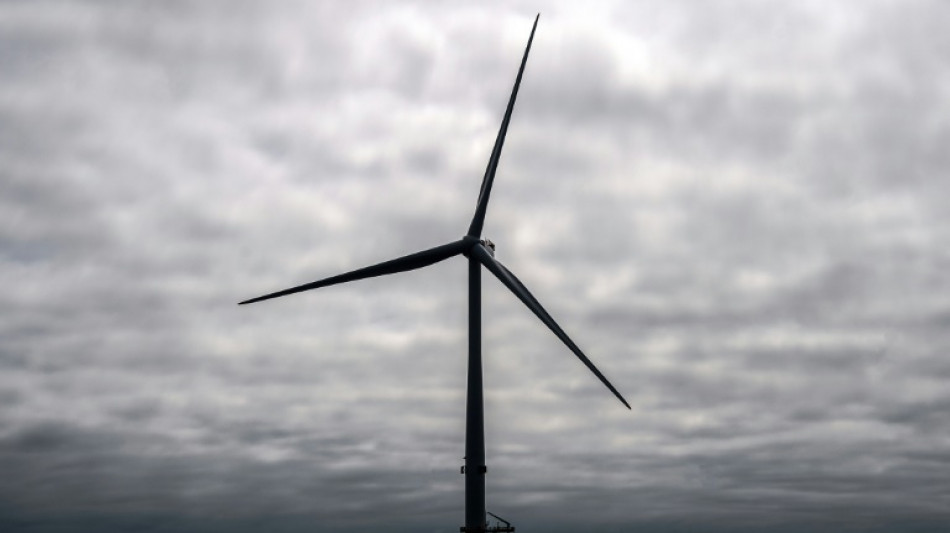
UK govt launches flagship green energy plan / Photo: Andy Buchanan - AFP

 Kenya's economy faces climate change risks: World Bank

 Far right and far left battle for power in polarised Berlin

 The last trio: S.Africa's zoo elephants await their fate
 Oil industry sees war windfall but girds for political blowback

 Amazon beats expectations with cloud and AI growth

 Blowout Microsoft results lift US stocks as oil retreats

 'Beginning of the end': Relief but no party as French wildfire winds down

 Southern Europe 'becoming more flammable' in hotter climate, experts say

 Mammoth bones found on parched bed of Danube in Bulgaria

 MEXC Lists Grvt (GRVT) with $60,000 Worth of GRVT and 10,000 USDT in Airdrop+ Rewards

 George and Amal Clooney flee French home due to wildfire

 MEXC Ventures Supports Alpha Arena's APAC Debut at Coinfest Bali

 AI data centre supplier Zhongji InnoLight slips on Hong Kong debut

 May, June heatwaves caused 2,877 extra deaths in England: govt

 BMW profit down a third as carmaker plans job cuts

 Seoul extends losses as most Asian markets drop, oil rises again

 Gambling.com Group Is Now Grandstand

 Meet the astronomer digging into the Milky Way's 'fossils'

 AI data centre supplier Zhongji InnoLight falls on Hong Kong debut

 Samsung operating profit up 1,800% in second quarter on AI boom

 Japanese population below 120 million for first time in decades

 US actor Jared Leto denies latest accusations of sexual assault

 Danube drops to 'historic lows' as fresh heatwave hits

 BTS pulls out of Grammys after Asian pop category introduction

 OpenAI says rogue AI agent attack hit other companies

Britain's new Labour government launched its flagship green energy infrastructure plan on Tuesday, announcing a multi-billion-pound partnership with the business arm of the royal family to develop offshore wind farms.
Prime Minister Keir Starmer is establishing a publicly owned body called Great British Energy to spearhead funding in domestic renewable energy projects as the UK weans itself off fossil fuels.
"There is a massive prize within our reach, and make no mistake the race is on to get there," Starmer said of his pledge to ensure Britain's energy "independence".
His government has allocated £8.3 billion ($10 billion) of public money over the next five years as Labour aims to meet Britain's climate change targets.
It also wants to bring down the price of energy by reducing reliance on foreign imports of oil and gas.
GB Energy will also seek to attract private investment, and the government announced a first tie-up with the monarchy's land and property holdings company that aims to leverage private investment of £60 billion.
The Crown Estate is an independently run business whose profits go to the government, which passes on a small portion to the monarchy to support official duties of the royal family.
It is one of Europe's biggest property empires, owning vast swathes of Britain's seabed with a huge commercial potential in developing offshore wind power generation.
The Crown Estate estimates that its GB Energy partnership will lease enough offshore land to produce up to 30 gigawatts of new energy, enough to power almost 20 million homes, by 2030.
The UK currently produces only 14 gigawatts of energy through offshore wind, according to government data.
- 'Clean energy superpower' -
The government was introducing its legislation to establish GB Energy into parliament on Thursday.
The company is the bedrock of Labour's pledge made before its landslide general election victory against the Conservatives on July 4 to make Britain a "clean energy superpower".
Labour, in power for the first time since 2010, is committed to meeting the UK's legal obligation of reaching net zero carbon emissions by 2050.
It also wants to decarbonise Britain's electricity grid by 2030, although experts have said the ambitious target will be difficult to meet.
Starmer's government has already ended a ban on new onshore wind farms in England that the Conservatives imposed in 2015.
The government is introducing a separate bill to widen the investment powers of the Crown Estate, giving it more scope to borrow for investments including offshore wind projects.
It has also proposed boosting investment in sustainable aviation fuel plants across the country.
Profit from the Crown Estate more than doubled last year to a record £1.1 billion, driven by a short-term boost from offshore wind farms, according to annual accounts published on Wednesday.
The government says GB Energy will have five key functions, including leading projects and building supply chains. It will not produce its own power.
New technologies it will invest in include carbon capture and storage, hydrogen, wave and tidal energy.
The public financing of the body will be funded through windfall taxes levied on oil and gas companies.
British customers' energy bills have soared since key producer Russia launched a full-scaled invasion of neighbouring Ukraine in February 2022.
Labour maintains the party's net-zero energy plans will save households £300 a year on their bills.
But the Conservatives' energy spokeswoman Claire Coutinho called GB Energy "nothing but a gimmick that will end up costing families, not cutting bills".
J.Bondarev--CPN