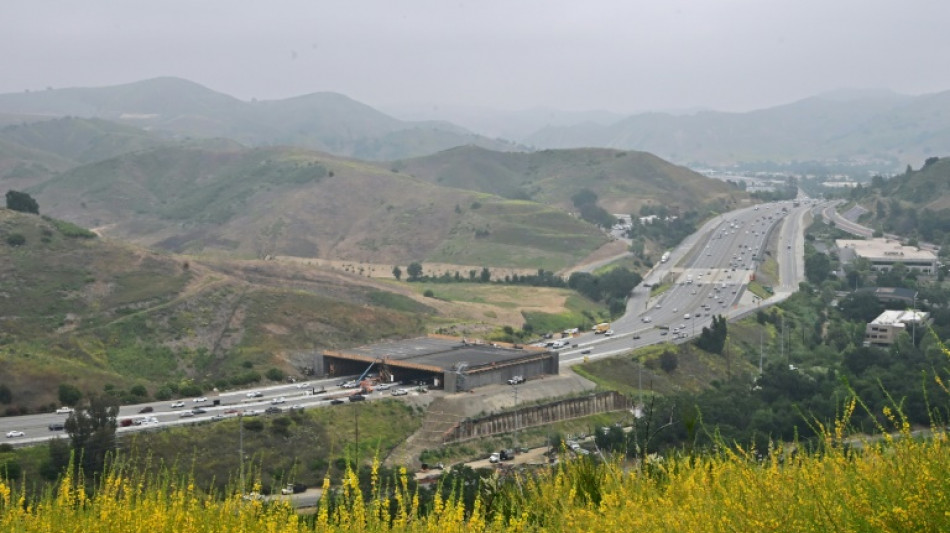
Animal crossing: Highway bridge aims to save California's cougars / Photo: Frederic J. BROWN - AFP

 Kenya's economy faces climate change risks: World Bank

 Far right and far left battle for power in polarised Berlin

 The last trio: S.Africa's zoo elephants await their fate

 Oil industry sees war windfall but girds for political blowback

 Amazon beats expectations with cloud and AI growth

 Blowout Microsoft results lift US stocks as oil retreats

 'Beginning of the end': Relief but no party as French wildfire winds down

 Southern Europe 'becoming more flammable' in hotter climate, experts say

 Mammoth bones found on parched bed of Danube in Bulgaria

 MEXC Lists Grvt (GRVT) with $60,000 Worth of GRVT and 10,000 USDT in Airdrop+ Rewards

 George and Amal Clooney flee French home due to wildfire

 MEXC Ventures Supports Alpha Arena's APAC Debut at Coinfest Bali

 AI data centre supplier Zhongji InnoLight slips on Hong Kong debut

 May, June heatwaves caused 2,877 extra deaths in England: govt

 BMW profit down a third as carmaker plans job cuts

 Seoul extends losses as most Asian markets drop, oil rises again

 Gambling.com Group Is Now Grandstand

 Meet the astronomer digging into the Milky Way's 'fossils'

 AI data centre supplier Zhongji InnoLight falls on Hong Kong debut

 Samsung operating profit up 1,800% in second quarter on AI boom

 Japanese population below 120 million for first time in decades

 US actor Jared Leto denies latest accusations of sexual assault

 Danube drops to 'historic lows' as fresh heatwave hits

 BTS pulls out of Grammys after Asian pop category introduction

 OpenAI says rogue AI agent attack hit other companies

Hollywood stars aren't the only celebrities who live in the hills around Los Angeles -- Southern California's mountain lions also make their homes there and are sometimes almost as famous.
The animal, also known as a puma or a cougar, is the region's apex predator, and spotting them is something of a hobby for locals.
A 2013 photograph of the much loved -- but unimaginatively named -- P-22 in front of the Hollywood sign cemented the creature's place in the popular imagination.
But the picture also highlighted the difficulties faced by a species whose habitat has been invaded by people, as well as from the growing risks of extreme weather events driven by human-caused climate change.
Mountain lions have "lived here forever, and now we're building homes and facilities out on their property," Andy Blue of the San Diego Humane Society's Ramona Wildlife Center, told AFP.
"So it's inevitable that there's going to be interaction between them."
One of the most ambitious efforts to reduce humanity's impact on mountain lions is taking shape northwest of Los Angeles: the Wallis Annenberg Wildlife Crossing.
The first phase of the project, on track to open in 2025, will see the completion of a bridge for wild animals over 10 lanes of Highway 101, one of the busiest roads in southern California, with over 300,000 daily travelers.
"When the 101 freeway was constructed through this area about 60 years ago, it had the unintended consequence of cutting off all of the Santa Monica Mountains" from another nearby mountain range, said Lauren Gill, the National Wildlife Federation's deputy director for California.
That separation created what Gill called an "island of habitat, cut off from all of the wild area to the north."
- 'Extinction vortex' -
The consequences of that highway have been significant for the area's wildlife.
Not only did it diminish the genetic diversity of several native species, it also markedly reduced the mountain lions' usual habitat for hunting and reproducing, putting the animal at risk of an "extinction vortex," Gill explained.
The wildlife crossing, which will be covered by local plants, aims to remedy the problem by reconnecting the mountains, providing safe passage for the pumas and other fauna in the region.
"You wouldn't think that birds would need the help of a wildlife crossing," Gill said.
"But in fact, we have some smaller birds like [the] wrentit, who are indigenous to this area, and they're so tiny that the wind currents generated by the freeway make it impossible for them to cross."
Once completed, the $80 million project will be the largest wildlife crossing in the world, according to organizers.
- Threat from cars -
The need for a protected zone like the crossing is evident at the Ramona Wildlife Center, where all kinds of animals from raccoons to bears are nursed back to strength after falling sick or being orphaned or injured.
Blue said mountain lions come into their care for any number of reasons, but most stem from "human-wildlife conflicts."
"One to two mountain lions are struck by cars a week in California, and it's the number one reason for mountain lion deaths in the state," he said, adding that the public needed to be better educated about how to interact with animals.
In June, an animal that was treated at the center was released back into the mountains near Los Angeles.
Wildlife photographer Johanna Turner, who uses remote cameras to capture animals in their natural habitat, said it does not take much to make the area around Los Angeles safer for mountain lions.
"I just want people to know how lucky they are to have this wildness, and it can go away," Turner said from a hill overlooking the city's skyline. "It can end so fast."
When P-22 died in December 2022 the outpouring of grief ended up being a wake-up call for Los Angeles.
Then last month, as often happens in Tinseltown, a new star was born when a Hollywood Hills resident captured images of another mountain lion before it disappeared into Griffith Park.
"We're so used to tragic stories about wildlife and having to just give up and say, 'This is a city... It just can't be that way here,'" Turner said.
"P-22 showed us it absolutely can."
H.Müller--CPN