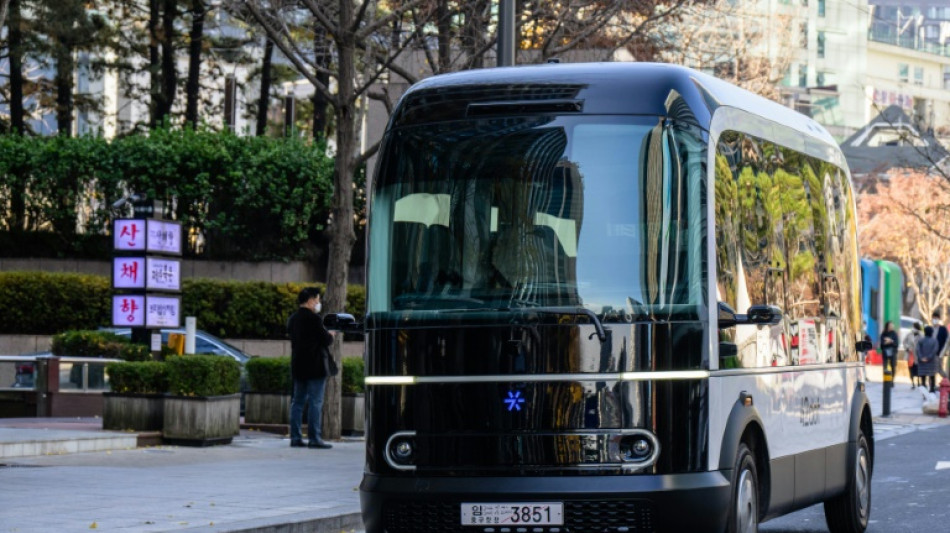
South Korean capital launches self-driving bus experiment / Photo: Anthony WALLACE - AFP

 US Fed raises rates to tackle 'too high' inflation, irking Trump

 Turkey releases 106 protesters, jails more LGBTQ activists

 Candidate for UN chief calls for AI regulation akin to nuclear weapons

 'We're losing control,' AI pioneer Yoshua Bengio tells AFP

 IR-MED and Dice Technologies Announce collaboration to Evaluate and Advance Pressure-Injury Prevention Platform in Japan

 Watts, Pitt, Cruz to light up Spain's top film festival

 Toogood Gold's Table Mountain Sits in the Shadow of a Nevada Gold Rush

 MEXC July–August Security Report: 38.66M USDT in Risk Funds Intercepted, Futures Insurance Fund Hits 792M USDT

 Emporio Armani names Dario Vitale new creative director

 EU to ban social media for under 13s, curb access until 15

 Wildfires push endangered Sumatran elephants to brink: Indonesian NGO

 Bank of Japan set to raise rates under pressure from inflation, US

 EU chief to unveil social media, gaming curbs for under-15s

 'Resident Evil' film brings video game's ethos to the big screen

 GA-ASI Mojave First UAS To Complete Battlefield Short Field Ops

 Sanders, Bannon warn of AI dangers in rare US left-right alignment

 Empty benches as schools reopen in Venezuela's quake-hit Guaira

 Tiny English village holds 'independence' vote over asylum seeker housing

 US Treasury chief says to meet Chinese counterpart at weekend

 BingX Evolves into a Multi-Asset Trading Platform, Connecting Users to Global Opportunities

 International Trading Institute Expands Professional Trader Development Beyond the Master’s in Trading

 Lake Energy Secures $80 Million for U.S. Renewable Energy Expansion

 Stocks drop, oil climbs and Treasury yields hit 19-year high

 SkySail Strategies Outperforms Wall Street's 30-Year Risk Standard With Proprietary AI Inference Model

 Just add fish: Scientists pursue more rice, less disease in Senegal paddies

South Korea's capital launched its first self-driving bus route on Friday, part of an experiment which engineers said aims to make people feel more comfortable with driverless vehicles on the roads.
The new vehicle does not look like a regular bus and has rounded edges along with large windows that make it appear more like a toy than a technological breakthrough.
This design is intentional, said Jeong Seong-gyun, head of autonomous driving at 42dot, the start-up responsible for the self-driving technology that is now owned by auto giant Hyundai.
"This is the future," he told AFP, adding that the bus required "a considerable new type of design".
The bus looks a bit "like Lego" and is made of composite parts to help keep costs down and make it easy to replicate, he said.
It uses cameras and lasers to navigate the way instead of expensive sensors, Seong-gyun added.
The company's goal was to make the technology low-cost, safe and easily transferable to many types of vehicle in the future, for example delivery trucks.
For now -- with a safety driver monitoring closely -- the bus will drive itself around a small 3.4-kilometre (2.1-mile) circuit in downtown Seoul that takes around 20 minutes.
The public can board at two designated stops after booking a free seat through an app.
"I feel like I've just hopped into a time machine to visit the future," said Kim Yi hae-ran, 68, after her 20-minute ride during the launch of the bus Friday.
"I thought it might make me dizzy from a sudden acceleration but I didn't feel any of it."
The ride felt "very smooth and safe", which she said made her feel proud of the technological progress the South Korean company has made.
Y.Ponomarenko--CPN