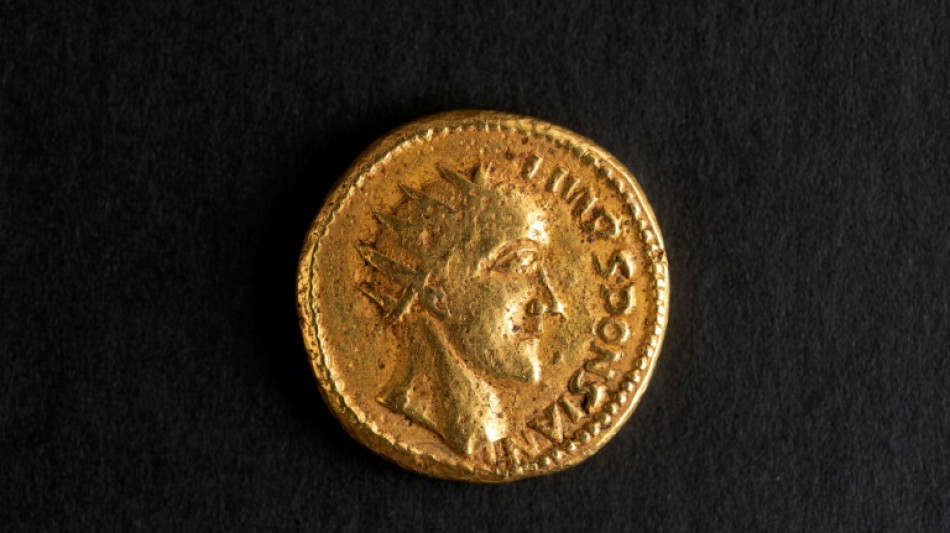
UK coin study salvages forgotten Roman emperor from 'obscurity' / Photo: Handout - THE HUNTERIAN/AFP

 US Fed raises rates to tackle 'too high' inflation, irking Trump

 Turkey releases 106 protesters, jails more LGBTQ activists

 Candidate for UN chief calls for AI regulation akin to nuclear weapons

 'We're losing control,' AI pioneer Yoshua Bengio tells AFP

 IR-MED and Dice Technologies Announce collaboration to Evaluate and Advance Pressure-Injury Prevention Platform in Japan

 Watts, Pitt, Cruz to light up Spain's top film festival

 Toogood Gold's Table Mountain Sits in the Shadow of a Nevada Gold Rush

 MEXC July–August Security Report: 38.66M USDT in Risk Funds Intercepted, Futures Insurance Fund Hits 792M USDT

 Emporio Armani names Dario Vitale new creative director

 EU to ban social media for under 13s, curb access until 15

 Wildfires push endangered Sumatran elephants to brink: Indonesian NGO

 Bank of Japan set to raise rates under pressure from inflation, US

 EU chief to unveil social media, gaming curbs for under-15s

 'Resident Evil' film brings video game's ethos to the big screen

 GA-ASI Mojave First UAS To Complete Battlefield Short Field Ops

 Sanders, Bannon warn of AI dangers in rare US left-right alignment

 Empty benches as schools reopen in Venezuela's quake-hit Guaira

 Tiny English village holds 'independence' vote over asylum seeker housing

 US Treasury chief says to meet Chinese counterpart at weekend

 BingX Evolves into a Multi-Asset Trading Platform, Connecting Users to Global Opportunities

 International Trading Institute Expands Professional Trader Development Beyond the Master’s in Trading

 Lake Energy Secures $80 Million for U.S. Renewable Energy Expansion

 Stocks drop, oil climbs and Treasury yields hit 19-year high

 SkySail Strategies Outperforms Wall Street's 30-Year Risk Standard With Proprietary AI Inference Model

 Just add fish: Scientists pursue more rice, less disease in Senegal paddies

A forgotten Roman emperor has been rescued from "obscurity" after UK researchers determined a coin long dismissed as fake was in fact authentic.
The coin featuring the profile of an emperor named Sponsian was among a handful of similar coins found in Transylvania in present-day Romania in 1713.
They had been considered fakes since the mid-19th century due to their jumbled inscriptions and unusual design.
But researchers who studied one of the coins housed at The Hunterian collection at the University of Glasgow in Scotland have now concluded that the coin is genuine after comparison with others with a similar history.
"Scientific analysis of these ultra-rare coins rescues the emperor Sponsian from obscurity," said lead author Professor Paul Pearson, of University College London.
"Our evidence suggests he ruled Roman Dacia, an isolated gold mining outpost, at a time when the empire was beset by civil wars and the borderlands were overrun by plundering invaders."
The Roman province of Dacia, a territory overlapping with modern-day Romania, was a region prized for its gold mines, according to the study published in the PLOS ONE journal.
It is believed it was cut off from the rest of the Roman empire in around 260 AD with Sponsian, possibly a local army officer, forced into assuming supreme command until order was restored.
The earth science researchers reexamining the coins used powerful microscopes in visible and ultraviolet light to help reach their new verdict.
They believe Sponsian could have authorised the creation of locally produced coins, some featuring an image of his face, to support the economy in his isolated frontier territory.
Curator of numismatics at The Hunterian, Jesper Ericsson, said he hoped the study would kickstart interest in this long-lost figure.
"Not only do we hope that this encourages further debate about Sponsian as a historical figure, but also the investigation of coins relating to him held in other museums across Europe," he said.
The coin held in Glasgow is one of only four Sponsian coins known to still be in existence.
Another of the four is on public display at Romania's Brukenthal National Museum.
M.P.Jacobs--CPN