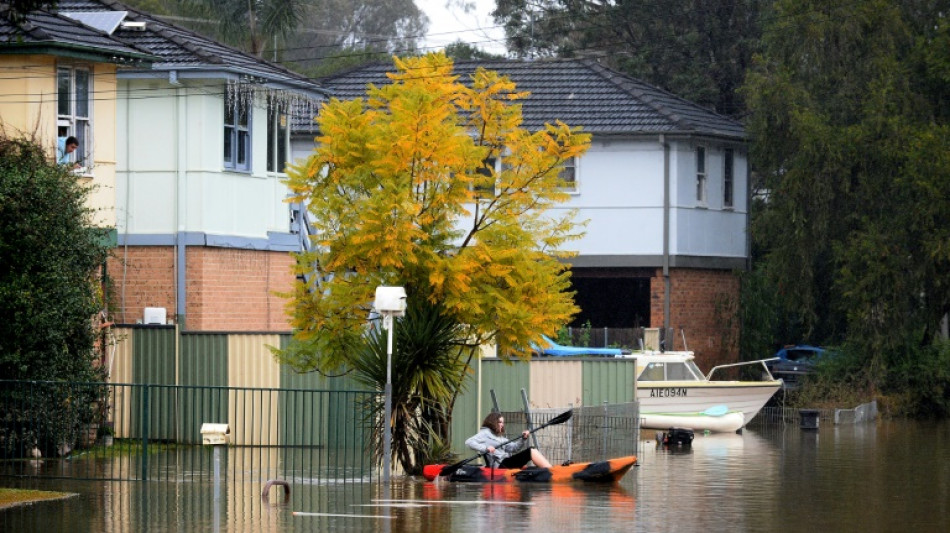
Report lays bare Australia's 'sobering' climate challenge / Photo: Muhammad FAROOQ - AFP

 US Fed raises rates to tackle 'too high' inflation, irking Trump

 Turkey releases 106 protesters, jails more LGBTQ activists

 Candidate for UN chief calls for AI regulation akin to nuclear weapons

 'We're losing control,' AI pioneer Yoshua Bengio tells AFP

 IR-MED and Dice Technologies Announce collaboration to Evaluate and Advance Pressure-Injury Prevention Platform in Japan

 Watts, Pitt, Cruz to light up Spain's top film festival

 Toogood Gold's Table Mountain Sits in the Shadow of a Nevada Gold Rush

 MEXC July–August Security Report: 38.66M USDT in Risk Funds Intercepted, Futures Insurance Fund Hits 792M USDT

 Emporio Armani names Dario Vitale new creative director

 EU to ban social media for under 13s, curb access until 15

 Wildfires push endangered Sumatran elephants to brink: Indonesian NGO

 Bank of Japan set to raise rates under pressure from inflation, US

 EU chief to unveil social media, gaming curbs for under-15s

 'Resident Evil' film brings video game's ethos to the big screen

 GA-ASI Mojave First UAS To Complete Battlefield Short Field Ops

 Sanders, Bannon warn of AI dangers in rare US left-right alignment

 Empty benches as schools reopen in Venezuela's quake-hit Guaira

 Tiny English village holds 'independence' vote over asylum seeker housing

 US Treasury chief says to meet Chinese counterpart at weekend

 BingX Evolves into a Multi-Asset Trading Platform, Connecting Users to Global Opportunities

 International Trading Institute Expands Professional Trader Development Beyond the Master’s in Trading

 Lake Energy Secures $80 Million for U.S. Renewable Energy Expansion

 Stocks drop, oil climbs and Treasury yields hit 19-year high

 SkySail Strategies Outperforms Wall Street's 30-Year Risk Standard With Proprietary AI Inference Model

 Just add fish: Scientists pursue more rice, less disease in Senegal paddies

Rising temperatures are fuelling widespread environmental degradation across Australia and supercharging natural disasters, according to a government report released Wednesday in the wake of flash floods on the country's east coast.
The State of the Climate report found global warming was also slowly melting Australia's fragile alpine regions while contributing to ocean acidification and rising sea levels.
Climate researcher Ian Lowe said the report was a "frightening" wake-up call for Australia, which relies heavily on coal and gas exports for economic growth.
"The scale of changes demonstrates that cleaning up our energy use is an urgent priority," Lowe said.
"We also need to reduce our exports of coal and gas."
The report, a joint effort between the government's weather bureau and national science agency, found Australia's climate had warmed by an average of 1.47 degrees Celsius since records began in 1910.
Environment Minister Tanya Plibersek said it was "sobering" reading.
"For our environment, for our communities, this report reinforces the urgent need for climate action," she said.
- 'Record-breaking extremes' -
Australia has in recent years experienced a series of extreme weather events linked to rising global temperatures.
Flash floods swept through parts of inland New South Wales earlier this month, tearing entire homes from their foundations in some country towns.
Tens of thousands of Sydney residents were ordered to evacuate in July when floods swamped the city's fringe.
An east coast flooding disaster in March -- caused by heavy storms in Queensland and New South Wales -- claimed more than 20 lives.
Catastrophic bushfires swept through huge chunks of New South Wales in the "Black Summer" of 2019 and 2020, while the Great Barrier Reef has suffered four separate mass coral bleaching events since 2016.
"These changes are happening at an increased pace," the State of the Climate report found.
"The past decade has seen record-breaking extremes leading to natural disasters that are exacerbated by anthropogenic (human-caused) climate change."
Prime Minister Anthony Albanese last week unveiled a bid to host the 2026 COP summit, seeking to repair Australia's international reputation as a climate change laggard.
Albanese's centre-left government introduced a 2050 net zero emissions target following its election earlier this year but has faced calls domestically to do more.
University of Melbourne climate scientist Andrew King said Australia needed to rapidly cut its carbon emissions.
"The consequences of our continued use of fossil fuels are clear in Australia like elsewhere," he said.
"We must act quickly to decarbonise our economy to limit further damages from worsening extreme events."
Ailie Gallant from the Australia Centre of Excellence for Climate Extremes said the deterioration in the country's climate would "continue without deep and aggressive cuts to carbon emissions".
Y.Jeong--CPN