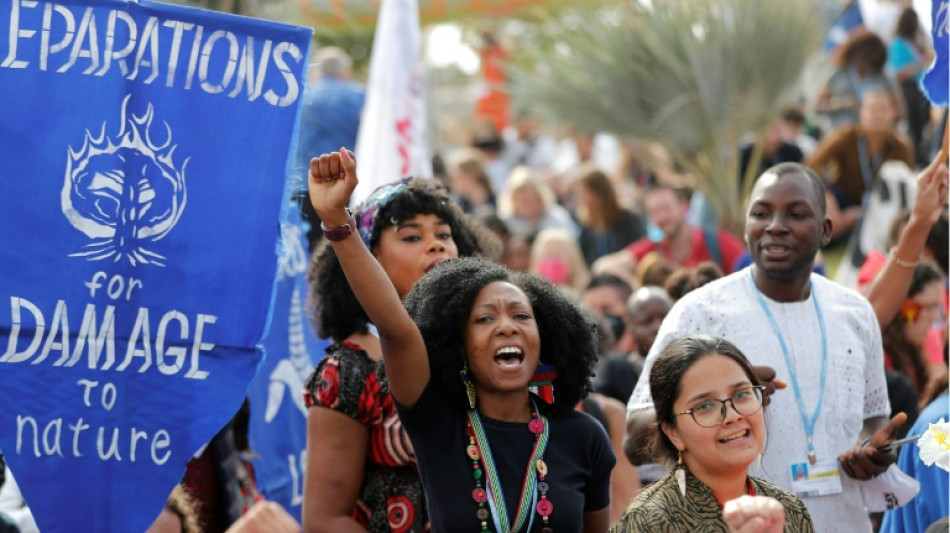
Climate damages are key flashpoint as UN COP talks go overtime / Photo: Mohammed ABED - AFP/File

 US Fed raises rates to tackle 'too high' inflation, irking Trump

 Turkey releases 106 protesters, jails more LGBTQ activists

 Candidate for UN chief calls for AI regulation akin to nuclear weapons

 'We're losing control,' AI pioneer Yoshua Bengio tells AFP

 IR-MED and Dice Technologies Announce collaboration to Evaluate and Advance Pressure-Injury Prevention Platform in Japan

 Watts, Pitt, Cruz to light up Spain's top film festival

 Toogood Gold's Table Mountain Sits in the Shadow of a Nevada Gold Rush

 MEXC July–August Security Report: 38.66M USDT in Risk Funds Intercepted, Futures Insurance Fund Hits 792M USDT

 Emporio Armani names Dario Vitale new creative director

 EU to ban social media for under 13s, curb access until 15

 Wildfires push endangered Sumatran elephants to brink: Indonesian NGO

 Bank of Japan set to raise rates under pressure from inflation, US

 EU chief to unveil social media, gaming curbs for under-15s

 'Resident Evil' film brings video game's ethos to the big screen

 GA-ASI Mojave First UAS To Complete Battlefield Short Field Ops

 Sanders, Bannon warn of AI dangers in rare US left-right alignment

 Empty benches as schools reopen in Venezuela's quake-hit Guaira

 Tiny English village holds 'independence' vote over asylum seeker housing

 US Treasury chief says to meet Chinese counterpart at weekend

 BingX Evolves into a Multi-Asset Trading Platform, Connecting Users to Global Opportunities

 International Trading Institute Expands Professional Trader Development Beyond the Master’s in Trading

 Lake Energy Secures $80 Million for U.S. Renewable Energy Expansion

 Stocks drop, oil climbs and Treasury yields hit 19-year high

 SkySail Strategies Outperforms Wall Street's 30-Year Risk Standard With Proprietary AI Inference Model

 Just add fish: Scientists pursue more rice, less disease in Senegal paddies

Climate negotiators were grappling for an agreement Saturday at the UN COP27 in Egypt after high stakes talks went deep into the night with key sticking points over funding for countries wracked by climate disasters and ambition in tackling global warming.
The meeting at the Red Sea resort of Sharm el-Sheikh has been dominated by the controversial issue of climate "loss and damage" funds to help developing nations cope with the impacts of increasingly intense and costly floods, heatwaves and droughts.
Wealthy nations, long reluctant to discuss the issue over fears of liability, have accepted that vulnerable nations are facing devastating impacts.
But there are disagreements over who pays and which countries are considered particularly affected.
With nations struggling to find common ground, Britain and several other countries circulated new suggestions trying to break the deadlock late Friday.
The issue was among a daunting list of outstanding areas of contention at the COP27 talks, where representatives from nearly 200 countries have gathered with the aim of driving forward action on climate change as the world faces a worsening onslaught of weather extremes.
Egyptian Foreign Minister Sameh Shoukry, who chairs the COP27 talks, told delegates on Friday -- the day talks were officially due to end -- that the negotiations would go into Saturday.
"I remain concerned at the number of outstanding issues," he said.
Delegates are looking to find agreement on emissions-cutting ambitions and reaffirm a goal to limit average warming to 1.5 degrees Celsius from pre-industrial levels, which scientists say is a safer guardrail to avoid the most dangerous impacts.
- Pressure over $100 bn promise -
Rich countries are also under pressure to finally fulfil promises to provide $100 billion a year to help developing countries green their economies and adapt to future impacts.
For many vulnerable countries loss and damage is the defining issue of the conference, with some saying the success of the meeting hinges on the creation of a specific fund at the Egypt talks.
Richer nations, which have previously baulked at the issue over fears of open-ended liability, have accepted that countries in the crosshairs of increasingly destructive climate-driven disasters need funding help, but have called for a broader set of donors -- and prioritising the most climate-vulnerable countries as recipients.
The G77 and China bloc of 134 developing countries launched an opening gambit on loss and damage this week, with a proposal to create a fund at COP27, with operational details to be agreed later.
A compromise response from the European Union, proposed late Thursday, suggested a fund specifically for the most vulnerable nations saying the money should come from a "broad funder base" -- code for countries including China and Saudi Arabia that have become wealthier since they were listed as developing nations in 1992.
Britain and several other countries have circulated a new draft proposal document, seen by AFP and confirmed by a source close to the negotiations, which suggested the fund could be part of a range of "funding arrangements".
The document, which has not been formally submitted to the UN process, suggested the new source of monies could be operationalised in two years.
But this would "only agree some ambiguous funding arrangements that kick the can down the road" said Mohamed Adow, of the think tank Power Shift Africa.
M.Mendoza--CPN