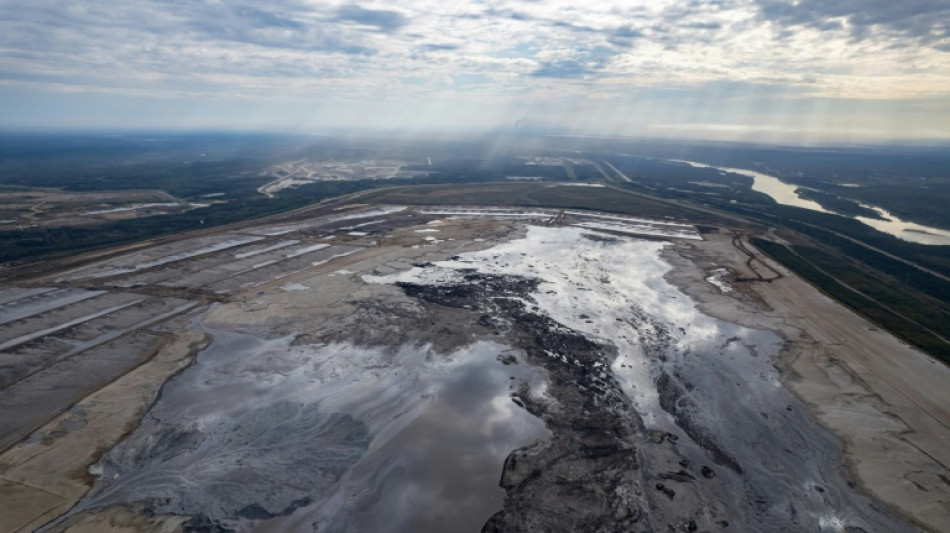
Fort McKay: where Canada's boreal forest gave way to oil sands / Photo: Ed JONES - AFP

 Candidate for UN chief calls for AI regulation akin to nuclear weapons

 'We're losing control,' AI pioneer Yoshua Bengio tells AFP

 IR-MED and Dice Technologies Announce collaboration to Evaluate and Advance Pressure-Injury Prevention Platform in Japan

 Watts, Pitt, Cruz to light up Spain's top film festival

 Toogood Gold's Table Mountain Sits in the Shadow of a Nevada Gold Rush

 MEXC July–August Security Report: 38.66M USDT in Risk Funds Intercepted, Futures Insurance Fund Hits 792M USDT

 Emporio Armani names Dario Vitale new creative director

 EU to ban social media for under 13s, curb access until 15

 Wildfires push endangered Sumatran elephants to brink: Indonesian NGO

 Bank of Japan set to raise rates under pressure from inflation, US

 EU chief to unveil social media, gaming curbs for under-15s

 'Resident Evil' film brings video game's ethos to the big screen

 GA-ASI Mojave First UAS To Complete Battlefield Short Field Ops

 Sanders, Bannon warn of AI dangers in rare US left-right alignment

 Empty benches as schools reopen in Venezuela's quake-hit Guaira

 Tiny English village holds 'independence' vote over asylum seeker housing

 US Treasury chief says to meet Chinese counterpart at weekend

 BingX Evolves into a Multi-Asset Trading Platform, Connecting Users to Global Opportunities

 International Trading Institute Expands Professional Trader Development Beyond the Master’s in Trading

 Lake Energy Secures $80 Million for U.S. Renewable Energy Expansion

 Stocks drop, oil climbs and Treasury yields hit 19-year high

 SkySail Strategies Outperforms Wall Street's 30-Year Risk Standard With Proprietary AI Inference Model

 Just add fish: Scientists pursue more rice, less disease in Senegal paddies

 Belgium completes outer structure of offshore energy island

 China retail sales growth weakens further in August
The acrid stench of gasoline permeates the air. And the soot coats everything in sight: the trees, the bushes, even the snow in winter. And all day long, explosions send the birds soaring to safety.
At Fort McKay near Fort McMurray in western Canada, in the heart of the country's boreal forest, the pines and the people were long ago cleared out to make way for huge open-pit mines dedicated to excavation of oil sands.
It's one of the biggest industrial projects in the world: as seen from above, the zone is in stark contrast to the vast expanse of green surrounding it. Huge black holes are gouged in the brown earth -- they are giant pools of water.
Then there is the network of roads on which hundreds of trucks drive every day, and the immense factories, with smoke spewing from wide chimneys.
On the ground, the noise is deafening. And it's quite a scene for the uninitiated: in the middle of the huge basins dug to capture the polluted waters stand huge metal scarecrows clad in helmets and security vests.
The ghoulish creatures are designed to scare away millions of migratory birds that arrive every year in this northern part of Alberta province. Adding to the mayhem: airhorns that are used several times a minute.
The mines have made the people left in Fort McKay -- many of them Indigenous Canadians -- very rich. But the installations have also profoundly altered and damaged the land on which their ancestors relied for centuries.
"Everything has changed, everything's destroyed to me now," says 74-year-old Margie Lacorde who lives in the center of town in a house chock full of knick knacks and framed photographs.
The talkative Lacorde, who belongs to the Metis people, is sad to see the parched, yellowing leaves due to drought, and wishes she could still swim in the rivers and gather berries in the forest like she did in her youth.
The hunting grounds are long gone -- the land was sold for industrial use.
"The pollution is killing our nature," Lacorde tells AFP, though she herself worked in the oil industry for years to provide for her family.
She remembers her childhood with a significant bit of nostalgia.
Back then, families gathered snow and melted it to use as drinking and cooking water. Such a thing would be impossible today -- once the snow hits the ground, it's immediately filthy, covered in the dust that filters down from the factories.
- 'Desecrated' -
"We're First Nations and this is our territory that is all being desecrated by the oil industry for the sake of the dollar, money, prosperity," says Jean L'Hommecourt, an environmental activist who took up the fight her parents once championed.
Even if agreements were reached with Indigenous communities to create jobs and protect some natural resources, the ecological impact of mining the oil sands have been so great that the 59-year-old woman says her people are now at risk.
"I lost my prosperity when the industry came in and took over all our lands and our waters and our access to our wildlife... everything that we depend on to sustain our culture has been compromised by industry," she says bitterly.
The area is a far cry from the picture postcard ideal of the Canadian West. There are no crystalline blue waterways or fish-filled rivers here.
Instead, Moose Lake -- sacred to L'Hommecourt's Dene people -- is now only accessible by all-terrain vehicle, a five-hour drive on a road pockmarked by potholes that runs in between the mines.
When she was growing up, L'Hommecourt's family cabin was in the middle of the forest, far away from the noise and bustle. But after the first oil sands mine was built in 1967, development proceeded at a rapid pace.
Today, the active oil sands extraction sites form a chain that is more than 60 kilometers (40 miles) long, hugging the shores of the Athabasca River.
Fort McKay -- population, 800 or so -- is a tiny speck on a map of this industrial complex.
Canada is home to 10 percent of the world's known crude oil reserves -- much of that is found in the oil sands of Alberta.
Every day, nearly three million barrels of crude are extracted from the sands, according to official government data, helping to make Canada the world's fourth largest oil producer, and the primary exporter of crude to the United States.
In all, more than 4,800 square kilometers are used for oil sands mining.
At first, local populations were consulted and their fears were noted, L'Hommecourt says.
"And then they just said okay, well, we collected the information, we collected their concerns and everything else and we'll mitigate with the money," she added.
- Pollution -
Many environmental activists say the impact of the oil industry is so great that the term "ecocide" is not too strong. Beyond the tangible destruction of the boreal forest, there is the massive amount of pollution in the air.
The oil and gas sector accounts for a quarter of Canada's greenhouse gas emissions, according to the latest official figures released this year. Of that total, the oil sands are responsible for 12 percent.
And traces of other toxic emissions, such as sulfur and nitrogen oxides, have been detected in the soil and the snow dozens of kilometers from the mining zone.
The industry also consumes a massive amount of water, taken from nearby rivers and lakes.
"There's still a lot we need to do on recognizing the harm from cleaning up existing operations," says Keith Stewart of the environmental pressure group Greenpeace, slamming companies that drag their feet on such matters.
Stewart nevertheless acknowledges a "huge shift" on protecting the environment in recent years.
"For a long time, even the notion that we could limit expansion was viewed as crazy and now... the idea of large-scale expansion now seems crazy," he said.
That reversal is not uniformly popular, as not everyone here sees the oil sands as a bad thing.
"The reality is that they shut off the oil sands tomorrow, my community would starve," says Ron Quintal, chief of the Fort McKay Metis, noting that nearly everyone around works in or for the industry.
For Quintal, "Indigenous communities have spent 30 to 40 years... trying to get their foot in the door" so it would be "very difficult for us to try to take our people backward."
He added matter-of-factly: "The development of the oil has empowered us to be able to do things that weren't possible before."
P.Gonzales--CPN