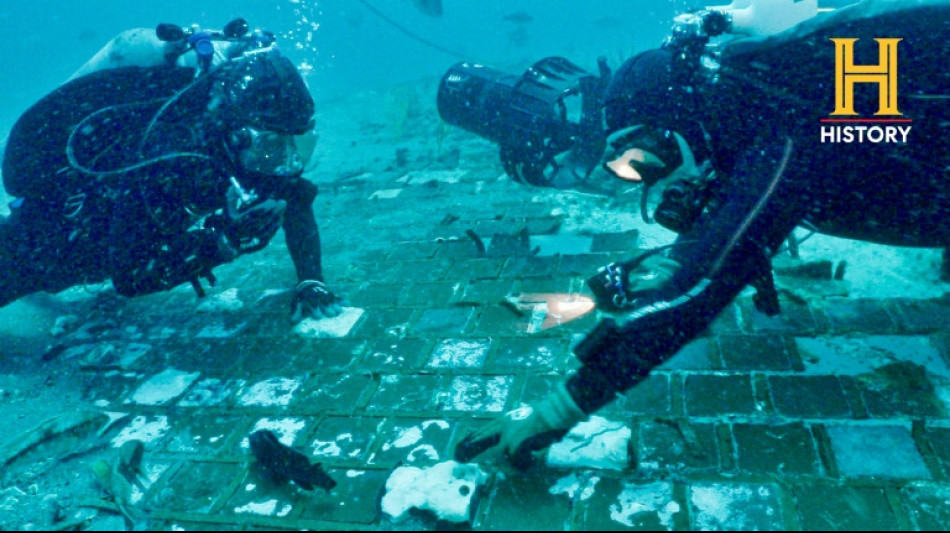
Piece of Challenger space shuttle found off Florida coast / Photo: Handout - The History Channel/AFP

 Candidate for UN chief calls for AI regulation akin to nuclear weapons

 'We're losing control,' AI pioneer Yoshua Bengio tells AFP

 IR-MED and Dice Technologies Announce collaboration to Evaluate and Advance Pressure-Injury Prevention Platform in Japan

 Watts, Pitt, Cruz to light up Spain's top film festival

 Toogood Gold's Table Mountain Sits in the Shadow of a Nevada Gold Rush

 MEXC July–August Security Report: 38.66M USDT in Risk Funds Intercepted, Futures Insurance Fund Hits 792M USDT

 Emporio Armani names Dario Vitale new creative director

 EU to ban social media for under 13s, curb access until 15

 Wildfires push endangered Sumatran elephants to brink: Indonesian NGO

 Bank of Japan set to raise rates under pressure from inflation, US

 EU chief to unveil social media, gaming curbs for under-15s

 'Resident Evil' film brings video game's ethos to the big screen

 GA-ASI Mojave First UAS To Complete Battlefield Short Field Ops

 Sanders, Bannon warn of AI dangers in rare US left-right alignment

 Empty benches as schools reopen in Venezuela's quake-hit Guaira

 Tiny English village holds 'independence' vote over asylum seeker housing

 US Treasury chief says to meet Chinese counterpart at weekend

 BingX Evolves into a Multi-Asset Trading Platform, Connecting Users to Global Opportunities

 International Trading Institute Expands Professional Trader Development Beyond the Master’s in Trading

 Lake Energy Secures $80 Million for U.S. Renewable Energy Expansion

 Stocks drop, oil climbs and Treasury yields hit 19-year high

 SkySail Strategies Outperforms Wall Street's 30-Year Risk Standard With Proprietary AI Inference Model

 Just add fish: Scientists pursue more rice, less disease in Senegal paddies

 Belgium completes outer structure of offshore energy island

 China retail sales growth weakens further in August

Divers searching for a World War II-era aircraft near the Bermuda Triangle have found a piece of an entirely different sort of vessel: part of the US Challenger space shuttle that exploded soon after takeoff in 1986.
The shuttle burst apart just dozens of seconds after launching from Florida, killing seven crew members, including the teacher Christa McAuliffe who had won a national screening.
The Challenger segment, preserved remarkably well at the bottom of the Atlantic, is one of the largest pieces ever discovered from the space disaster, NASA confirmed Thursday.
Images from the discovery, which was made in spring 2022, show two divers surrounded by fish, touching some of the shuttle's sand-covered tiles -- small squares that covered the entire underside of the ship to enable it to withstand extreme heat during its return to the atmosphere.
One of the two divers, Mike Barnette, told AFP that he experienced a real "roller coaster ride of emotions" when he realized what he was touching.
"When we found it, (there were) a lot of mixed emotions," said the marine biologist, who explores ship wrecks as a hobby.
"I'm used to diving on shipwrecks that are decades to centuries old, and not a piece of the space program. This is quite unique," he said.
"That turned quickly to realizing 'Yeah, this is an episode that I lived through. When this happened, I remember exactly where I was, watching this live on TV,'" he said.
After the discovery, he showed the images to an astronaut friend who confirmed it was the shuttle. A few months later, the US space agency officially confirmed it.
"They were stunned and staggered by how large of a piece it was," Barnette said.
- Partly buried -
The visible part of the shuttle is about 4.5 by 4.5 meters. But the piece extends under the sand and it is still unknown its total size.
One thing is certain, however: "I can certainly say with confidence, it's one of the largest we've ever found," Mike Ciannilli, a NASA employee for more than 25 years, said of the segment.
It's definitely Challenger's underside, Ciannilli told AFP, but it's hard to know exactly which part of the ship.
Analysis of the piece, he said, will not shed any new light on the accident itself. The cause of the tragedy is well established -- severe cold caused damage to crucial rubber seals. Observing how the materials have aged could still be interesting, however.
Above all, he emphasized, the discovery could help with "reigniting the lessons learned from that particular mission."
Following the January 28, 1986 accident, extensive search operations were carried out to find pieces of the ship. Ten years later, two new ones emerged on a beach after a storm. These were the last found to date.
One piece is on display at a public memorial at the Kennedy Space Center in Florida and others are kept nearby.
- 'Honor and remembrance' -
Barnette and his diving partner were looking for a World War II plane for a documentary about disappearances in the Bermuda Triangle when they discovered the Challenger piece.
The first episode, which will air on the History Channel on November 22, in the end will have a space ship rather than a boat or plane for its subject.
"That's what I love about this endeavor, you go out trying to find one thing and you stumble upon a totally different mystery," Barnette said.
The site was chosen thanks to information from fishermen, who guessed there might be a wreck at the spot because it seemed to attract a lot of fish.
The spot in question is west of the Bermuda Triangle, not within it, but the exact location is not being revealed so as not to attract curious onlookers. Nor would the divers reveal the depth of the seafloor at the wreckage site.
According to Barnette, it would be "very easy" for NASA to recover the piece from the water, but such a move might only end up "reopening wounds."
Discussions are ongoing, Ciannilli added, but "whatever we do, our first and foremost objective is to make sure we bring honor and remembrance for the legacy of the crew, and we honor the families."
Y.Tengku--CPN