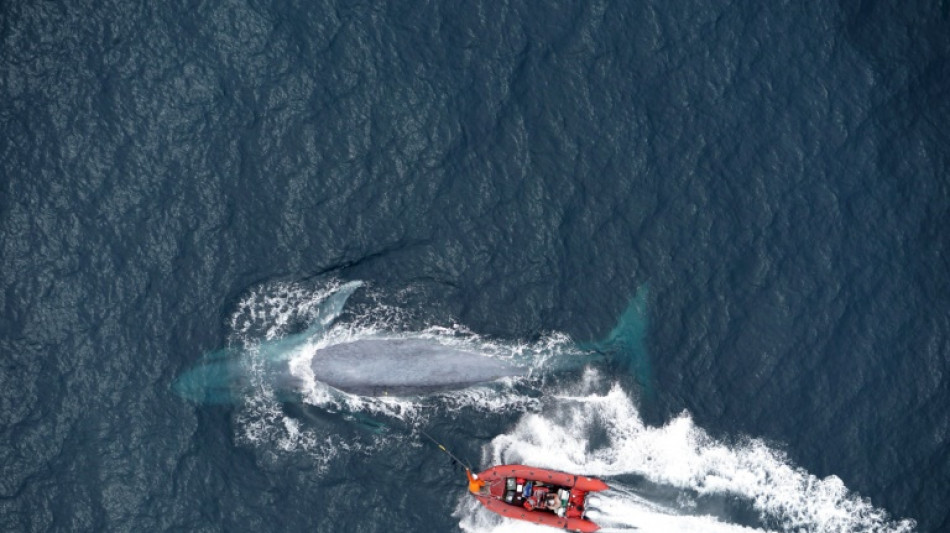
Blue whales eat 10 million pieces of microplastic a day: study / Photo: - - Goldbogen Laboratory/AFP/File

 Candidate for UN chief calls for AI regulation akin to nuclear weapons

 'We're losing control,' AI pioneer Yoshua Bengio tells AFP

 IR-MED and Dice Technologies Announce collaboration to Evaluate and Advance Pressure-Injury Prevention Platform in Japan

 Watts, Pitt, Cruz to light up Spain's top film festival

 Toogood Gold's Table Mountain Sits in the Shadow of a Nevada Gold Rush

 MEXC July–August Security Report: 38.66M USDT in Risk Funds Intercepted, Futures Insurance Fund Hits 792M USDT

 Emporio Armani names Dario Vitale new creative director

 EU to ban social media for under 13s, curb access until 15

 Wildfires push endangered Sumatran elephants to brink: Indonesian NGO

 Bank of Japan set to raise rates under pressure from inflation, US

 EU chief to unveil social media, gaming curbs for under-15s

 'Resident Evil' film brings video game's ethos to the big screen

 GA-ASI Mojave First UAS To Complete Battlefield Short Field Ops

 Sanders, Bannon warn of AI dangers in rare US left-right alignment

 Empty benches as schools reopen in Venezuela's quake-hit Guaira

 Tiny English village holds 'independence' vote over asylum seeker housing

 US Treasury chief says to meet Chinese counterpart at weekend

 BingX Evolves into a Multi-Asset Trading Platform, Connecting Users to Global Opportunities

 International Trading Institute Expands Professional Trader Development Beyond the Master’s in Trading

 Lake Energy Secures $80 Million for U.S. Renewable Energy Expansion

 Stocks drop, oil climbs and Treasury yields hit 19-year high

 SkySail Strategies Outperforms Wall Street's 30-Year Risk Standard With Proprietary AI Inference Model

 Just add fish: Scientists pursue more rice, less disease in Senegal paddies
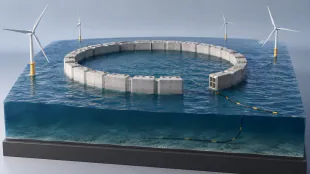 Belgium completes outer structure of offshore energy island

 China retail sales growth weakens further in August
Blue whales consume up to 10 million pieces of microplastic every day, research estimated Tuesday, suggesting that the omnipresent pollution poses a bigger danger to the world's largest animal than previously thought.
The tiny fragments of plastic have been found everywhere from the deepest oceans to the highest mountains, and even inside human organs and blood.
Now a modelling study published in the journal Nature Communications has estimated how much is being ingested by whales.
A US-led research team put tags on 191 blue, fin and humpback whales that live off the coast of California to observe their movements.
"It's basically like an Apple Watch, just on the back of a whale," said Shirel Kahane-Rapport, a researcher at California State University, Fullerton and the study's first author.
The whales mostly fed at depths of between 50 to 250 metres (165-820 feet), which is home to the "greatest concentration of microplastics in the water column," Kahane-Rapport told AFP.
The researchers then estimated the size and number of mouthfuls the whales had daily and what was filtered out, modelling three different scenarios.
Under the most likely scenario, the blue whales ate up to 10 million microplastic pieces a day.
Over the 90-120 day annual feeding season, that represents more than a billion pieces a year.
The largest animal ever to live on Earth is also likely the biggest microplastic consumer, eating up to 43.6 kilogrammes a day, the study said.
"Imagine carrying around an extra 45 kilogrammes -- yes, you're a very big whale, but that will take up space," Kahane-Rapport said.
Humpback whales were estimated to eat around four million pieces a day.
While it is easy to imagine whales sucking in vast amounts of microplastics as they gulp their way through the ocean, the researchers found that was not the case.
Instead, 99 percent of the microplastics entered the whales because they were already inside their prey.
"That's concerning for us," Kahane-Rapport said, because humans eat that prey.
"We also eat anchovies and sardines," she said, adding that "krill is the basis of the food web".
Previous research has shown that if krill are in a tank with microplastic, "they will eat it," Kahane-Rapport said.
Now that the researchers know how much microplastic is being consumed by whales, next they aim to determine how much harm it could be doing.
"The dose defines the poison," Kahane-Rapport said.
O.Hansen--CPN