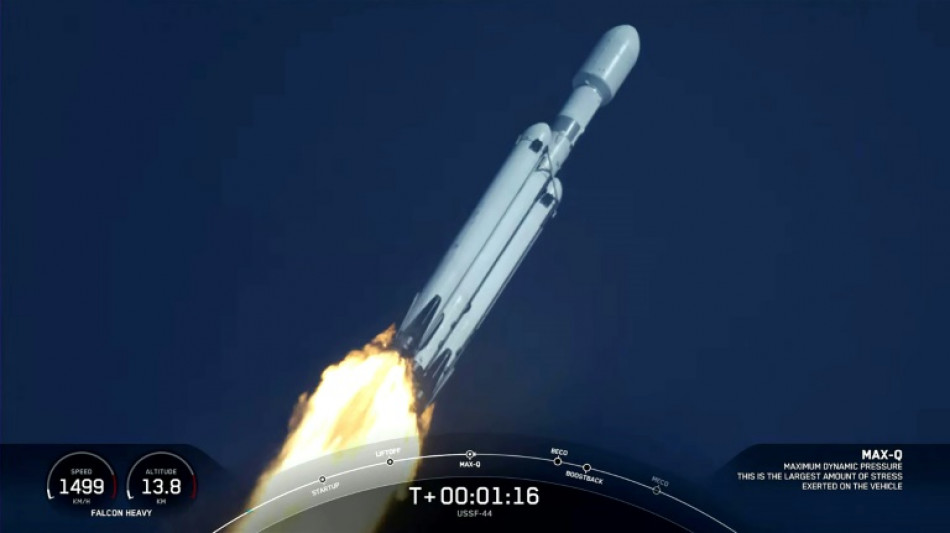
SpaceX launches Falcon Heavy rocket for first time in three years / Photo: Handout - SPACEX/AFP

 Candidate for UN chief calls for AI regulation akin to nuclear weapons

 'We're losing control,' AI pioneer Yoshua Bengio tells AFP

 IR-MED and Dice Technologies Announce collaboration to Evaluate and Advance Pressure-Injury Prevention Platform in Japan

 Watts, Pitt, Cruz to light up Spain's top film festival

 Toogood Gold's Table Mountain Sits in the Shadow of a Nevada Gold Rush

 MEXC July–August Security Report: 38.66M USDT in Risk Funds Intercepted, Futures Insurance Fund Hits 792M USDT

 Emporio Armani names Dario Vitale new creative director

 EU to ban social media for under 13s, curb access until 15

 Wildfires push endangered Sumatran elephants to brink: Indonesian NGO

 Bank of Japan set to raise rates under pressure from inflation, US

 EU chief to unveil social media, gaming curbs for under-15s

 'Resident Evil' film brings video game's ethos to the big screen

 GA-ASI Mojave First UAS To Complete Battlefield Short Field Ops

 Sanders, Bannon warn of AI dangers in rare US left-right alignment

 Empty benches as schools reopen in Venezuela's quake-hit Guaira

 Tiny English village holds 'independence' vote over asylum seeker housing

 US Treasury chief says to meet Chinese counterpart at weekend

 BingX Evolves into a Multi-Asset Trading Platform, Connecting Users to Global Opportunities

 International Trading Institute Expands Professional Trader Development Beyond the Master’s in Trading

 Lake Energy Secures $80 Million for U.S. Renewable Energy Expansion

 Stocks drop, oil climbs and Treasury yields hit 19-year high

 SkySail Strategies Outperforms Wall Street's 30-Year Risk Standard With Proprietary AI Inference Model

 Just add fish: Scientists pursue more rice, less disease in Senegal paddies

 Belgium completes outer structure of offshore energy island

 China retail sales growth weakens further in August
SpaceX launched its Falcon Heavy rocket from Florida Tuesday, the first flight since 2019 of the world's most powerful rocket.
Mission USSF-44, transporting cargo for the US Space Force, including the TETRA 1 satellite, blasted off from the Kennedy Space Center around 9:40 am (1340 GMT).
Several minutes later, the rocket's two side boosters made their way back to Earth -- the craft's main stage will never be recovered.
Falcon Heavy was launched for the first time as part of a test in 2018, carrying SpaceX boss' Elon Musk's own Tesla car.
Tuesday's flight was Falcon Heavy's third operational commercial flight, and the first since June 2019.
The US aerospace company currently operates two rockets.
The first is the Falcon 9, which is primarily used to transport NASA astronauts to the International Space Station and to launch satellites for SpaceX's Starlink internet program.
Falcon Heavy is used to launch much heavier payloads into further orbits. It is capable of carrying up to 64 tons into Earth orbit.
NASA has also chosen Falcon Heavy to fly parts of its future space station set to orbit around the Moon.
SpaceX is also developing another rocket at its base in Texas, the Starship, which consists of a spacecraft mounted on a first-stage booster called the Super Heavy, though the craft has never flown in its complete configuration.
The spaceship part of the craft has taken several suborbital test flights on its own, many of which ended in dramatic explosions.
NASA has already picked Starship to ferry its astronauts to the Moon as part of the Artemis 3 mission, set for 2025 at the earliest.
The space agency will take astronauts up to lunar orbit itself, thanks to its own heavy rocket called the SLS, which has been in development for more than a decade.
The SLS, which is expected to surpass Falcon Heavy to become the most powerful rocket in the world, has seen its first launch twice canceled at the last minute in recent months.
The next tentatively planned launch date for the uncrewed flight is set for November 14.
O.Ignatyev--CPN