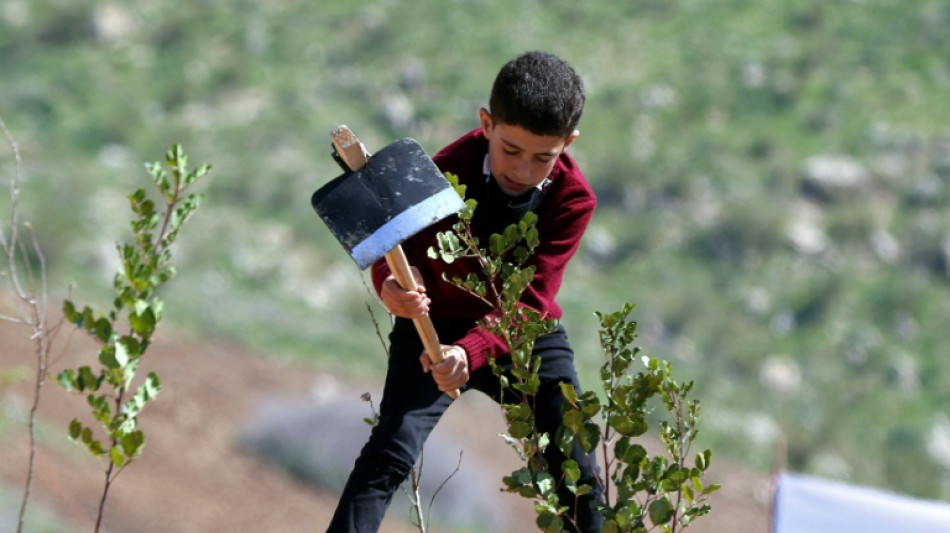
Land-based climate plans 'unrealistic': report / Photo: Khalil MAZRAAWI - AFP/File

 Candidate for UN chief calls for AI regulation akin to nuclear weapons

 'We're losing control,' AI pioneer Yoshua Bengio tells AFP

 IR-MED and Dice Technologies Announce collaboration to Evaluate and Advance Pressure-Injury Prevention Platform in Japan

 Watts, Pitt, Cruz to light up Spain's top film festival

 Toogood Gold's Table Mountain Sits in the Shadow of a Nevada Gold Rush

 MEXC July–August Security Report: 38.66M USDT in Risk Funds Intercepted, Futures Insurance Fund Hits 792M USDT

 Emporio Armani names Dario Vitale new creative director

 EU to ban social media for under 13s, curb access until 15

 Wildfires push endangered Sumatran elephants to brink: Indonesian NGO

 Bank of Japan set to raise rates under pressure from inflation, US

 EU chief to unveil social media, gaming curbs for under-15s

 'Resident Evil' film brings video game's ethos to the big screen

 GA-ASI Mojave First UAS To Complete Battlefield Short Field Ops

 Sanders, Bannon warn of AI dangers in rare US left-right alignment

 Empty benches as schools reopen in Venezuela's quake-hit Guaira

 Tiny English village holds 'independence' vote over asylum seeker housing

 US Treasury chief says to meet Chinese counterpart at weekend

 BingX Evolves into a Multi-Asset Trading Platform, Connecting Users to Global Opportunities

 International Trading Institute Expands Professional Trader Development Beyond the Master’s in Trading

 Lake Energy Secures $80 Million for U.S. Renewable Energy Expansion

 Stocks drop, oil climbs and Treasury yields hit 19-year high

 SkySail Strategies Outperforms Wall Street's 30-Year Risk Standard With Proprietary AI Inference Model

 Just add fish: Scientists pursue more rice, less disease in Senegal paddies

 Belgium completes outer structure of offshore energy island

 China retail sales growth weakens further in August
The world needs to set aside an area bigger than the United States for tree planting and other measures to meet climate pledges, according to research published Tuesday that warned against "unrealistic" carbon-cutting plans.
Almost 200 nations will begin high-stakes UN climate talks in Egypt from November 6, as increasing damage from floods, heat waves and droughts are being felt across the world.
Recent UN assessments conclude that current policies and plans are not nearly enough to limit global warming and avoid catastrophic climate impacts.
They may also be unattainable, new research showed Tuesday on the planned use of land-based schemes such as tree planting to offset fossil fuel pollution.
An assessment of plans from 166 countries and the European Union, released by the University of Melbourne, estimated that the total area implied was almost 1.2 billion hectares (2.9 billion acres) -- bigger than the United States, or four times the size of India.
"Servicing all of the land-based carbon removal pledges is unrealistic because it would require a land mass half the size of current global cropland, putting potential pressure on ecosystems, food security and indigenous peoples' rights," the report said.
The research looked at countries' targets, particularly longer-term commitments, and if the land needed was not explicitly stated, they calculated using information about the types of activity as well as carbon removal data from UN climate experts.
They found that while over 550 hectares were earmarked for restoring degraded land and protecting primary forests, some 630 million hectares were estimated for carbon capture schemes, like tree planting.
"Land-based carbon removals have to be considered together with deep cuts in fossil fuel emissions, not as a replacement," said Anne Larson, of the Center for International Forestry Research and World Agroforestry, who was a co-author of the report.
Larson said governments might see tree planting as "easy, compared to other options", but cautioned that these projects can cause their own problems.
If there is no long-term management plan or if the species are not native, the trees can simply wither.
Tree plantations imposed on communities risk being "neglected, burned, cut down", she said.
A.Mykhailo--CPN