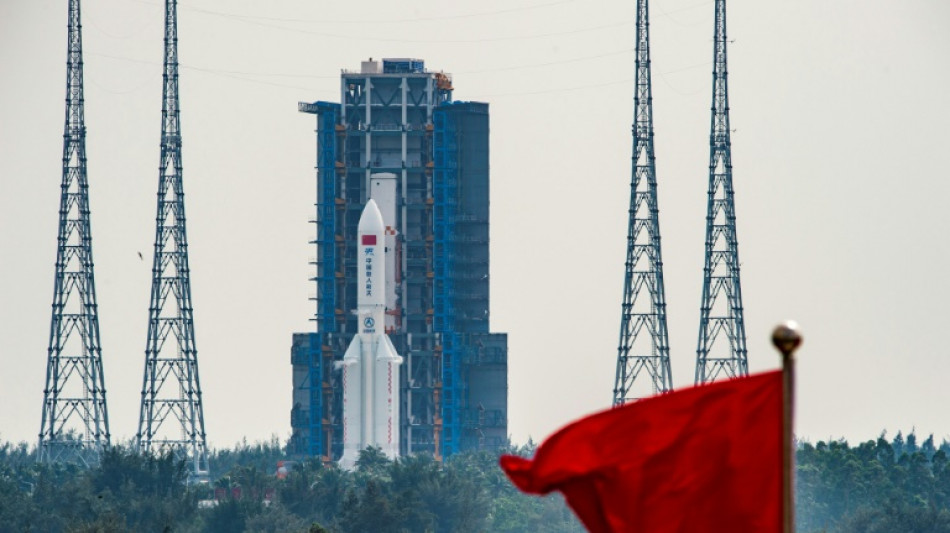
Final module docks at China's Tiangong space station / Photo: - - CNS/AFP

 Candidate for UN chief calls for AI regulation akin to nuclear weapons

 'We're losing control,' AI pioneer Yoshua Bengio tells AFP

 IR-MED and Dice Technologies Announce collaboration to Evaluate and Advance Pressure-Injury Prevention Platform in Japan

 Watts, Pitt, Cruz to light up Spain's top film festival

 Toogood Gold's Table Mountain Sits in the Shadow of a Nevada Gold Rush

 MEXC July–August Security Report: 38.66M USDT in Risk Funds Intercepted, Futures Insurance Fund Hits 792M USDT

 Emporio Armani names Dario Vitale new creative director

 EU to ban social media for under 13s, curb access until 15

 Wildfires push endangered Sumatran elephants to brink: Indonesian NGO

 Bank of Japan set to raise rates under pressure from inflation, US

 EU chief to unveil social media, gaming curbs for under-15s

 'Resident Evil' film brings video game's ethos to the big screen

 GA-ASI Mojave First UAS To Complete Battlefield Short Field Ops

 Sanders, Bannon warn of AI dangers in rare US left-right alignment

 Empty benches as schools reopen in Venezuela's quake-hit Guaira

 Tiny English village holds 'independence' vote over asylum seeker housing

 US Treasury chief says to meet Chinese counterpart at weekend

 BingX Evolves into a Multi-Asset Trading Platform, Connecting Users to Global Opportunities

 International Trading Institute Expands Professional Trader Development Beyond the Master’s in Trading

 Lake Energy Secures $80 Million for U.S. Renewable Energy Expansion

 Stocks drop, oil climbs and Treasury yields hit 19-year high

 SkySail Strategies Outperforms Wall Street's 30-Year Risk Standard With Proprietary AI Inference Model

 Just add fish: Scientists pursue more rice, less disease in Senegal paddies

 Belgium completes outer structure of offshore energy island

 China retail sales growth weakens further in August

The final module of China's Tiangong space station successfully docked with the core structure on Tuesday, state media said -- a key step in its completion by year's end and a landmark moment in the country's space ambitions.
Tiangong is one of the crown jewels in Beijing's well-funded programme -- which has landed robotic rovers on Mars and the Moon, and made the country only the third to put humans in orbit -- as it looks to catch up with major spacefaring powers like the United States and Russia.
China has been excluded from the International Space Station (ISS) since 2011, when Washington banned NASA from engaging with Beijing.
Tiangong's completion would signal "China is now an equal player in space with the United States, Russia and Europe", analyst Chen Lan told AFP.
"In terms of scientific and commercial aspects, it is always good to see new players coming.... Competition will always speed up innovation," he added.
The lab module, named Mengtian -- or "dreaming of the heavens" -- was launched on a Long March 5B rocket from the Wenchang launch centre on China's tropical island Hainan, state broadcaster CCTV reported.
Amateur photographers and space enthusiasts watched the launch, which took place at 3:27 pm local time (0727 GMT), from a nearby beach.
About 10 minutes in, the event was declared a "complete success" by launch site commander Deng Hongqin.
Approximately 13 hours later, in the early hours of Tuesday Beijing time, Mengtian docked with the Tianhe core module, Xinhua news agency said, citing the China Manned Space Agency.
- Cold atomic clocks -
Over the past two years, China has successfully sent up the core module, three manned spacecraft, the Wentian lab module and several cargo spacecraft to build Tiangong.
Mengtian is the third and final major component of the T-shaped space station, and is almost 18 metres (60 feet) long, weighing 23 metric tonnes (50,700 pounds).
It carries scientific equipment that will be used to study microgravity and carry out experiments in fluid physics, materials science, combustion science and fundamental physics, the space agency said.
It is also carrying "the world's first space-based cold atomic clock system", Xinhua reported.
"If successful, the cold atomic clocks will form the most precise time and frequency system in space, which should not lose one second in hundreds of millions of years," said Zhang Wei, a researcher at the Chinese Academy of Sciences.
The three-member crew of the Shenzhou-14 mission, who are currently living in the space station, will be joined by three more astronauts to complete construction of Tiangong by the end of this year, according to the space agency.
Once completed, the Tiangong space station is expected to have a mass of 90 tonnes -- around a quarter of the ISS -- or similar in size to the Soviet-built Mir station that orbited Earth from the 1980s until 2001.
Tiangong, which means "heavenly palace", will operate for around a decade and host a variety of experiments in near-zero gravity.
Next year, Beijing plans to launch the Xuntian space telescope with a field of view 350 times that of NASA's Hubble Space Telescope.
J.Bondarev--CPN