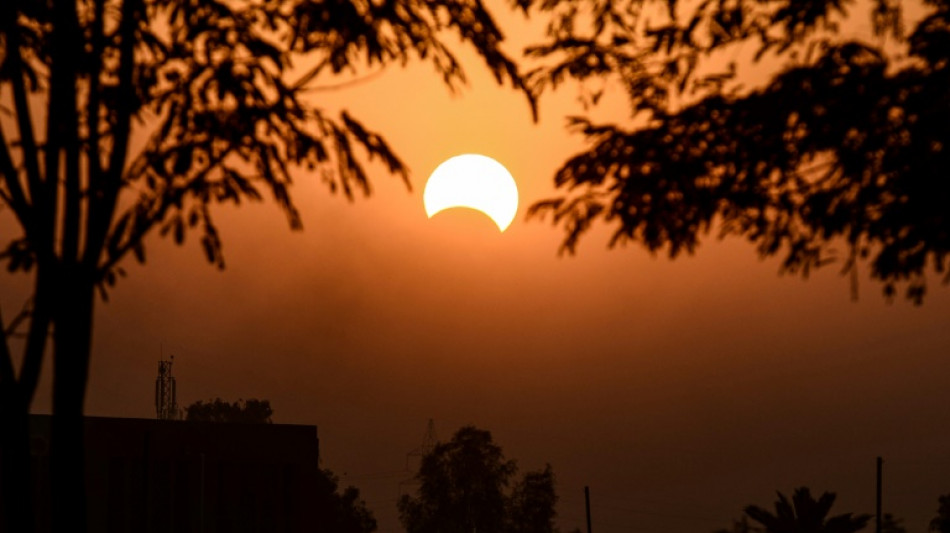
Partial solar eclipse from Iceland to India on Tuesday / Photo: Haidar HAMDANI - AFP/File

 Candidate for UN chief calls for AI regulation akin to nuclear weapons

 'We're losing control,' AI pioneer Yoshua Bengio tells AFP

 IR-MED and Dice Technologies Announce collaboration to Evaluate and Advance Pressure-Injury Prevention Platform in Japan

 Watts, Pitt, Cruz to light up Spain's top film festival

 Toogood Gold's Table Mountain Sits in the Shadow of a Nevada Gold Rush

 MEXC July–August Security Report: 38.66M USDT in Risk Funds Intercepted, Futures Insurance Fund Hits 792M USDT

 Emporio Armani names Dario Vitale new creative director

 EU to ban social media for under 13s, curb access until 15

 Wildfires push endangered Sumatran elephants to brink: Indonesian NGO

 Bank of Japan set to raise rates under pressure from inflation, US

 EU chief to unveil social media, gaming curbs for under-15s

 'Resident Evil' film brings video game's ethos to the big screen

 GA-ASI Mojave First UAS To Complete Battlefield Short Field Ops

 Sanders, Bannon warn of AI dangers in rare US left-right alignment

 Empty benches as schools reopen in Venezuela's quake-hit Guaira

 Tiny English village holds 'independence' vote over asylum seeker housing

 US Treasury chief says to meet Chinese counterpart at weekend

 BingX Evolves into a Multi-Asset Trading Platform, Connecting Users to Global Opportunities

 International Trading Institute Expands Professional Trader Development Beyond the Master’s in Trading

 Lake Energy Secures $80 Million for U.S. Renewable Energy Expansion

 Stocks drop, oil climbs and Treasury yields hit 19-year high

 SkySail Strategies Outperforms Wall Street's 30-Year Risk Standard With Proprietary AI Inference Model

 Just add fish: Scientists pursue more rice, less disease in Senegal paddies

 Belgium completes outer structure of offshore energy island

 China retail sales growth weakens further in August

A partial solar eclipse will be visible across a swathe of the Northern Hemisphere on Tuesday, with amateur astronomers warned to take care watching the rare phenomenon.
The eclipse will start at 0858 GMT in Iceland and end off the coast of India at 1302 GMT, crossing Europe, North Africa and the Middle East on its way, according to the IMCCE institute of France's Paris Observatory.
Solar eclipses occur when the Moon passes between the Sun and Earth, casting its shadow down onto our planet.
A total solar eclipse happens when the Moon completely blocks the Sun's disk, momentarily plunging a portion of the Earth into complete darkness.
However Tuesday's eclipse is only partial, and the "Moon's shadow will not touch the surface of the Earth at any point," the Paris Observatory said in a statement.
The Moon will cover a maximum of 82 percent of the Sun over Kazakhstan, but it will not be enough darken the daylight, Paris Observatory astronomer Florent Deleflie said.
"To start getting the sense of darkness in the sky, to perceive a kind of cold light, the Sun needs to be at least 95 percent obscured," Deleflie told AFP.
Those hoping to watch the eclipse should not look at the Sun directly, even through clouds, to avoid eye damage, according to experts. Protective eyewear should be worn instead.
"We will see that a small piece of the Sun is missing. It won't be spectacular, but it's always an event for amateur astronomers -- and it can make for beautiful photos," Deleflie said.
It will be the 16th partial solar eclipse of the century, and the second of this year.
The next total solar eclipse will cross North America on April 8, 2024, according to NASA.
P.Petrenko--CPN