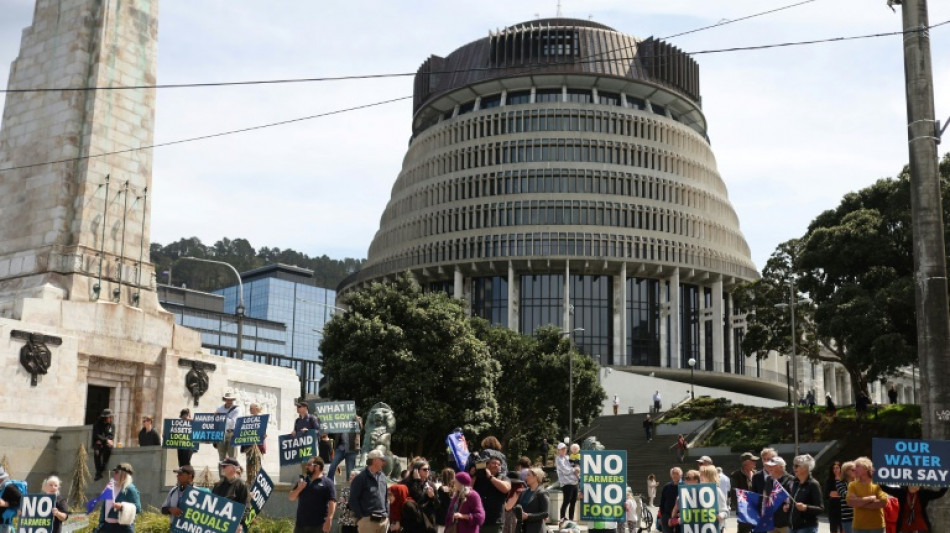
New Zealand farmers protest livestock 'burp and fart' tax / Photo: Marty MELVILLE - AFP

 Candidate for UN chief calls for AI regulation akin to nuclear weapons

 'We're losing control,' AI pioneer Yoshua Bengio tells AFP

 IR-MED and Dice Technologies Announce collaboration to Evaluate and Advance Pressure-Injury Prevention Platform in Japan

 Watts, Pitt, Cruz to light up Spain's top film festival

 Toogood Gold's Table Mountain Sits in the Shadow of a Nevada Gold Rush

 MEXC July–August Security Report: 38.66M USDT in Risk Funds Intercepted, Futures Insurance Fund Hits 792M USDT

 Emporio Armani names Dario Vitale new creative director

 EU to ban social media for under 13s, curb access until 15

 Wildfires push endangered Sumatran elephants to brink: Indonesian NGO

 Bank of Japan set to raise rates under pressure from inflation, US

 EU chief to unveil social media, gaming curbs for under-15s

 'Resident Evil' film brings video game's ethos to the big screen

 GA-ASI Mojave First UAS To Complete Battlefield Short Field Ops

 Sanders, Bannon warn of AI dangers in rare US left-right alignment

 Empty benches as schools reopen in Venezuela's quake-hit Guaira

 Tiny English village holds 'independence' vote over asylum seeker housing

 US Treasury chief says to meet Chinese counterpart at weekend

 BingX Evolves into a Multi-Asset Trading Platform, Connecting Users to Global Opportunities

 International Trading Institute Expands Professional Trader Development Beyond the Master’s in Trading

 Lake Energy Secures $80 Million for U.S. Renewable Energy Expansion

 Stocks drop, oil climbs and Treasury yields hit 19-year high

 SkySail Strategies Outperforms Wall Street's 30-Year Risk Standard With Proprietary AI Inference Model

 Just add fish: Scientists pursue more rice, less disease in Senegal paddies

 Belgium completes outer structure of offshore energy island

 China retail sales growth weakens further in August

Farmers quit their fields and hit the streets of New Zealand's cities Thursday in countrywide protests against plans to tax greenhouse emissions from farm animals.
Convoys of tractors, 4x4s and farmyard vehicles disrupted traffic in Wellington, Auckland and other major hubs, as protestors demanded the centre-left government ditch plans for an animal "burp and fart" tax.
Earlier this month, Prime Minister Jacinda Ardern touted a "world first" levy on emissions of methane and nitrous oxide produced by the nation's six million cows and 26 million sheep as a step to tackling climate change.
Thousands of farmers gathered Thursday brandishing signs saying the policy "stinks" and warning that the tax would make food more costly, while putting their livelihoods at risk.
"Most farmers have had enough," said one Wellington protestor who gave his name only as Chris. "It's getting hard to carry on farming and this government isn't really supporting us -- it's a tough gig at the moment."
Animals produce methane and nitrous oxide as a byproduct of munching on grass and feed.
Methane is much less abundant than carbon dioxide and does not linger as long in the atmosphere, but is a much more potent warming agent.
Scientists believe methane is responsible for roughly 30 percent of the global rise in temperatures despite being a fraction of the greenhouse gas mix.
Ardern has argued the tax is needed to reach climate targets and could even benefit farmers if they can charge more for climate-friendly meat.
She also signalled a possible willingness to compromise.
"We are out talking to our farmers and food producers as to the best possible design," she told reporters in Auckland.
- 'Stress and heartbreak' -
Bryan McKenzie of protest organisers Groundswell NZ said the tax was "punitive" and "an existential threat to rural communities".
"After years of faux consultation, the government has given up on all pretence of a fair and workable agricultural emissions policy."
While the government hopes the tax will reduce livestock emissions by 20 percent, McKenzie argues that any "reductions will be replaced by less efficient foreign farmers".
Urban supporters also joined the protest in some regions, with one sign in the southern city of Dunedin reading "Farming tax affects us all".
In a joint statement, several mayors from New Zealand's remote west coast regions said they "stand strongly in support" of the protest.
Environmentalists argue that protesting farmers are stuck in the mud.
"This country's rural and agricultural sector has been hard hit by floods, intense storms and droughts this year alone," said Emily Bailey of Climate Justice Taranaki.
"That cost millions in damages and loads of stress and heartbreak for those losing homes, sheds, stock and fences... It's only getting worse," she said.
"Farmers can either adapt and rapidly bring down their emissions or they, and everyone else, will suffer more."
P.Gonzales--CPN