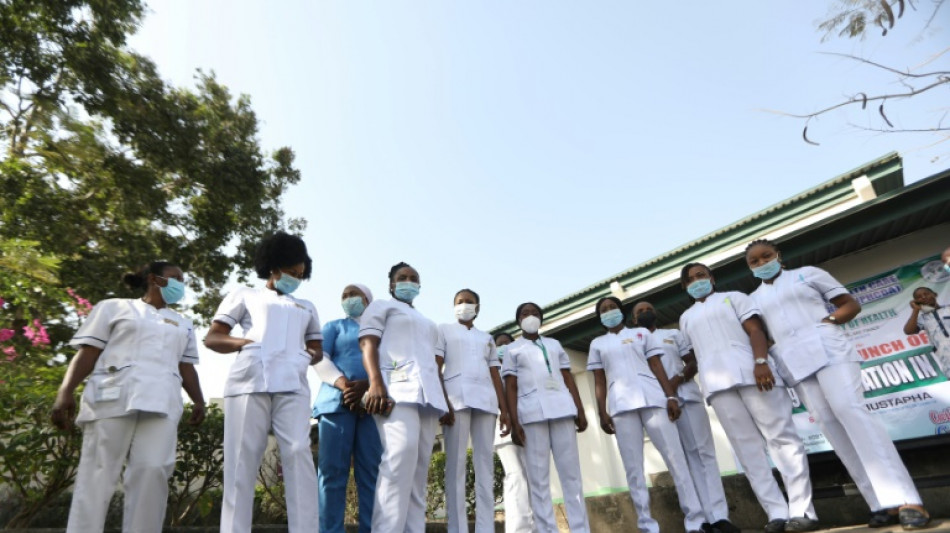
One million children lose mother to cancer a year: research / Photo: Kola Sulaimon - AFP

 Candidate for UN chief calls for AI regulation akin to nuclear weapons

 'We're losing control,' AI pioneer Yoshua Bengio tells AFP

 IR-MED and Dice Technologies Announce collaboration to Evaluate and Advance Pressure-Injury Prevention Platform in Japan

 Watts, Pitt, Cruz to light up Spain's top film festival

 Toogood Gold's Table Mountain Sits in the Shadow of a Nevada Gold Rush

 MEXC July–August Security Report: 38.66M USDT in Risk Funds Intercepted, Futures Insurance Fund Hits 792M USDT

 Emporio Armani names Dario Vitale new creative director

 EU to ban social media for under 13s, curb access until 15

 Wildfires push endangered Sumatran elephants to brink: Indonesian NGO

 Bank of Japan set to raise rates under pressure from inflation, US

 EU chief to unveil social media, gaming curbs for under-15s

 'Resident Evil' film brings video game's ethos to the big screen

 GA-ASI Mojave First UAS To Complete Battlefield Short Field Ops

 Sanders, Bannon warn of AI dangers in rare US left-right alignment

 Empty benches as schools reopen in Venezuela's quake-hit Guaira

 Tiny English village holds 'independence' vote over asylum seeker housing

 US Treasury chief says to meet Chinese counterpart at weekend

 BingX Evolves into a Multi-Asset Trading Platform, Connecting Users to Global Opportunities

 International Trading Institute Expands Professional Trader Development Beyond the Master’s in Trading

 Lake Energy Secures $80 Million for U.S. Renewable Energy Expansion

 Stocks drop, oil climbs and Treasury yields hit 19-year high

 SkySail Strategies Outperforms Wall Street's 30-Year Risk Standard With Proprietary AI Inference Model

 Just add fish: Scientists pursue more rice, less disease in Senegal paddies

 Belgium completes outer structure of offshore energy island

 China retail sales growth weakens further in August

Around one million children worldwide lose their mother to cancer every year, often leaving orphans caught up in a "vicious cycle of disadvantage", researchers said Wednesday.
The first-ever estimate for the number of children left motherless from cancer was announced at the World Cancer Congress in Geneva on Wednesday.
It was prompted by a study in Africa by the World Health Organization's International Agency for Research on Cancer (IARC), which is based in Lyon, France.
That research followed more than 2,000 women with breast cancer in Namibia, Uganda, Zambia and Nigeria, over half of whom died in just five years.
The study illustrated that "the intergenerational impact of cancer deaths of mothers hasn't been documented," IARC epidemiologist Valerie McCormack told AFP.
So the IARC researchers calculated that out of the four million who died from cancer in 2020, one million children were left motherless.
Around 45 percent of the mothers died from breast and cervical cancer, which are "very preventable", McCormack said, calling for more investment to fight both diseases.
During the research in sub-Saharan Africa, McCormack said families described selling their land to pay for cancer treatment, leaving no money left for educating the children.
"It's a vicious cycle of disadvantage" for poorer families, she said.
The researchers arrived at their global estimate, which has not been peer reviewed, by combining the number of annual female cancer deaths from IARC's GLOBOCAN database with fertility data from the United Nations.
More women than men die from cancer between the ages of 35 and 50 worldwide, largely due to cancer in female reproductive organs.
As time goes on, the situation reverses as men increasingly get prostate and lifestyle-related types of cancer.
And people in high-income countries are more likely to die from cancer later in life, when their children are grown.
McCormack said the IARC was working on finding a similar global figure for children left fatherless by cancer, but it was a trickier equation without the fertility data.
P.Petrenko--CPN