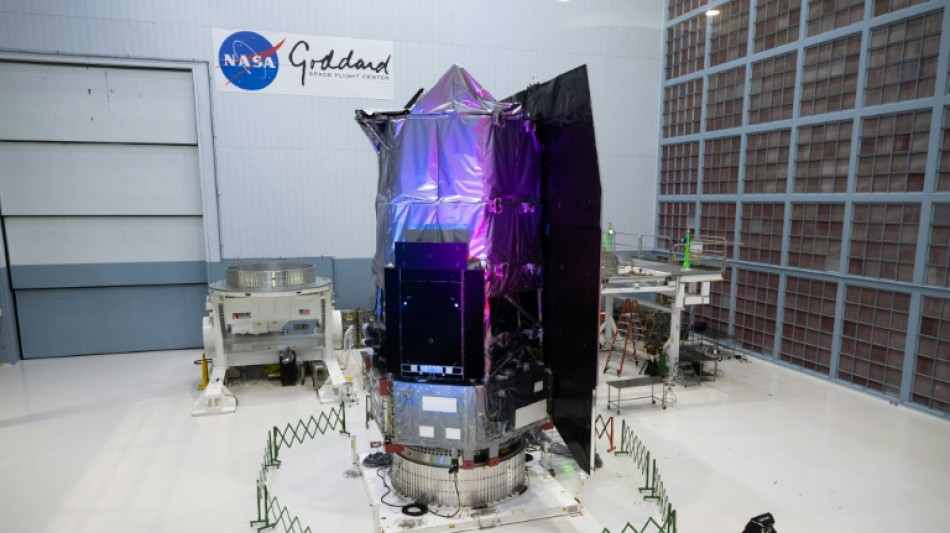
NASA unveils new space telescope to give 'atlas of the universe' / Photo: SAUL LOEB - AFP

 Emporio Armani names Dario Vitale new creative director

 EU to ban social media for under 13s, curb access until 15

 Wildfires push endangered Sumatran elephants to brink: Indonesian NGO

 Bank of Japan set to raise rates under pressure from inflation, US

 EU chief to unveil social media, gaming curbs for under-15s

 'Resident Evil' film brings video game's ethos to the big screen

 i-payout Expands U.S. Money Transmitter Licensing Footprint and Advances European EMI Strategy

 US Senate crypto bill collapses amid partisan deadlock

 OpenAI, Anthropic and Google are working to create an AI standards body

 Protesting shepherds, farmers clash with Romanian police

 Foundation Lets Ledger Users Switch to Open Source Without Starting Over

 EU to propose curbing social media, online games for under 15s

 FX Junction Reaches 40,600 Members and 26 Million Trades

 'We unleashed the beast': the world's fears and hopes about AI

 Hospitality leaders ask Burnham to halve VAT amid rising costs

 Worcestershire invited to nominate groups for 2027 King’s volunteer award

 Berlin's run-down public spaces at heart of election campaign

 'Widow's Bay' and 'The Pitt' win big at Emmy Awards

 Most markets drop as oil extends gains ahead of expected US rate hike

 Sri Lanka's famed beach shack battles demolition

 Vserv targets ₹1,000 crore revenue by 2030 through AI expansion

 India prohibits bank fees on UPI payments up to ₹2,000

 Brazil's Amazon defender Raoni has cancer

 Trump rejects AI slowdown concerns as UN urges coordinated controls

 Higher wages draw migrant workers to Kashmir despite attacks

NASA unveiled a new telescope on Tuesday to scan vast swathes of the universe for planets outside our solar system and probe the mysteries of dark matter and dark energy.
The Roman space telescope is expected to discover tens of thousands of planets, possibly offering clarity abut how many could be out there.
"Roman will give the Earth a new atlas of the universe," NASA administrator Jared Isaacman told a news conference at the Goddard Space Flight Center in Maryland, where the telescope went on display.
The 12-metre (39-feet), silvery contraption with massive solar panels will be transported to Florida ahead of a launch into space aboard a SpaceX rocket planned for September at the earliest.
Roman, which took more than $4 billion and over a decade to build, is named after astronomer Nancy Grace Roman, nicknamed the "Mother of Hubble" for her role in developing the landmark space telescope.
Thirty-six years after Hubble launched into space, revolutionizing astronomical observations, NASA hopes Roman will help to shed light on questions that remain unresolved.
Boasting a field of view at least 100 times larger than Hubble's, the telescope will sweep across vast regions of space from its position 1.5 million kilometres (930,000 miles) from Earth.
The telescope will send 11 terabytes of data a day down to Earth, said Mark Melton, a systems engineer at Goddard Space Flight Center.
"In the first year, we'll have sent down more data than Hubble will have for its entire life," he told AFP.
The telescope's wide-angle lens will allow NASA to conduct a census of the objects that make up our universe, said Nicky Fox, associate administrator for NASA's Science Mission Directorate.
"Roman will discover tens of thousands of new planets outside our solar system. It will reveal billions of galaxies, thousands of supernovae and tens of billions of stars," she said.
This wealth of information will enable NASA to tease out areas of interest that can then be investigated by complementary telescopes, such as the James Webb Space Telescope.
- Study the invisible -
But Roman will also study the invisible -- dark matter and dark energy, whose origins remain unknown but which are thought to constitute 95 percent of our universe.
Dark matter is believed to be the glue that holds galaxies together, while dark energy pulls them apart by making the universe expand faster and faster over time.
Thanks to its infrared vision, the telescope will be able to observe light emitted by celestial bodies billions of years ago, effectively looking back in time to hopefully discover more about the two phenomena.
Complementing the work of Europe's Euclid space telescope and the Vera Rubin Observatory in Chile, Roman will probe "how the dark matter structures itself throughout cosmic time" and "calculate how fast galaxies are moving away from us," Darryl Seligman, an assistant professor of physics and astronomy at Michigan State University, told AFP.
These discoveries could fundamentally change our understanding of the structure of our universe, said astrophysicist Julie McEnery, who led the Roman project.
"If Roman wins a Nobel Prize at some point, it's probably for something we haven't even thought about or questioned yet," said Melton.
A.Leibowitz--CPN