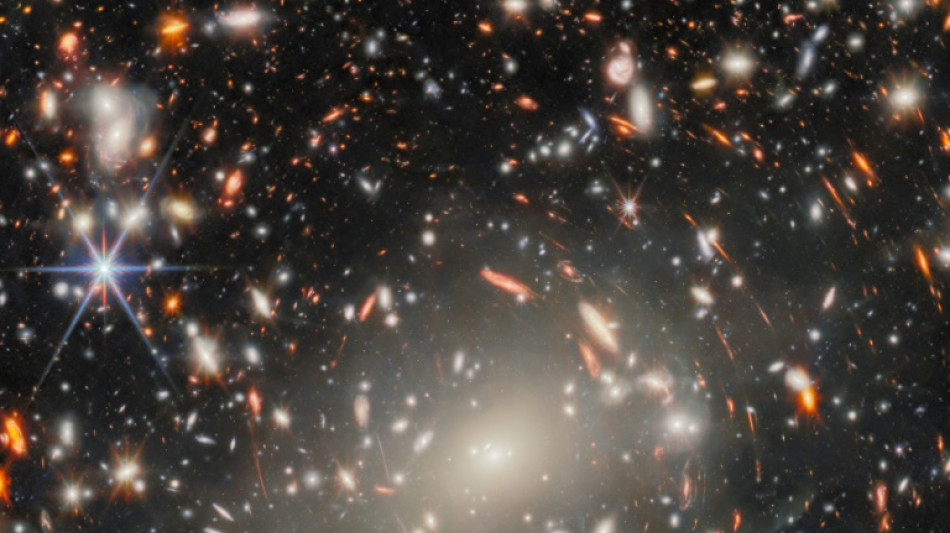
Webb telescope captures deep view of ancient galaxies / Photo: HANDOUT - ESA/WEBB/AFP

 UK-Sudanese author pens book to give children 'African history of Africa'

 US Congress passes sweeping Russia sanctions bill

 US stocks fall, dollar gains after Fed lifts interest rates

 US Fed raises rates to tackle 'too high' inflation in move sure to rile Trump

 US Fed raises rates to battle inflation in move likely to rile Trump

 US House faces test on sweeping Russia sanctions bill

 British PM says to make 'difficult decisions' as inflation rises

 Global fuel price demos: a round-up

 Leverate Launches MCP for Traders to Connect AI Assistants With Trading Platforms

 MEXC Launches $1M "Discover Your Wall Street DNA" Campaign to Help Traders Find Their Market Fit

 Stocks edge higher ahead of US Fed rate call

 BASIS.pro Expands On-Chain Infrastructure with XDC Network Partnership and Zypher DAO as Auto Earn Goes Live

 Pickle-flavoured tart? AI inspires Japan's convenience stores

 EU chief hosts Canada's Carney in push to 'deepen' alliance

 Meta chief pushes back on AI slowdown calls

 US Fed to deliver rate decision with markets betting on hike

 i-payout Expands U.S. Money Transmitter Licensing Footprint and Advances European EMI Strategy

 US Senate crypto bill collapses amid partisan deadlock

 OpenAI, Anthropic and Google are working to create an AI standards body

 Protesting shepherds, farmers clash with Romanian police

 Foundation Lets Ledger Users Switch to Open Source Without Starting Over

 EU to propose curbing social media, online games for under 15s

 FX Junction Reaches 40,600 Members and 26 Million Trades

 'We unleashed the beast': the world's fears and hopes about AI

 Hospitality leaders ask Burnham to halve VAT amid rising costs

The James Webb space telescope's deepest view of a single target yet depicts spinning arcs of light that are galaxies from the universe's distant past, the European Space Agency said Tuesday.
The new image took the world's most powerful telescope more than 120 hours to capture, making it the longest Webb has ever focused on a single target.
It is also "Webb's deepest gaze on a single target to date", the European Space Agency (ESA) said in a statement, making the image one of the deepest ever captured of the cosmos.
At the bright centre of the image is a massive cluster of galaxies called Abell S1063, which is 4.5 billion light years from Earth.
But it is not the true target.
Such huge celestial objects can bend the light of things behind them, creating a kind of magnifying glass called a gravitational lens.
Therefore the "warped arcs" spinning around the Abell S1063 are what really interest scientists, the ESA said in a statement.
Because looking into distant space also means looking back in time, scientists hope to learn how the first galaxies formed during a period known as the Cosmic Dawn, when the universe was only a few million years old.
The image includes nine separate shots of different near-infrared wavelengths of light, the ESA said.
Since coming online in 2022, the Webb telescope has ushered in a new era of scientific breakthroughs.
It has also revealed that galaxies in the early universe are far bigger than scientists expected, leading some to suspect there might be something wrong with our understanding of the cosmos.
A.Leibowitz--CPN