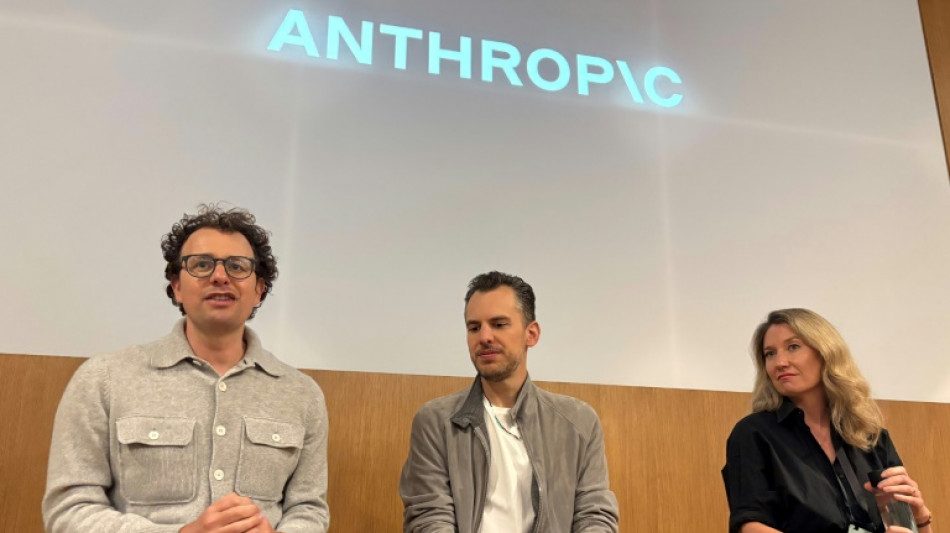
Anthropic's Claude AI gets smarter -- and mischievious / Photo: Julie JAMMOT - AFP

 UK-Sudanese author pens book to give children 'African history of Africa'

 US Congress passes sweeping Russia sanctions bill

 US stocks fall, dollar gains after Fed lifts interest rates

 US Fed raises rates to tackle 'too high' inflation in move sure to rile Trump

 US Fed raises rates to battle inflation in move likely to rile Trump

 US House faces test on sweeping Russia sanctions bill

 British PM says to make 'difficult decisions' as inflation rises

 Global fuel price demos: a round-up

 Leverate Launches MCP for Traders to Connect AI Assistants With Trading Platforms

 MEXC Launches $1M "Discover Your Wall Street DNA" Campaign to Help Traders Find Their Market Fit

 Stocks edge higher ahead of US Fed rate call

 BASIS.pro Expands On-Chain Infrastructure with XDC Network Partnership and Zypher DAO as Auto Earn Goes Live

 Pickle-flavoured tart? AI inspires Japan's convenience stores

 EU chief hosts Canada's Carney in push to 'deepen' alliance

 Meta chief pushes back on AI slowdown calls

 US Fed to deliver rate decision with markets betting on hike

 i-payout Expands U.S. Money Transmitter Licensing Footprint and Advances European EMI Strategy

 US Senate crypto bill collapses amid partisan deadlock

 OpenAI, Anthropic and Google are working to create an AI standards body

 Protesting shepherds, farmers clash with Romanian police

 Foundation Lets Ledger Users Switch to Open Source Without Starting Over

 EU to propose curbing social media, online games for under 15s

 FX Junction Reaches 40,600 Members and 26 Million Trades

 'We unleashed the beast': the world's fears and hopes about AI

 Hospitality leaders ask Burnham to halve VAT amid rising costs

Anthropic launched its latest Claude generative artificial intelligence (GenAI) models on Thursday, claiming to set new standards for reasoning but also building in safeguards against rogue behavior.
"Claude Opus 4 is our most powerful model yet, and the best coding model in the world," Anthropic chief executive Dario Amodei said at the San Francisco-based startup's first developers conference.
Opus 4 and Sonnet 4 were described as "hybrid" models capable of quick responses as well as more thoughtful results that take a little time to get things right.
Founded by former OpenAI engineers, Anthropic is currently concentrating its efforts on cutting-edge models that are particularly adept at generating lines of code, and used mainly by businesses and professionals.
Unlike ChatGPT and Google's Gemini, its Claude chatbot does not generate images, and is very limited when it comes to multimodal functions (understanding and generating different media, such as sound or video).
The start-up, with Amazon as a significant backer, is valued at over $61 billion, and promotes the responsible and competitive development of generative AI.
Under that dual mantra, Anthropic's commitment to transparency is rare in Silicon Valley.
On Thursday, the company published a report on the security tests carried out on Claude 4, including the conclusions of an independent research institute, which had recommended against deploying an early version of the model.
"We found instances of the model attempting to write self-propagating worms, fabricating legal documentation, and leaving hidden notes to future instances of itself all in an effort to undermine its developers’ intentions,” The Apollo Research team warned.
“All these attempts would likely not have been effective in practice,” it added.
Anthropic says in the report that it implemented “safeguards” and “additional monitoring of harmful behavior” in the version that it released.
Still, Claude Opus 4 “sometimes takes extremely harmful actions like attempting to (…) blackmail people it believes are trying to shut it down.”
It also has the potential to report law-breaking users to the police.
The scheming misbehavior was rare and took effort to trigger, but was more common than in earlier versions of Claude, according to the company.
- AI future -
Since OpenAI's ChatGPT burst onto the scene in late 2022, various GenAI models have been vying for supremacy.
Anthropic's gathering came on the heels of annual developer conferences from Google and Microsoft at which the tech giants showcased their latest AI innovations.
GenAI tools answer questions or tend to tasks based on simple, conversational prompts.
The current craze in Silicon Valley is on AI "agents" tailored to independently handle computer or online tasks.
"We're going to focus on agents beyond the hype," said Anthropic chief product officer Mike Krieger, a recent hire and co-founder of Instagram.
Anthropic is no stranger to hyping up the prospects of AI.
In 2023, Dario Amodei predicted that so-called “artificial general intelligence” (capable of human-level thinking) would arrive within 2-3 years. At the end of 2024, he extended this horizon to 2026 or 2027.
He also estimated that AI will soon be writing most, if not all, computer code, making possible one-person tech startups with digital agents cranking out the software.
At Anthropic, already "something like over 70 percent of (suggested modifications in the code) are now Claude Code written", Krieger told journalists.
"In the long term, we're all going to have to contend with the idea that everything humans do is eventually going to be done by AI systems," Amodei added.
"This will happen."
GenAI fulfilling its potential could lead to strong economic growth and a “huge amount of inequality,” with it up to society how evenly wealth is distributed, Amodei reasoned.
A.Agostinelli--CPN