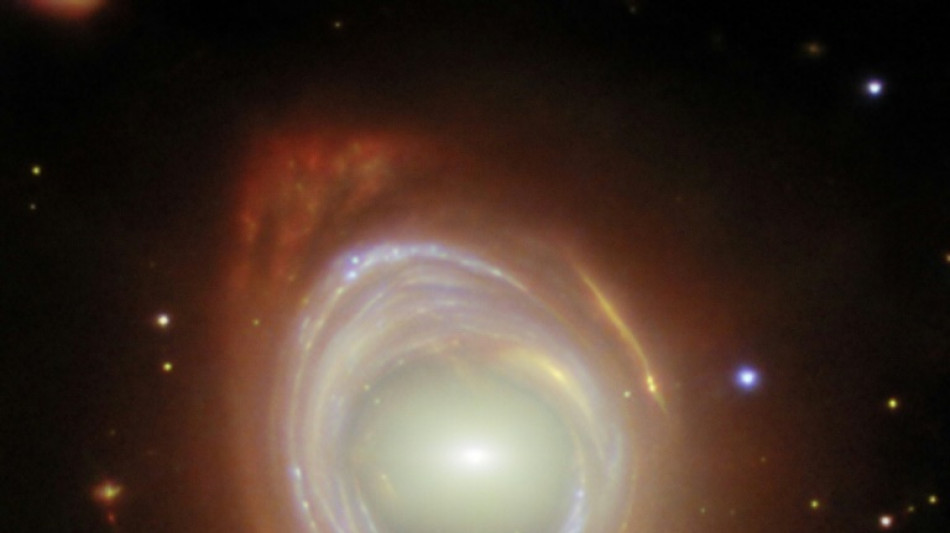
Universe dying quicker than thought, says new research / Photo: Handout - ESA/Webb, NASA & CSA, G. Mahler/AFP

 Where the US-China tariff row stands ahead of White House summit

 Indonesia cash-for-photos scheme turns animal hunters into protectors

 Argentine judge orders suspension of Falklands oil project

 US Fed raises rates to tackle 'too high' inflation, irking Trump

 Turkey releases 106 protesters, jails more LGBTQ activists

 Candidate for UN chief calls for AI regulation akin to nuclear weapons

 'We're losing control,' AI pioneer Yoshua Bengio tells AFP

 IR-MED and Dice Technologies Announce collaboration to Evaluate and Advance Pressure-Injury Prevention Platform in Japan

 Watts, Pitt, Cruz to light up Spain's top film festival

 Toogood Gold's Table Mountain Sits in the Shadow of a Nevada Gold Rush

 MEXC July–August Security Report: 38.66M USDT in Risk Funds Intercepted, Futures Insurance Fund Hits 792M USDT

 Emporio Armani names Dario Vitale new creative director

 EU to ban social media for under 13s, curb access until 15

 Wildfires push endangered Sumatran elephants to brink: Indonesian NGO

 Bank of Japan set to raise rates under pressure from inflation, US

 EU chief to unveil social media, gaming curbs for under-15s

 'Resident Evil' film brings video game's ethos to the big screen

 GA-ASI Mojave First UAS To Complete Battlefield Short Field Ops

 Sanders, Bannon warn of AI dangers in rare US left-right alignment

 Empty benches as schools reopen in Venezuela's quake-hit Guaira

 Tiny English village holds 'independence' vote over asylum seeker housing

 US Treasury chief says to meet Chinese counterpart at weekend

 BingX Evolves into a Multi-Asset Trading Platform, Connecting Users to Global Opportunities

 International Trading Institute Expands Professional Trader Development Beyond the Master’s in Trading

 Lake Energy Secures $80 Million for U.S. Renewable Energy Expansion

The universe is poised to die much faster than previously thought, according to new research by Dutch scientists.
But there's no great need to panic. We still have 10 to the power of 78 years before it happens -- that's a one with 78 zeroes.
However, that is a major revision from the previous estimate of 10 to the power of 1,100 years, notes the research paper from Radboud University, published in the Journal of Cosmology and Astroparticle Physics.
"The final end of the universe is coming much sooner than expected but fortunately it still takes a very long time," said lead author Heino Falcke.
A trio of scientists at Radboud set out to calculate when the most "durable" celestial bodies -- white dwarf stars -- would eventually die out.
They based their calculations on Hawking radiation, named after celebrated British physicist Stephen Hawking.
Hawking postulated in the mid-1970s that black holes leak radiation, slowly dissolving like aspirin in a glass of water -- giving them a finite lifetime.
The Radboud scientists extended this to other objects in the universe, calculating that the "evaporation time" depends on density.
This enabled them to calculate the theoretical dissolution of the longest-lasting body, the white dwarf.
"By asking these kinds of questions and looking at extreme cases, we want to better understand the theory, and perhaps one day, we can unravel the mystery of Hawking radiation," said co-author Walter van Suijlekom.
Humankind needn't worry too much about the end of the universe. Unless we escape planet Earth, we'll be long gone.
Scientists think that our Sun will be too hot for life in about a billion years, boiling our oceans.
In about eight billion years, our star will eventually expand towards the Earth, finally gobbling up our by-then barren and lifeless planet and condemning it to a fiery death.
S.F.Lacroix--CPN