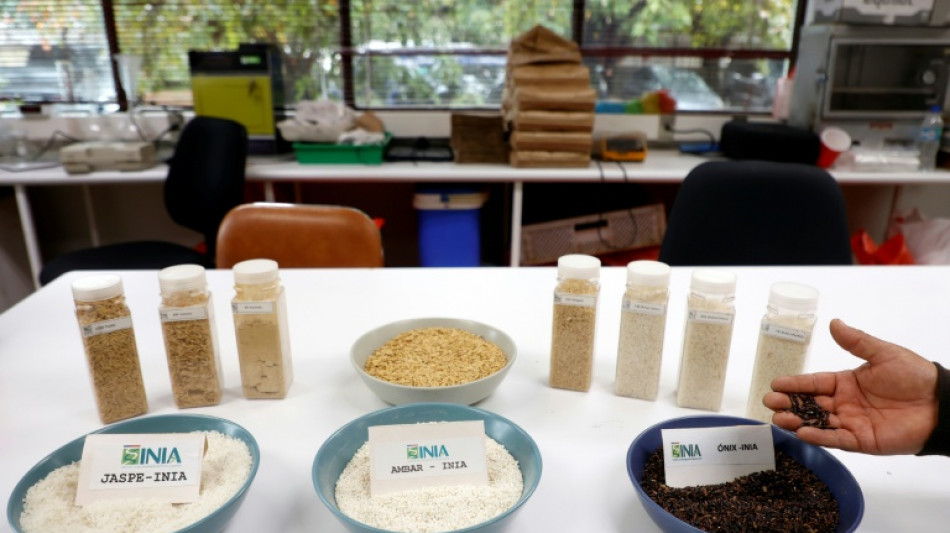
Less-thirsty rice offers hope in drought-stricken Chile / Photo: RAUL BRAVO - AFP

 Where the US-China tariff row stands ahead of White House summit

 Indonesia cash-for-photos scheme turns animal hunters into protectors

 Argentine judge orders suspension of Falklands oil project

 US Fed raises rates to tackle 'too high' inflation, irking Trump

 Turkey releases 106 protesters, jails more LGBTQ activists

 Candidate for UN chief calls for AI regulation akin to nuclear weapons

 'We're losing control,' AI pioneer Yoshua Bengio tells AFP

 IR-MED and Dice Technologies Announce collaboration to Evaluate and Advance Pressure-Injury Prevention Platform in Japan

 Watts, Pitt, Cruz to light up Spain's top film festival

 Toogood Gold's Table Mountain Sits in the Shadow of a Nevada Gold Rush

 MEXC July–August Security Report: 38.66M USDT in Risk Funds Intercepted, Futures Insurance Fund Hits 792M USDT

 Emporio Armani names Dario Vitale new creative director

 EU to ban social media for under 13s, curb access until 15

 Wildfires push endangered Sumatran elephants to brink: Indonesian NGO

 Bank of Japan set to raise rates under pressure from inflation, US

 EU chief to unveil social media, gaming curbs for under-15s

 'Resident Evil' film brings video game's ethos to the big screen

 GA-ASI Mojave First UAS To Complete Battlefield Short Field Ops

 Sanders, Bannon warn of AI dangers in rare US left-right alignment

 Empty benches as schools reopen in Venezuela's quake-hit Guaira

 Tiny English village holds 'independence' vote over asylum seeker housing

 US Treasury chief says to meet Chinese counterpart at weekend

 BingX Evolves into a Multi-Asset Trading Platform, Connecting Users to Global Opportunities

 International Trading Institute Expands Professional Trader Development Beyond the Master’s in Trading

 Lake Energy Secures $80 Million for U.S. Renewable Energy Expansion

A cold, dry part of Chile might not sound like the best place to grow rice, a famously thirsty grain that thrives in tropical conditions.
But a new strain of the world's favorite cereal developed by scientists in the drought-plagued South American country has generated hope that rice can be grown in seemingly inhospitable conditions.
Using an innovative planting technique, Javier Munoz has been trialling the "Jaspe" strain created by experts at the Agricultural Research Institute's (INIA) Rice Breeding Program.
It is one of several research efforts worldwide to come up with less resource-hungry crops at a time of increased water scarcity in parts of the world due to global warming.
Using Jaspe in combination with a growing method that requires only intermittent watering cut the Munoz family's water consumption in half in a country that has for generations cultivated rice in flooded fields, or paddies.
At the same time, yield rocketed, with each seed yielding about thirty plants -- nearly ten times more than a conventional rice field.
Irrigating rather than flooding rice fields "is a historic step... towards the future," Munoz, 25, told AFP at his farm in the region of Nuble, a nearly five-hour drive south from the capital Santiago.
Next year, he said, he hoped to increase his production area from one hectare to five.
Chile's Maule and Nuble regions contain the southernmost rice fields in the world.
Typically grown in wetter, tropical areas, rice cultivation in Chile has been hampered by an unprecedented megadrought, now in its 15th year and driven by climate change, according to scientists.
Each Chilean eats on average 10 kilograms (22 pounds) of rice per year -- nearly half of which is grown domestically and 80 percent of that in flooded fields, according to the SRI-Rice research center at Cornell University.
The flooding method, which requires about 2,500 liters (660 gallons) of water per kilogram (2.2 pounds) of rice, is used around the world to combat weeds and regulate the temperature around vulnerable seedlings.
- Less methane -
The Jaspe rice strain was obtained by INIA agricultural engineer Karla Cordero and colleagues by crossing a Chilean seed with a Russian one better adapted to cold and dry climates.
The modified seed is then grown using the SRI growing technique developed in Madagascar in the 1980s that involves spacing the seedlings further apart in enriched soil, and watering only sporadically to build a more resilient root system.
Cordero presented the results of nearly 20 years of experimentation -- conducted with backing from the Inter-American Institute for Cooperation on Agriculture (IICA) -- at an International Rice Research Conference in Manila in 2023.
The findings have yet to be published in a peer-reviewed scientific journal, but Chile's Agriculture and Livestock Service, an arm of the agriculture ministry, gave the green light in 2023 for the new strain of long-grain white rice to be rolled out commercially.
Apart from using less water and fewer seeds, the new Jaspe-SRI method also emits less methane, a potent planet-warming gas more famously produced by cows.
Rice cultivation in flooded paddies crawling with microorganisms is responsible for about 10 percent of human-caused methane emissions, according to the UN's Food and Agriculture Organization.
- 'Climate-smart' -
Jaspe has proven to be more resistant to storms, floods and heatwaves. "The plants are much more robust, which allows rice to be produced without flooding," Cordero said.
Makiko Taguchi, a rice cultivation expert at the UN Food and Agriculture Organization (FAO), told AFP the Chilean work amounted to "a promising approach to improving rice production while reducing the environmental impact."
Pointing to similar work being done in Japan, she said: "Obtaining resistant varieties is one of the main ways to increase resilience to climate change."
Cordero said the results suggested the approach could also work in other parts of the world "where large quantities of rice are produced and where there are droughts."
The team hopes to test Jaspe soon in Brazil -- the largest rice producer in the region -- and in other South American countries.
"This is the future," said Munoz. "If we want... food security and care about the environment, this is the way."
Y.Tengku--CPN
