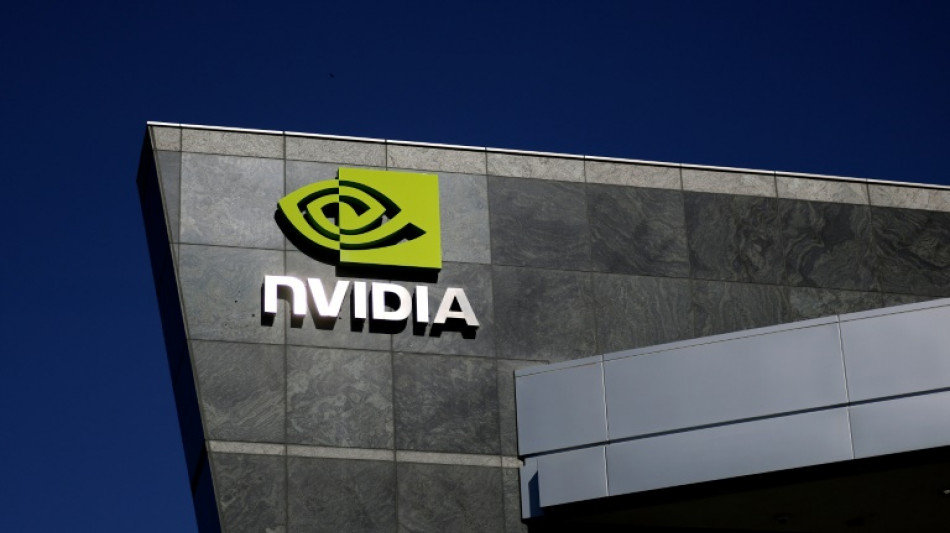
Nvidia to build supercomputer chips entirely in US for first time / Photo: JUSTIN SULLIVAN - GETTY IMAGES NORTH AMERICA/AFP

 Where the US-China tariff row stands ahead of White House summit

 Indonesia cash-for-photos scheme turns animal hunters into protectors

 Argentine judge orders suspension of Falklands oil project

 US Fed raises rates to tackle 'too high' inflation, irking Trump

 Turkey releases 106 protesters, jails more LGBTQ activists

 Candidate for UN chief calls for AI regulation akin to nuclear weapons

 'We're losing control,' AI pioneer Yoshua Bengio tells AFP

 IR-MED and Dice Technologies Announce collaboration to Evaluate and Advance Pressure-Injury Prevention Platform in Japan

 Watts, Pitt, Cruz to light up Spain's top film festival

 Toogood Gold's Table Mountain Sits in the Shadow of a Nevada Gold Rush

 MEXC July–August Security Report: 38.66M USDT in Risk Funds Intercepted, Futures Insurance Fund Hits 792M USDT

 Emporio Armani names Dario Vitale new creative director

 EU to ban social media for under 13s, curb access until 15

 Wildfires push endangered Sumatran elephants to brink: Indonesian NGO

 Bank of Japan set to raise rates under pressure from inflation, US

 EU chief to unveil social media, gaming curbs for under-15s

 'Resident Evil' film brings video game's ethos to the big screen

 GA-ASI Mojave First UAS To Complete Battlefield Short Field Ops

 Sanders, Bannon warn of AI dangers in rare US left-right alignment

 Empty benches as schools reopen in Venezuela's quake-hit Guaira

 Tiny English village holds 'independence' vote over asylum seeker housing

 US Treasury chief says to meet Chinese counterpart at weekend

 BingX Evolves into a Multi-Asset Trading Platform, Connecting Users to Global Opportunities

 International Trading Institute Expands Professional Trader Development Beyond the Master’s in Trading

 Lake Energy Secures $80 Million for U.S. Renewable Energy Expansion

Nvidia on Monday announced plans to build top-end artificial intelligence supercomputer chips entirely in the United States for the first time.
Supercomputer plants are being built in Texas in partnerships with Foxconn and Wistron, with manufacturing expected to ramp up over the course of the next 12 to 15 months, according to the Silicon Valley-based company.
TSMC plants in Arizona have already started production of Nvidia's most advanced graphics processing unit (GPU), called Blackwell, Nvidia added.
"The engines of the world's AI infrastructure are being built in the United States for the first time," Nvidia chief executive Jensen Huang said in the blog post.
"Adding American manufacturing helps us better meet the incredible and growing demand for AI chips and supercomputers, strengthens our supply chain and boosts our resiliency."
Nvidia plans to produce as much as half a trillion dollars worth of AI infrastructure in the United States by the end of this decade through partnerships with TSMC, Foxconn, Wistron, Amkor and SPIL.
"Onshoring these industries is good for the American worker, good for the American economy, and good for American national security," the White House said in a statement.
The US government has clamped down on the export of sophisticated AI chips to China due to national security concerns, and keeping production close to home could allow for tighter control of designs and products.
Now, chips are poised to get caught up in a trade war between the US and China.
On Air Force One Sunday, Trump said tariffs on semiconductors -- which power any major technology from e-vehicles and iPhones to missile systems -- "will be in place in the not distant future."
"We want to make our chips and semiconductors and other things in our country," Trump reiterated.
The US president said he would announce tariffs rates for semiconductors "over the next week" and Commerce Secretary Howard Lutnick said they would likely be in place "in a month or two."
P.Kolisnyk--CPN
