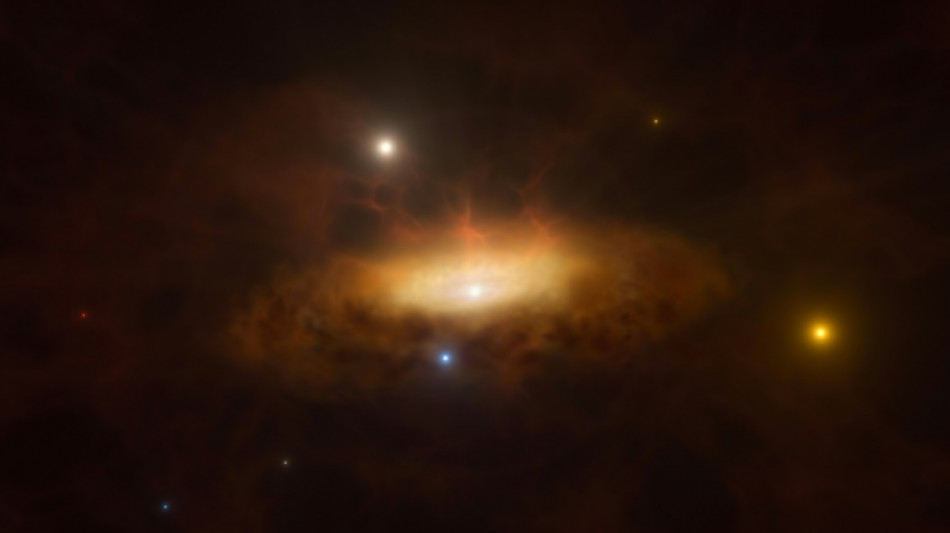
Massive black hole 'waking up' in Virgo constellation / Photo: ESO/M. Kornmesser - European Southern Observatory/AFP/File

 Where the US-China tariff row stands ahead of White House summit

 Indonesia cash-for-photos scheme turns animal hunters into protectors

 Argentine judge orders suspension of Falklands oil project

 US Fed raises rates to tackle 'too high' inflation, irking Trump

 Turkey releases 106 protesters, jails more LGBTQ activists

 Candidate for UN chief calls for AI regulation akin to nuclear weapons

 'We're losing control,' AI pioneer Yoshua Bengio tells AFP

 IR-MED and Dice Technologies Announce collaboration to Evaluate and Advance Pressure-Injury Prevention Platform in Japan

 Watts, Pitt, Cruz to light up Spain's top film festival

 Toogood Gold's Table Mountain Sits in the Shadow of a Nevada Gold Rush

 MEXC July–August Security Report: 38.66M USDT in Risk Funds Intercepted, Futures Insurance Fund Hits 792M USDT

 Emporio Armani names Dario Vitale new creative director

 EU to ban social media for under 13s, curb access until 15

 Wildfires push endangered Sumatran elephants to brink: Indonesian NGO

 Bank of Japan set to raise rates under pressure from inflation, US

 EU chief to unveil social media, gaming curbs for under-15s

 'Resident Evil' film brings video game's ethos to the big screen

 GA-ASI Mojave First UAS To Complete Battlefield Short Field Ops

 Sanders, Bannon warn of AI dangers in rare US left-right alignment

 Empty benches as schools reopen in Venezuela's quake-hit Guaira

 Tiny English village holds 'independence' vote over asylum seeker housing

 US Treasury chief says to meet Chinese counterpart at weekend

 BingX Evolves into a Multi-Asset Trading Platform, Connecting Users to Global Opportunities

 International Trading Institute Expands Professional Trader Development Beyond the Master’s in Trading

 Lake Energy Secures $80 Million for U.S. Renewable Energy Expansion

A massive black hole at the heart of a galaxy in the Virgo constellation is waking up, shooting out intense X-ray flares at regular intervals that have puzzled scientists, a study said Friday.
Astronomers previously had little reason to pay any attention to galaxy SDSS1335+0728, which is 300 million light years from Earth.
But in 2019, the galaxy suddenly started shining with a brightness that turned some telescopes its way.
Then in February last year, Chilean astronomers started noticing regular bursts of X-rays coming from the galaxy.
This was a sign that the galaxy's sleeping black hole was waking from its slumber, according to the study published in the journal Nature Astronomy.
Most galaxies, including our home Milky Way, have a supermassive black hole squatting at their heart, like a spider in a web.
These invisible monsters gobble up everything that comes their way -- not even light can escape their almighty suck.
If an unlucky star swings too close, it gets torn apart.
The star's shattered material becomes a stream that spins rapidly around the black hole, forming what is called an accretion disc that is gradually swallowed.
But black holes can also go through long periods of inactivity when they do not attract matter.
And after a fairly uneventful period, the bright, compact region at the heart of galaxy SDSS1335+0728 has been classified as an "active galactic nucleus" -- and given the nickname "Ansky".
"This rare event provides an opportunity for astronomers to observe a black hole's behaviour in real time" using several X-ray telescopes, astronomer Lorena Hernandez-Garcia of Chile's Valparaiso University said in a statement.
- 'Pushes models to their limits' -
Ansky's short-lived X-ray flares are called quasiperiodic eruptions, or QPEs.
"This is the first time we have observed such an event in a black hole that seems to be waking up," Hernandez-Garcia said.
"We don't yet understand what causes them."
The current theory is that QPEs are linked to the accretion discs that form after black holes swallow stars.
But there is no sign that Ansky has recently feasted on a star.
And its flares are quite unusual.
"The bursts of X-rays from Ansky are 10 times longer and 10 times more luminous than what we see from a typical QPE," said Joheen Chakraborty, a PhD student at MIT and member of the research team.
"Each of these eruptions is releasing a hundred times more energy than we have seen elsewhere."
The intervals of 4.5 days between these blasts are also the longest ever observed, he added.
"This pushes our models to their limits and challenges our existing ideas about how these X-ray flashes are being generated," he said in the statement.
Astronomers have had to come up with some theories for what could be causing these strange bursts.
One was that the accretion disc was formed by gas getting sucked into the black hole, which only shoots out X-ray flares when a small celestial object such as a star crosses its path.
"Simply imagine a black hole and disc around it," Norbert Schartel, chief scientist of the European Space Agency's XMM-Newton telescope which has observed Ansky, told AFP.
Now imagine the star crossing the disc twice every time it orbits -- shooting out flares -- but at a particular angle which means "there is no real strong force to drag it in," he said.
X-ray astronomer Erwan Quintin told AFP that "for QPEs, we're still at the point where we have more models than data".
"We need more observations to understand what's happening."
M.P.Jacobs--CPN
