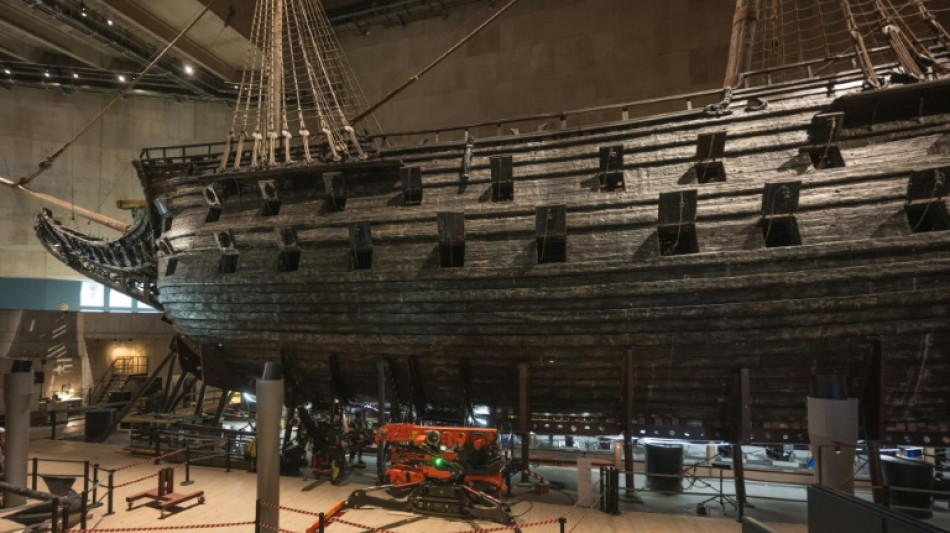
Race to save Sweden's 17th century warship in preservation project / Photo: Jonathan NACKSTRAND - AFP

 Where the US-China tariff row stands ahead of White House summit

 Indonesia cash-for-photos scheme turns animal hunters into protectors

 Argentine judge orders suspension of Falklands oil project

 US Fed raises rates to tackle 'too high' inflation, irking Trump

 Turkey releases 106 protesters, jails more LGBTQ activists

 Candidate for UN chief calls for AI regulation akin to nuclear weapons

 'We're losing control,' AI pioneer Yoshua Bengio tells AFP

 IR-MED and Dice Technologies Announce collaboration to Evaluate and Advance Pressure-Injury Prevention Platform in Japan

 Watts, Pitt, Cruz to light up Spain's top film festival

 Toogood Gold's Table Mountain Sits in the Shadow of a Nevada Gold Rush

 MEXC July–August Security Report: 38.66M USDT in Risk Funds Intercepted, Futures Insurance Fund Hits 792M USDT

 Emporio Armani names Dario Vitale new creative director

 EU to ban social media for under 13s, curb access until 15

 Wildfires push endangered Sumatran elephants to brink: Indonesian NGO

 Bank of Japan set to raise rates under pressure from inflation, US

 EU chief to unveil social media, gaming curbs for under-15s

 'Resident Evil' film brings video game's ethos to the big screen

 GA-ASI Mojave First UAS To Complete Battlefield Short Field Ops

 Sanders, Bannon warn of AI dangers in rare US left-right alignment

 Empty benches as schools reopen in Venezuela's quake-hit Guaira

 Tiny English village holds 'independence' vote over asylum seeker housing

 US Treasury chief says to meet Chinese counterpart at weekend

 BingX Evolves into a Multi-Asset Trading Platform, Connecting Users to Global Opportunities

 International Trading Institute Expands Professional Trader Development Beyond the Master’s in Trading

 Lake Energy Secures $80 Million for U.S. Renewable Energy Expansion

A Swedish museum has launched a massive four-year project to preserve the sagging hull of the Vasa, a majestic warship that sank nearly 400 years ago and is now one of Sweden's most popular tourist attractions.
Experts have begun putting in place a complex metal structure to support the hull, which more than 60 years after its salvage has begun to sag in the Stockholm museum custom-built for it.
"Today we put in a part of the new support structure, one cradle, and it's needed because the ship needs better support, because the old one from 1961 doesn't cut it anymore," said project leader Peter Rydebjork, showing off the new structure around the 17th century warship.
Due for completion in 2028, in time to mark the 400th anniversary of the shipwreck, the cost of the project is estimated at up to 17.7 million euros ($19.5 million).
Originally intended to sail to the southern Baltic, the three-masted Vasa -- a symbol of a rising Swedish kingdom -- sank only a few hundred metres into its maiden voyage in 1628.
After just fifteen minutes at sea, it capsized and sank in Stockholm's harbour due to a design flaw. The incident claimed the lives of several dozen crewmembers.
Well-preserved in the cold mud and low-salinity waters of the Baltic for more than three centuries, the Vasa was brought to the surface in 1961 after a delicate salvage operation.
Since then, the ship, which is largely intact, has been exhibited at the popular Vasa Museum.
But preserving the wreck is complex: the wood has shrunk over the years and the hull is sagging due to gravity.
It is also listing to one side.
Rydebjork said the old support structure "doesn't really do the work that it should be doing, because the Vasa needs to be supported in the right places."
"The new support structure will actually support the ship where it's strongest on the inside," he added.
The first phase of the project involves stabilising the exterior of the wreck, while a second phase will stabilise the interior.
A third and final phase will right the ship so it no longer lists.
M.Anderson--CPN
