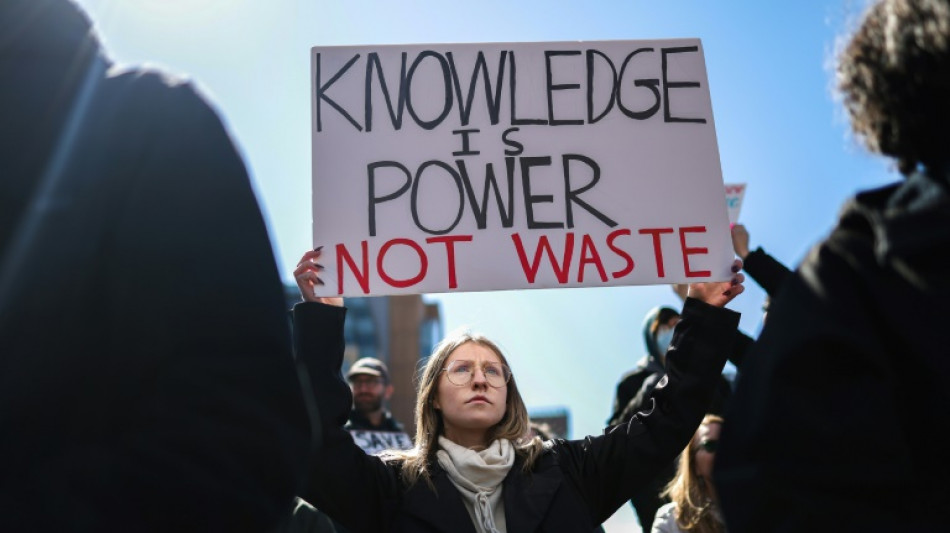
'Major brain drain': Researchers eye exit from Trump's America / Photo: CHARLY TRIBALLEAU - AFP

 Where the US-China tariff row stands ahead of White House summit

 Indonesia cash-for-photos scheme turns animal hunters into protectors

 Argentine judge orders suspension of Falklands oil project

 US Fed raises rates to tackle 'too high' inflation, irking Trump

 Turkey releases 106 protesters, jails more LGBTQ activists

 Candidate for UN chief calls for AI regulation akin to nuclear weapons

 'We're losing control,' AI pioneer Yoshua Bengio tells AFP

 IR-MED and Dice Technologies Announce collaboration to Evaluate and Advance Pressure-Injury Prevention Platform in Japan

 Watts, Pitt, Cruz to light up Spain's top film festival

 Toogood Gold's Table Mountain Sits in the Shadow of a Nevada Gold Rush

 MEXC July–August Security Report: 38.66M USDT in Risk Funds Intercepted, Futures Insurance Fund Hits 792M USDT

 Emporio Armani names Dario Vitale new creative director

 EU to ban social media for under 13s, curb access until 15

 Wildfires push endangered Sumatran elephants to brink: Indonesian NGO

 Bank of Japan set to raise rates under pressure from inflation, US

 EU chief to unveil social media, gaming curbs for under-15s

 'Resident Evil' film brings video game's ethos to the big screen

 GA-ASI Mojave First UAS To Complete Battlefield Short Field Ops

 Sanders, Bannon warn of AI dangers in rare US left-right alignment

 Empty benches as schools reopen in Venezuela's quake-hit Guaira

 Tiny English village holds 'independence' vote over asylum seeker housing

 US Treasury chief says to meet Chinese counterpart at weekend

 BingX Evolves into a Multi-Asset Trading Platform, Connecting Users to Global Opportunities

 International Trading Institute Expands Professional Trader Development Beyond the Master’s in Trading

 Lake Energy Secures $80 Million for U.S. Renewable Energy Expansion

In the halls of US universities and research labs, one question has become increasingly common as President Donald Trump tightens his grip on the field: whether to move abroad.
"Everybody is talking about it," JP Flores, a doctoral student in genetics at the University of North Carolina, told AFP.
The discussion was thrust into the spotlight after Yale philosophy professor Jason Stanley, a specialist in fascism, announced he was taking a new post in Canada over the Trump administration's "authoritarian" bent.
"I made the decision when Columbia folded," he told CBS News. "I made it in a split second."
Columbia University, which the Trump administration has threatened with major funding cuts, said it agreed to take steps to rein in pro-Palestinian protests, among other actions.
"It is not the time to cower and fear," said Stanley, who added there was "absolutely no doubt that the United States is an authoritarian country."
With similar threats lodged by Trump against other universities, many researchers are worried about the future of academic freedom in the United States.
Coupled with the administration's broad cuts to federal funding, some fear the country's research field, once viewed as the envy of the world, may be losing its luster.
More than 75 percent of scientists are now considering departing the country over Trump's policies, according to a survey of over 1,600 people published in late March by the journal Nature.
"The trend was particularly pronounced among early-career researchers," the journal said.
- 'Surreal' -
"People are just so scared," Daniella Fodera, a Columbia PhD student whose research grant was cancelled, told AFP.
Amid the uncertainty, several academic institutions in recent weeks have announced a hiring freeze and a reduction in the number of graduate student positions.
"That's definitely messing up the academic pipeline," said Fodera, a biomechanics student.
Karen Sfanos, head of a research lab at Johns Hopkins University, said: "It's kind of a surreal time for scientists because we just don't know what's going to happen with funding."
"There's not a lot of clarity, and things are changing day by day," she said, noting it is hitting the "youngest generation" relatively hard.
Fodera, who studies uterine fibroids -- benign tumors affecting many women -- said she has begun to "actively look at positions in Europe and abroad for continuing my post-doctoral training."
- 'Generational loss' -
With mounting concerns among US researchers, several European and Canadian universities have launched initiatives to attract some of the talent, though they may not need to try too hard.
"I know researchers already that have dual citizenship, or who have family in Canada, in France, in Germany, are saying, 'I think I'm going to go live in Germany for the next, you know, five years and do research there,'" said Gwen Nichols.
The physician, a senior leader at a blood cancer research group, warned the possible exodus could make the United States "lose our dominance as the biopharmaceutical innovation leader of the world."
"We'll see the problem 10 years from now, when we don't have the innovation we need," she added.
Genetics researcher Flores agreed, saying "it has become quite clear that there's gonna be a major brain drain here in American research."
One young climate researcher, who requested to remain anonymous, said she had started the process of attaining EU citizenship and that colleagues in Europe "have all been extremely sympathetic to the situation."
But she noted that those with limited resources, like many recent graduates, would be the least likely to be taken on by European institutions and may decide to drop out of science altogether.
"This is a generational loss for science across all disciplines," she warned.
H.Müller--CPN
