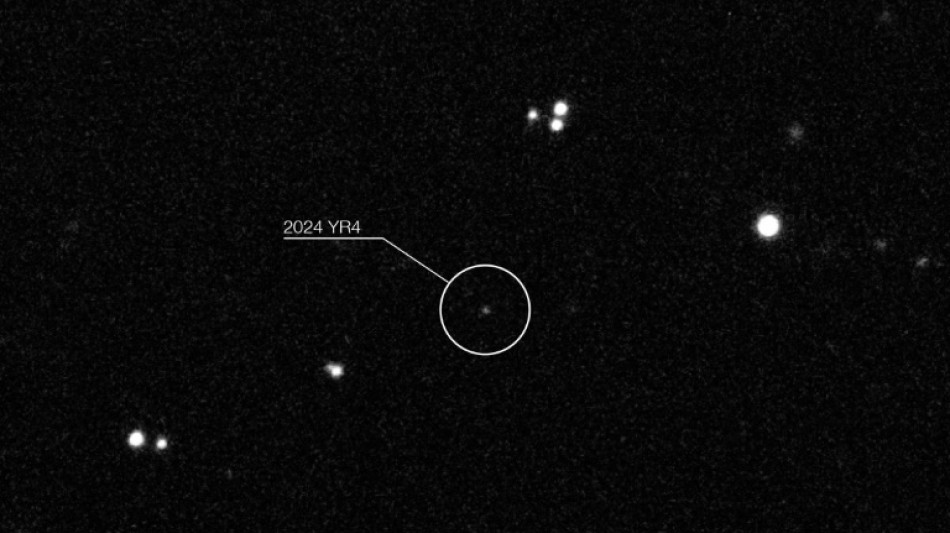
Rising odds asteroid that briefly threatened Earth will hit Moon / Photo: Handout - European Southern Observatory/AFP/File

 NASA scan discovers new, 'once in a century' Moon crater

 Most stocks rise as Fed hikes and indicates drive to curb inflation

 UK-Sudanese author pens book to give children 'African history of Africa'

 US Congress passes sweeping Russia sanctions bill

 US stocks fall, dollar gains after Fed lifts interest rates

 US Fed raises rates to tackle 'too high' inflation in move sure to rile Trump

 US Fed raises rates to battle inflation in move likely to rile Trump

 US House faces test on sweeping Russia sanctions bill

 British PM says to make 'difficult decisions' as inflation rises

 Global fuel price demos: a round-up

 Leverate Launches MCP for Traders to Connect AI Assistants With Trading Platforms

 MEXC Launches $1M "Discover Your Wall Street DNA" Campaign to Help Traders Find Their Market Fit

 Stocks edge higher ahead of US Fed rate call

 BASIS.pro Expands On-Chain Infrastructure with XDC Network Partnership and Zypher DAO as Auto Earn Goes Live

 Pickle-flavoured tart? AI inspires Japan's convenience stores

 EU chief hosts Canada's Carney in push to 'deepen' alliance

 Meta chief pushes back on AI slowdown calls

 US Fed to deliver rate decision with markets betting on hike

 i-payout Expands U.S. Money Transmitter Licensing Footprint and Advances European EMI Strategy

 US Senate crypto bill collapses amid partisan deadlock

 OpenAI, Anthropic and Google are working to create an AI standards body

 Protesting shepherds, farmers clash with Romanian police

 Foundation Lets Ledger Users Switch to Open Source Without Starting Over

 EU to propose curbing social media, online games for under 15s

 FX Junction Reaches 40,600 Members and 26 Million Trades

An huge asteroid that was briefly feared to strike Earth now has a nearly four percent chance of smashing into the Moon, according to new data from the James Webb Space Telescope.
The asteroid, thought to be capable of levelling a city, set a new record in February for having the highest chance -- 3.1 percent -- of hitting our home planet than scientists have ever measured.
Earth's planetary defence community leapt into action and further observations quickly ruled out that the asteroid -- called 2024 YR4 -- will strike Earth on December 22, 2032.
But the odds that it will instead crash into Earth's satellite have been steadily rising.
After the Webb telescope turned its powerful gaze towards the asteroid last month, the chance of a Moon shot is now at 3.8 percent, NASA said.
"There is still a 96.2 percent chance that the asteroid will miss the Moon," NASA said in a statement on Thursday.
Richard Moissl, head of the European Space Agency's planetary defence office, told AFP that this aligned with their internal estimates of around four percent.
The new Webb data also shed light on the size of the space rock, which was previously estimated to be between 40 and 90 metres (131 to 295 feet).
It is now believed to be 53 to 67 metres, roughly the height of a 15-storey building.
This is significant because it is bigger than the 50-metre threshold for activating planetary defence plans.
If the asteroid still had a more than one percent chance of hitting Earth, "the development of one or more deflection missions would already be starting now", Moissl said.
There are a range of ideas for how Earth could fend off an oncoming asteroid, including nuclear weapons and lasers.
But only one has been tested on an actual asteroid. In 2022, NASA's DART mission successfully altered a harmless asteroid's trajectory by smashing a spacecraft into it.
- 'Perfect opportunity' -
While no one wanted to need to test Earth's defences on the potentially hugely destructive asteroid 2024 YR4, many scientists are hoping it will strike the Moon.
"The possibility of getting a chance for an observation of a sizeable Moon impact is indeed an interesting scenario from a scientific point of view," Moissl said.
It could offer up a range of information that would be "valuable for planetary defence purposes," he added.
Mark Burchell, a space scientist at the UK's University of Kent, told New Scientist that a Moon hit would be "a great experiment and a perfect opportunity".
And on Earth, "telescopes would certainly see it, I would say, and binoculars might see it," he added.
The asteroid is the smallest object ever targeted by the Webb telescope.
Webb's measurements of the space rock's thermal data indicate that it "does not share properties observed in larger asteroids", the European Space agency said in a statement.
"This is likely a combination of its fast spin and lack of fine-grained sand on its surface," it said, adding that this was more common in fist-sized asteroids.
More information will come when Webb again observes the asteroid again next month.
O.Hansen--CPN