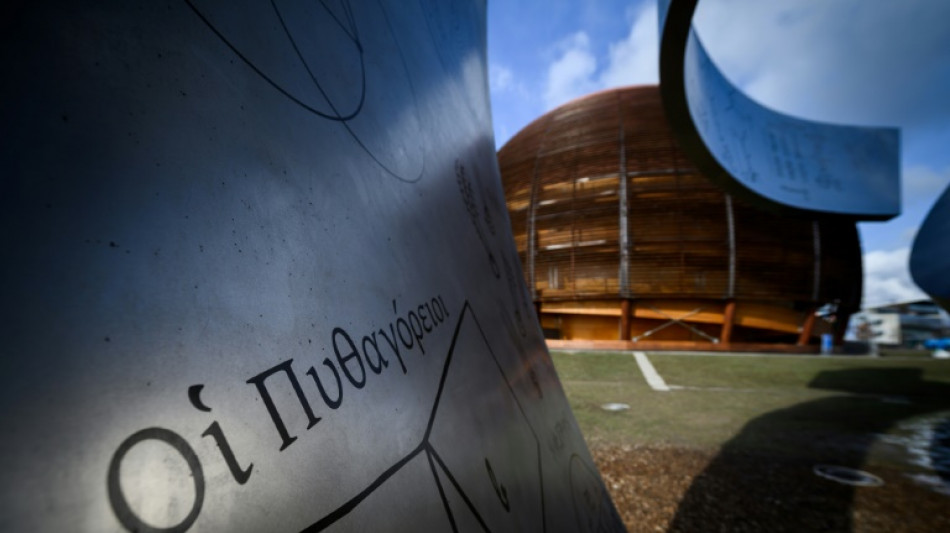
No technical obstacles to new giant particle collider in Europe: CERN / Photo: Fabrice COFFRINI - AFP/File

 NASA scan discovers new, 'once in a century' Moon crater

 Most stocks rise as Fed hikes and indicates drive to curb inflation

 UK-Sudanese author pens book to give children 'African history of Africa'

 US Congress passes sweeping Russia sanctions bill

 US stocks fall, dollar gains after Fed lifts interest rates

 US Fed raises rates to tackle 'too high' inflation in move sure to rile Trump

 US Fed raises rates to battle inflation in move likely to rile Trump

 US House faces test on sweeping Russia sanctions bill

 British PM says to make 'difficult decisions' as inflation rises

 Global fuel price demos: a round-up

 Leverate Launches MCP for Traders to Connect AI Assistants With Trading Platforms

 MEXC Launches $1M "Discover Your Wall Street DNA" Campaign to Help Traders Find Their Market Fit

 Stocks edge higher ahead of US Fed rate call

 BASIS.pro Expands On-Chain Infrastructure with XDC Network Partnership and Zypher DAO as Auto Earn Goes Live

 Pickle-flavoured tart? AI inspires Japan's convenience stores

 EU chief hosts Canada's Carney in push to 'deepen' alliance

 Meta chief pushes back on AI slowdown calls

 US Fed to deliver rate decision with markets betting on hike

 i-payout Expands U.S. Money Transmitter Licensing Footprint and Advances European EMI Strategy

 US Senate crypto bill collapses amid partisan deadlock

 OpenAI, Anthropic and Google are working to create an AI standards body

 Protesting shepherds, farmers clash with Romanian police

 Foundation Lets Ledger Users Switch to Open Source Without Starting Over

 EU to propose curbing social media, online games for under 15s

 FX Junction Reaches 40,600 Members and 26 Million Trades

Europe's CERN laboratory said on Monday that a detailed analysis revealed no technical obstacles to building the world's biggest particle collider, even as critics took issue with the "pharaonic" $17-billion project.
The Future Circular Collider (FCC) project is essential for ensuring that Europe maintains its global leadership in fundamental physics, CERN chief Fabiola Gianotti told AFP.
"There is real competition" from China in particular, she cautioned, hailing that the giant FCC "project is absolutely on the good track" and urging states to release the funding needed to move forward.
After analysing around 100 different scenarios, CERN on Monday published the results of a years-long feasibility study for its preferred option: a nearly 91-kilometre (56-mile) circular tunnel straddling the French-Swiss border.
With an average depth of 200 metres (660 feet), the tunnel would accommodate a particle accelerator that would be more than three times the length of CERN's existing Large Hadron Collider, currently the largest of its kind.
The LHC -- a 27-kilometre proton-smashing ring running about 100 metres below ground -- has among other things been used to prove the existence of the Higgs boson.
Dubbed the God particle, the Nobel Prize-winning discovery broadened science's understanding of how particles acquire mass.
- 'Rich in possibilities' -
With LHC expected to have fully run its course by 2041, CERN has been analysing options to allow scientists to keep pushing the envelope.
Gianotti hailed the success of the feasibility study, stressing that "we have found no technical showstopper so far".
Others were similarly enthusiastic about the FCC.
"To make major progress in its quest to understand the origin of the universe and the role the Higgs boson plays... the global scientific community needs a machine as powerful and rich in possibilities as the FCC," Catherine Biscarat of the L2IT lab at Toulouse University told AFP.
But not everyone is thrilled with the idea of the giant project, which has been estimated to cost 15 billion Swiss francs ($16.9 billion).
CERN's member states -- 23 European countries and Israel -- need to decide by 2028 whether to release the funds needed.
But Germany, CERN's largest contributor, last year voiced reservations about the towering sums required.
CERN spokesman Arnaud Marsollier tried to allay those concerns, insisting that up to 80 percent of the FCC's cost "could be covered by the organisation's budget".
- 'Like David and Goliath' -
Some locals are meanwhile up in arms about the project and the impact it could have on their lives and livelihoods.
Thierry Perrillat, a dairy farmer in Roche-sure-Foron in France, maintained that the planned collider would swallow "five hectares of our farm".
"It's like David and Goliath," he said bitterly.
The project has also sparked disagreement among scientists.
"The financial, ecological, and operating costs are astronomical," physicist Olivier Cepas of the Neel Institute at the University of Grenoble told AFP.
"It would be better to fund smaller scientific projects," he insisted.
FCC project engineer Jean-Paul Burnet meanwhile insisted that the FCC plans had been "improved to reduce its environmental impact", by for instance lowering the number of wells and surface sites.
But environmental groups in the region were not convinced.
In a report, the environmental association Noe21 slammed the "excessive" FCC project, pointing to its "astronomical electricity consumption", its climate impact, its cost and scale.
- 'Stunned' -
Franco-Swiss collective CO-CERNes, which includes the WWF and Greenpeace, has been organising information sessions in nearby communities.
At a recent such session in Marcellaz, located near one of the eight planned FCC surface sites, organiser Thierry Lemmel told AFP the group was providing information about this "pharaonic project".
"Progress is necessary," he said.
But, he asked, given the state of the planet today, "should we really be mobilising so many resources, so much wealth ... for this project, with uncertain results?".
Among the around 100 people who attended the Marcellaz meeting was Kevin Mugnier, who had only just heard of the FCC project.
"I was a bit stunned," he said, worried his land might be requisitioned.
In Ferney-Voltaire, at one of the seven surface sites planned on the French side, mayor Daniel Raphoz said he favoured the "win-win" project, which he maintained would have positive effects on employment and energy.
"CERN's overflow energy will be used to heat the town," he said.
If the FCC is not built here, progress would move elsewhere, he warned.
"It will be happening in China, (marking) European decline."
apo-burs/nl/sbk
O.Hansen--CPN