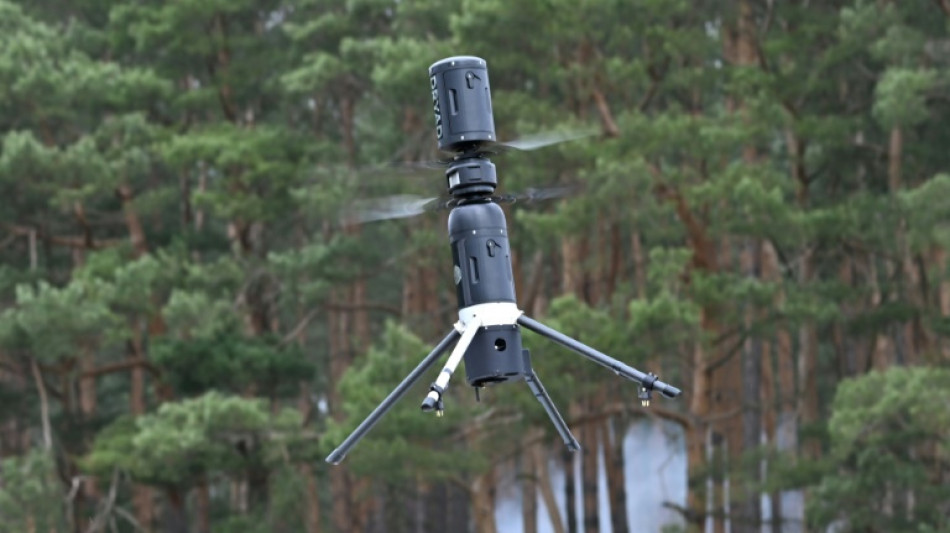
AI-powered drones track down fires in German forests / Photo: RALF HIRSCHBERGER - AFP/File

 NASA scan discovers new, 'once in a century' Moon crater

 Most stocks rise as Fed hikes and indicates drive to curb inflation

 UK-Sudanese author pens book to give children 'African history of Africa'

 US Congress passes sweeping Russia sanctions bill

 US stocks fall, dollar gains after Fed lifts interest rates

 US Fed raises rates to tackle 'too high' inflation in move sure to rile Trump

 US Fed raises rates to battle inflation in move likely to rile Trump

 US House faces test on sweeping Russia sanctions bill

 British PM says to make 'difficult decisions' as inflation rises

 Global fuel price demos: a round-up

 Leverate Launches MCP for Traders to Connect AI Assistants With Trading Platforms

 MEXC Launches $1M "Discover Your Wall Street DNA" Campaign to Help Traders Find Their Market Fit

 Stocks edge higher ahead of US Fed rate call

 BASIS.pro Expands On-Chain Infrastructure with XDC Network Partnership and Zypher DAO as Auto Earn Goes Live

 Pickle-flavoured tart? AI inspires Japan's convenience stores

 EU chief hosts Canada's Carney in push to 'deepen' alliance

 Meta chief pushes back on AI slowdown calls

 US Fed to deliver rate decision with markets betting on hike

 i-payout Expands U.S. Money Transmitter Licensing Footprint and Advances European EMI Strategy

 US Senate crypto bill collapses amid partisan deadlock

 OpenAI, Anthropic and Google are working to create an AI standards body

 Protesting shepherds, farmers clash with Romanian police

 Foundation Lets Ledger Users Switch to Open Source Without Starting Over

 EU to propose curbing social media, online games for under 15s

 FX Junction Reaches 40,600 Members and 26 Million Trades

Inside a green orb planted in the German countryside is a high-tech aid to prevent wildfires that have grown more common and destructive with rising global temperatures.
The installation, resembling a giant golf ball covered in solar panels, is the hangar for an AI-powered drone that its developer hopes one day will be able to sniff out and extinguish new blazes in minutes.
"Fires are spreading much faster and more aggressively than in the past. That also means we have to react more quickly," Carsten Brinkschulte, the CEO of the German firm Dryad, told AFP at a demonstration of the technology outside Berlin.
Once a rarity, the German capital has to get used to more wildfires. Flames ripped through a forest on the city's western edge in the midst of a 2022 heatwave that saw several wildfires spring up in Germany.
The sort of tinderbox conditions which promote blazes -- where heat, drought and strong winds dry out the landscape -- have increased with climate change.
Wildfires have reached the point where they were "basically unstoppable", said Lindon Pronto, senior wildfire management expert at the European Forest Institute.
That is why action is needed to develop tools to "address fire in the prevention phase, during the operational phase, and also post-fire", said Pronto.
- 'Prevent a disaster' -
Dryad is in the running with 29 other teams from around the globe for a multi-million-dollar prize to develop the ability to autonomously put out fires within 10 minutes.
During Dryad's demonstration on Thursday -- the first for a computer-steered wildfire detection drone according to the company -- chemicals in smoke from burning wood were picked up by sensors distributed in the forest.
The signal was relayed back to the company's platform which released the drone from the orb. The unit rose above the trees, charting a zig-zag course to track down the precise location and extent of the fire.
Firefighters using the information collected by the drone would be able "to respond much more efficiently and quickly and prevent a disaster", Brinkschulte said.
Dryad eventually hopes to have the drone descend below the canopy and put out the fire using a novel technology: a "sonic cannon" blasting low-frequency sound waves at the right pressure to suppress small fires.
An experimental acoustic suppression method, if it can be realised, would save the drone from carrying "large amounts of heavy water", making the unit more nimble and effective, according to Brinkschulte.
- 'Civilisation meets nature' -
Technologies like Dryad's are a step towards putting out fires "without putting people's lives in danger", said Pronto, a native of California, where recent wildfires have had a devastating impact.
Huge blazes in Los Angeles in January killed 29 people, razed more than 10,000 homes and caused some $250 billion (231 billion euros) in damage, according to estimates by the private meteorological firm AccuWeather.
The greatest benefits of an autonomous fire prevention system would be in areas where "civilisation meets nature", Brinkschulte said.
Such crossover zones are the most vulnerable to man-made wildfires and "where the risk to life and limb is naturally highest".
The company hopes to bring the drone to market in 2026, with the first deployment likely to be outside Europe.
"These systems still need to have the regulatory framework to be able to operate commercially," Brinkschulte said, adding that Dryad was aiming for deployment in Europe in the "coming years"
A couple of kinks need to be worked out before then, however. The first attempt to respond to the dummy fire on Thursday was held up by a faulty GPS signal.
Y.Ibrahim--CPN