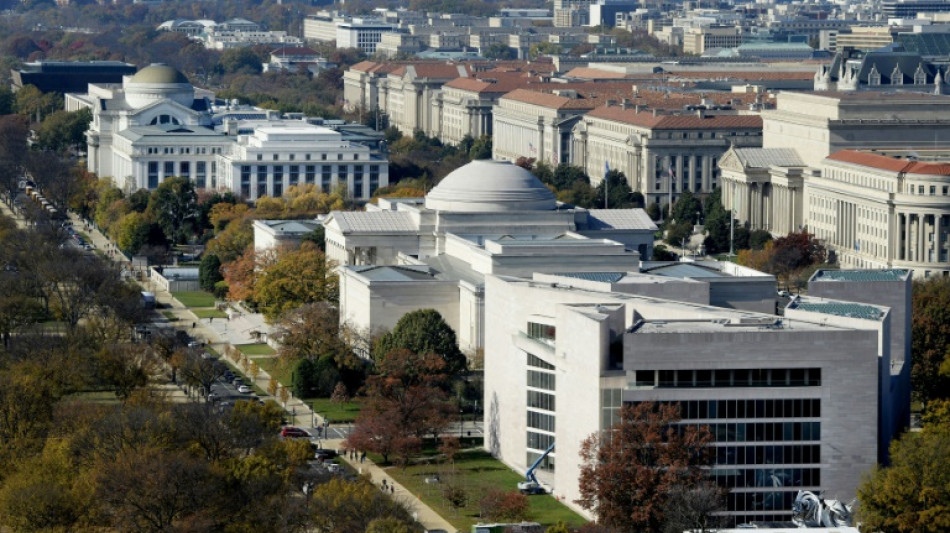
Performance, museums, history: Trump's cultural power grab / Photo: POOL - GETTY IMAGES NORTH AMERICA/AFP/File

 NASA scan discovers new, 'once in a century' Moon crater

 Most stocks rise as Fed hikes and indicates drive to curb inflation

 UK-Sudanese author pens book to give children 'African history of Africa'

 US Congress passes sweeping Russia sanctions bill

 US stocks fall, dollar gains after Fed lifts interest rates

 US Fed raises rates to tackle 'too high' inflation in move sure to rile Trump

 US Fed raises rates to battle inflation in move likely to rile Trump

 US House faces test on sweeping Russia sanctions bill

 British PM says to make 'difficult decisions' as inflation rises

 Global fuel price demos: a round-up

 Leverate Launches MCP for Traders to Connect AI Assistants With Trading Platforms

 MEXC Launches $1M "Discover Your Wall Street DNA" Campaign to Help Traders Find Their Market Fit

 Stocks edge higher ahead of US Fed rate call

 BASIS.pro Expands On-Chain Infrastructure with XDC Network Partnership and Zypher DAO as Auto Earn Goes Live

 Pickle-flavoured tart? AI inspires Japan's convenience stores

 EU chief hosts Canada's Carney in push to 'deepen' alliance

 Meta chief pushes back on AI slowdown calls

 US Fed to deliver rate decision with markets betting on hike

 i-payout Expands U.S. Money Transmitter Licensing Footprint and Advances European EMI Strategy

 US Senate crypto bill collapses amid partisan deadlock

 OpenAI, Anthropic and Google are working to create an AI standards body

 Protesting shepherds, farmers clash with Romanian police

 Foundation Lets Ledger Users Switch to Open Source Without Starting Over

 EU to propose curbing social media, online games for under 15s

 FX Junction Reaches 40,600 Members and 26 Million Trades

Washington's Smithsonian is a sprawling chain of museums dedicated to both celebrating and scrutinizing the American story -- and the latest cultural institution targeted by President Donald Trump's bid to quash diversity efforts.
His recent executive order to excavate "divisive ideology" from the famed visitor attraction and research complex follows a wave of efforts to keep culture and history defined on his terms, including his takeover of the national capital's prestigious performing arts venue, the Kennedy Center.
And it's got critics up in arms.
"It's a declaration of war," said David Blight of Yale University, who leads the Organization of American Historians.
"It is arrogant and appalling for them to claim they have the power and the right to say what history actually is and how it should be exhibited, written, and taught," Blight told AFP.
Trump's latest order also says monuments to the historic Confederate rebellion, many of which were removed in recent years in the wake of anti-racism protests, might soon be restored.
His order even mentioned the National Zoo -- which is operated by the Smithsonian and recently welcomed two pandas from China -- as potentially needing a cleanse from "improper, divisive, or anti-American ideology."
And Trump says a number of Smithsonian museums, including the distinguished National Museum of African American History and Culture, espouse "corrosive ideology," and are trying to rewrite American history in relation to issues of race and gender.
Critical observers say the exact opposite is true.
Margaret Huang -- president of the nonprofit Southern Poverty Law Center, which tracks hate -- called Trump's order "the latest attempt to erase our history" and "a blatant attempt to mask racism and white supremacy as patriotism."
"Black history is US history. Women's history is US history. This country's history is ugly and beautiful," Huang said.
For critics like Huang and Blight, Trump's push to tell a rose-tinted history of "American greatness" is a disservice to museum-goers in a complicated country built on values including freedom of speech -- but whose history is rife with war, slavery and civil rights struggles.
"What's at stake is the way the United States officially portrays its own past, to itself, and to the world," Blight said.
- 'Stories about ourselves' -
Trump is a 78-year-old Frank Sinatra fan with a penchant for Broadway -- he's spoken particularly fondly of the 1980s-era musical "Cats," the fantastical tale of a dancing tribe of felines.
But his brand of culture war is much bigger than personal taste: in his second term, the president appears intent on rooting out what he deems too "woke."
The executive crusade is part of a broader effort to strip American society of efforts to promote diversity, equity and inclusion that institutions nationwide have vied to incorporate in recent years, purging culture of anti-racism and LGBTQ+ support.
Critics say Trump's extension of his grip to the Smithsonian represents an eyebrow-raising incursion into the programming independence of the more than 175-year-old institution.
Founded in the mid-19th century, the Smithsonian "has transformed along with our culture and our society," said Robert McCoy, a history professor at Washington State University.
The complex -- including the zoo, 21 museums and 14 education and research centers -- is approximately two-thirds federally funded, with the rest of its approximately billion-dollar-budget stemming from sources including endowments, memberships and donations.
Its Board of Regents includes the vice president. But, similarly to the Kennedy Center, until now it operated largely above political lines, especially when it came to programming.
- 'Meaning and belonging' -
"It's become more diverse. The stories it tells are more complicated. These are people who are attempting to help us broaden what it means to be an American -- what it means to tell us stories about ourselves that are more accurate and include more people," McCoy told AFP.
"When you lose that, you begin to marginalize a lot of different groups."
McCoy fears the White House's bid to clamp down on the Smithsonian's work could prompt resignations, a concern Blight echoed: "If they stay in their jobs, they're in effect working for an authoritarian takeover of what they do. That will not be acceptable."
Trump's attempts at cultural dominance in federal institutions are part of a broader package of control, McCoy said, a pattern that echoes research on how authoritarian regimes seize power.
"It's not just political and economic institutions," he said. "It's also the institutions that provide people with a sense of meaning and belonging -- that they're American."
M.Mendoza--CPN