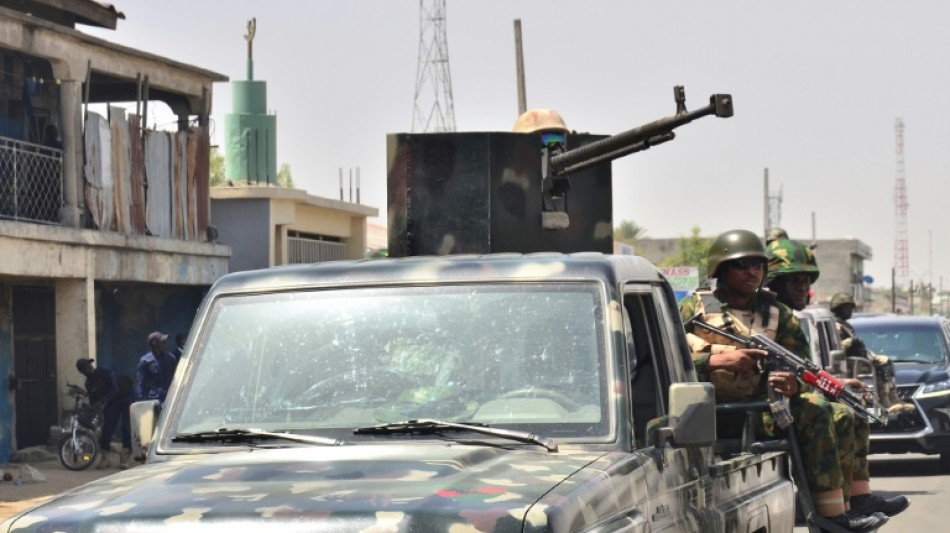
Nigeria, Sahel militants embrace DIY drone warfare / Photo: Audu MARTE - AFP

 NASA scan discovers new, 'once in a century' Moon crater

 Most stocks rise as Fed hikes and indicates drive to curb inflation

 UK-Sudanese author pens book to give children 'African history of Africa'

 US Congress passes sweeping Russia sanctions bill

 US stocks fall, dollar gains after Fed lifts interest rates

 US Fed raises rates to tackle 'too high' inflation in move sure to rile Trump

 US Fed raises rates to battle inflation in move likely to rile Trump

 US House faces test on sweeping Russia sanctions bill

 British PM says to make 'difficult decisions' as inflation rises

 Global fuel price demos: a round-up

 Leverate Launches MCP for Traders to Connect AI Assistants With Trading Platforms

 MEXC Launches $1M "Discover Your Wall Street DNA" Campaign to Help Traders Find Their Market Fit

 Stocks edge higher ahead of US Fed rate call

 BASIS.pro Expands On-Chain Infrastructure with XDC Network Partnership and Zypher DAO as Auto Earn Goes Live

 Pickle-flavoured tart? AI inspires Japan's convenience stores

 EU chief hosts Canada's Carney in push to 'deepen' alliance

 Meta chief pushes back on AI slowdown calls

 US Fed to deliver rate decision with markets betting on hike

 i-payout Expands U.S. Money Transmitter Licensing Footprint and Advances European EMI Strategy

 US Senate crypto bill collapses amid partisan deadlock

 OpenAI, Anthropic and Google are working to create an AI standards body

 Protesting shepherds, farmers clash with Romanian police

 Foundation Lets Ledger Users Switch to Open Source Without Starting Over

 EU to propose curbing social media, online games for under 15s

 FX Junction Reaches 40,600 Members and 26 Million Trades

Under the cover of darkness, the jihadists moved into Wulgo, where the shores of Lake Chad meet the arid countryside of northern Nigeria.
Around 1:00 am, a "barrage" of rocket-propelled grenades was fired, sending Cameroonian troops, stationed there as part of an anti-jihadist coalition, into "disarray", a security source told AFP.
While the militants had disguised themselves in a nearby town as herders coming into the weekly market, they also might have had another advantage, according to an intelligence report seen by AFP: the use of armed drones.
The Tuesday morning attack, which sources said killed 25 Cameroonian troops in one of the region's deadliest incidents in recent months, comes as armed groups in west Africa turn towards the use of cheap, recreational drones -- modified into deadly, explosives-laden killers from above.
Armed groups in Nigeria and the Sahel have long used drones for surveillance and filming propaganda, but a shift is under way as jihadists and separatists kit them out for attacks.
"It's an available, at-reach technology, and it's easier and easier to use, and it's cheaper and cheaper," Wassim Nasr, researcher at the Soufan Center and journalist at France24, said. "It was only a matter of time before it arrived into the Sahel region and Nigeria."
In a major three-day battle in Mali in July, Tuareg separatists used drones against Russian paramilitary and Malian armed forces, analysts observed. In February, the rebels said they used a drone to down an army helicopter, though the military disputed the incident.
Meanwhile, jihadist groups in Mali and Burkina Faso have claimed to use drones equipped to drop grenades from above, as well as explosive-laden "suicide drones" that crash into targets, according to conflict analysis group WAMAPS.
Late last year, a drone attack wounded five soldiers at Nigeria's Wajirko base, in the northeast, battered from years of insurgency from Boko Haram and Islamic State West Africa Province (ISWAP) fighters.
In January, soldiers at another base shot down drones hovering above them.
The South Africa-based Institute for Security Studies recently warned that "use of armed drones in battlefield operations is a dangerous new phase in ISWAP's insurgency".
In a sign of the military's own caution, drones were banned in northeast Nigeria in December.
- 'Spreading around the Sahel' -
Charlie Werb, an analyst with Alert:24, a risk consultancy, said over the past year he had noticed an increase in claims and reports of jihadists in the Sahel using drones, with a noted uptick since January.
"It's a pretty stark contrast," he told AFP.
"Every week or month this year, I've seen evidence of these drones spreading around the Sahel," he said, though he added that their use had been inconsistent and at times "rudimentary".
Nasr warned against drones being labelled a "game changer", adding that having a drone available "does not mean it will be properly used".
The continued reluctance of some jihadist groups to modify their surveillance drones for attack purposes, he added, suggests that drones are still relatively difficult to come by in the region, even as globalisation has eased their spread.
- Shifting skies -
For those on the receiving end, however, the drones have become a deadly addition to the militants' arsenals.
"The destruction on the base is massive. It is completely burnt along with military vehicles," said Muhammad Sani Umar, a nearby resident who visited the site of the Wulgo attack.
The incident was claimed by the Islamic State group, though local sources suggested Boko Haram might have been responsible based on their observations of the suspected militants.
The Nigerian military did not respond to requests for comment. The Cameroonian military said 12 of its soldiers were killed.
The use of drones by jihadists and separatists also heralds a shift in the air dominance by regional militaries -- which was itself marked by hundreds of civilian deaths at the hand of military-grade UAVs, notably in Mali, Burkina Faso and Nigeria.
As the skies above shift, Burkina junta leader Ibrahim Traore has been spotted at public events with a security detail that includes soldiers with anti-drone equipment, Werb noted.
But deficits remain: Major General Godwin Mutkut, who heads a multi-national coalition fighting jihadists in the Lake Chad region, noted at a coalition gathering in January that there was a general lack of anti-drone equipment among member countries.
That could pose problems if militants in the region -- largely confined to the countryside in recent years -- make renewed attempts to push into cities, where drones would potentially be "a core component... to changing their level of threat," Werb said.
D.Goldberg--CPN