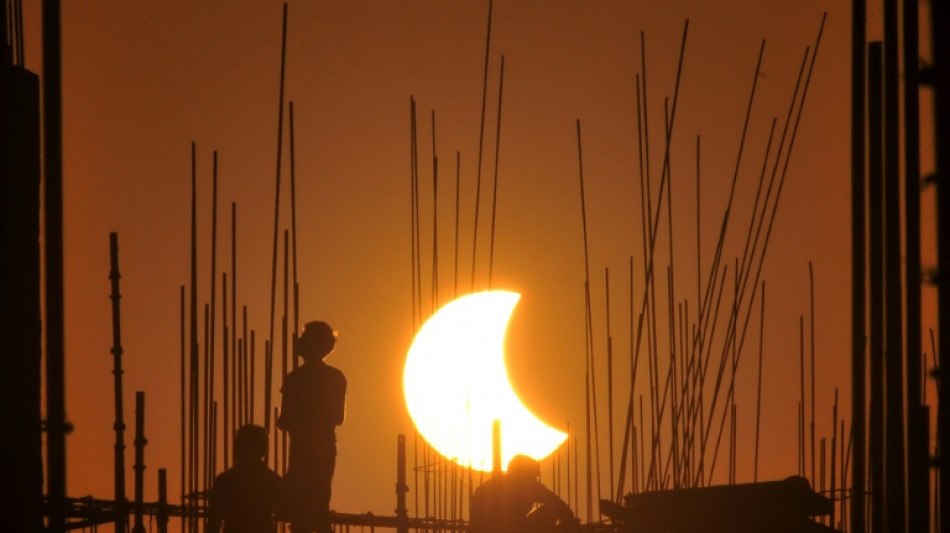
Partial solar eclipse in northern areas on Saturday / Photo: Vinay GUPTA - AFP/File

 NASA scan discovers new, 'once in a century' Moon crater

 Most stocks rise as Fed hikes and indicates drive to curb inflation

 UK-Sudanese author pens book to give children 'African history of Africa'

 US Congress passes sweeping Russia sanctions bill

 US stocks fall, dollar gains after Fed lifts interest rates

 US Fed raises rates to tackle 'too high' inflation in move sure to rile Trump

 US Fed raises rates to battle inflation in move likely to rile Trump

 US House faces test on sweeping Russia sanctions bill

 British PM says to make 'difficult decisions' as inflation rises

 Global fuel price demos: a round-up

 Leverate Launches MCP for Traders to Connect AI Assistants With Trading Platforms

 MEXC Launches $1M "Discover Your Wall Street DNA" Campaign to Help Traders Find Their Market Fit

 Stocks edge higher ahead of US Fed rate call

 BASIS.pro Expands On-Chain Infrastructure with XDC Network Partnership and Zypher DAO as Auto Earn Goes Live

 Pickle-flavoured tart? AI inspires Japan's convenience stores

 EU chief hosts Canada's Carney in push to 'deepen' alliance

 Meta chief pushes back on AI slowdown calls

 US Fed to deliver rate decision with markets betting on hike

 i-payout Expands U.S. Money Transmitter Licensing Footprint and Advances European EMI Strategy

 US Senate crypto bill collapses amid partisan deadlock

 OpenAI, Anthropic and Google are working to create an AI standards body

 Protesting shepherds, farmers clash with Romanian police

 Foundation Lets Ledger Users Switch to Open Source Without Starting Over

 EU to propose curbing social media, online games for under 15s

 FX Junction Reaches 40,600 Members and 26 Million Trades

The moon will cross in front of the Sun for around four hours on Saturday, creating a partial solar eclipse that careful skygazers will able to see in parts of the Northern Hemisphere.
The eclipse will stretch from eastern Canada to northern Russia, and potentially be visible in most of Europe and some areas of northeastern North America and northwest Africa, according to France's Paris Observatory.
The eclipse will begin at 0850 GMT on Saturday and end at 1243 GMT.
The relatively rare celestial event occurs when the Sun, Moon and Earth all line up. A total solar eclipse is when the moon totally blots out the Sun, creating an eerie twilight.
But this time, the Moon will cover at most 90 percent of the Sun in some northern latitudes, turning the Sun's rays into "cold light", Paris Observatory astronomer Florent Deleflie told AFP.
The maximum amount of eclipse will be visible in northeastern Canada and Greenland at 1047 GMT.
It will be less spectacular in other areas. In France, for example, between 10 to 30 percent of the Sun's disc will be obscured, depending on the region.
"The naked eye will not be able to see any difference," Deleflie said.
- Be careful -
People wanting to see the moon apparently take a bite out of the Sun will need to take precautions.
Looking straight at the Sun -- during an eclipse or otherwise -- can lead to irreversible vision loss.
"Using special glasses is one solution," Deleflie said.
However if the glasses are not new, even a slight defect or "microscopic hole" can cause eye damage, he warned, advising people to try observing an eclipse at a local astronomy observation centre.
There, "you can safely verify the precision of celestial mechanics and marvel at interesting details on the Sun's surface, such as sunspots", he said.
The partial eclipse will not turn up on a smartphone camera without a suitable filter, Deleflie added.
"The light is so intense that the obscured part won't appear."
The latest celestial show will come two weeks after skygazers across much of the world marvelled at a rare total lunar eclipse, dubbed a "Blood Moon".
Saturday's partial solar eclipse will be the first of the year, and the 17th of this century.
A bigger one is coming -- On August 12, 2026 a total solar eclipse will be visible in Iceland, northern Spain and a parts of Portugal.
More than 90 percent of the Sun will also be obscured in parts of Europe including Britain, France and Italy.
It will be the first total solar eclipse since one swept across North America in April 2024.
M.Davis--CPN