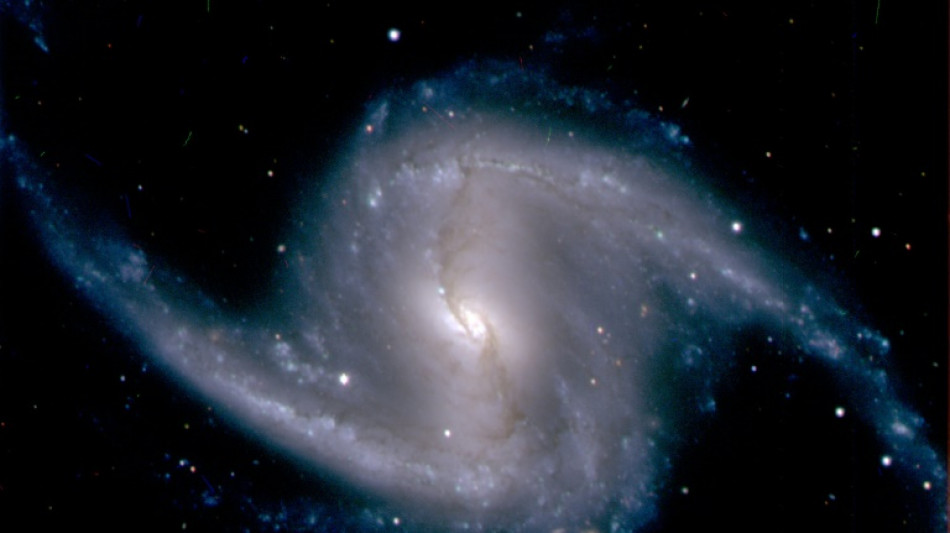
What is dark energy? One of science's great mysteries, explained / Photo: HO - FERMILAB/AFP/File

 NASA scan discovers new, 'once in a century' Moon crater

 Most stocks rise as Fed hikes and indicates drive to curb inflation

 UK-Sudanese author pens book to give children 'African history of Africa'

 US Congress passes sweeping Russia sanctions bill

 US stocks fall, dollar gains after Fed lifts interest rates

 US Fed raises rates to tackle 'too high' inflation in move sure to rile Trump

 US Fed raises rates to battle inflation in move likely to rile Trump

 US House faces test on sweeping Russia sanctions bill

 British PM says to make 'difficult decisions' as inflation rises

 Global fuel price demos: a round-up

 Leverate Launches MCP for Traders to Connect AI Assistants With Trading Platforms

 MEXC Launches $1M "Discover Your Wall Street DNA" Campaign to Help Traders Find Their Market Fit

 Stocks edge higher ahead of US Fed rate call

 BASIS.pro Expands On-Chain Infrastructure with XDC Network Partnership and Zypher DAO as Auto Earn Goes Live

 Pickle-flavoured tart? AI inspires Japan's convenience stores

 EU chief hosts Canada's Carney in push to 'deepen' alliance

 Meta chief pushes back on AI slowdown calls

 US Fed to deliver rate decision with markets betting on hike

 i-payout Expands U.S. Money Transmitter Licensing Footprint and Advances European EMI Strategy

 US Senate crypto bill collapses amid partisan deadlock

 OpenAI, Anthropic and Google are working to create an AI standards body

 Protesting shepherds, farmers clash with Romanian police

 Foundation Lets Ledger Users Switch to Open Source Without Starting Over

 EU to propose curbing social media, online games for under 15s

 FX Junction Reaches 40,600 Members and 26 Million Trades

Dark energy makes up roughly 70 percent of the universe, yet we know nothing about it.
Around 25 percent of the universe is the equally mysterious dark matter, leaving just five percent for everything that we can see and touch -- matter made up of atoms.
Dark energy is the placeholder name scientists have given to the unknown force causing the universe to expand faster and faster over time.
But some recent cosmic clues have been chipping away at the leading theory for this phenomenon, which could eventually mean humanity will have to rethink our understanding of the universe.
And with several new telescopes taking aim at the problem, scientists hope to have some concrete answers soon.
Here is what you need to know about what many scientists have called the greatest mystery in the universe.
- So what is dark energy exactly? -
No one knows. It is invisible and it does not interact with matter or light.
And it may not even exist.
This story begins -- like everything else -- at the Big Bang around 13.8 billion years ago, when the universe first started expanding.
Since then, there has been "cosmic tug-of-war" between two mysterious forces, Joshua Frieman, a theoretical astrophysicist at the University of Chicago, told AFP.
Dark matter is thought to pull galaxies together, while dark energy pushes them apart.
During the first nine or so billion years of the universe, "dark matter was winning," forming galaxies and everything else, Frieman said.
Then dark energy gained the upper hand, starting to speed up the expansion of the universe.
However for most of history, scientists had little idea this almighty tussle was going on. They thought that the expansion of the universe would simply start to slow down because of gravity.
Everything changed in 1998, when two separate groups of astronomers noticed that distant exploding stars called supernovae were farther away than they ought to be.
This led to the discovery that the universe is not just expanding -- it is do so faster and faster.
So what could be causing this acceleration? They gave this strange force a name: dark energy.
- What are the main theories? -
The leading theory has long been that empty space itself produces dark energy.
Think of a cup of coffee, Frieman said.
"If I remove all the particles from the cup of coffee, there is still energy in there due to what we call the quantum vacuum," he said.
This energy of empty space is known as the cosmological constant. It is the theory used in the standard model of cosmology, Lambda-CDM, which is our best guess for how the universe works.
But in recent years, several scientific results have appeared to support a rival theory -- called evolving dark energy -- which has brought the standard model into question.
On Wednesday, new results from the Dark Energy Spectroscopic Instrument provided the latest signs that dark energy could actually be weakening over time.
However the scientists behind the research emphasise there is not yet definitive proof.
If proven right, this would rule out that dark energy is a cosmological constant.
It could not be "the energy of empty space -- because empty space doesn't change," explained Frieman, a leading proponent of the theory.
For dark matter to change, it would likely require the existence of some incredibly light, as-yet-unknown particle.
Another possibility is that there is something wrong with our calculations -- or our understanding of gravity.
Einstein's theory of relativity has withstood an incredible amount of scientific scrutiny over the last century, and has been proven right again and again.
There is no evidence that Einstein was wrong, but there is "a little bit of room" to change his theory when it comes to the largest scales of the universe, Frieman said.
- When could we know more? -
Soon. The best way to understand dark energy is to look at a vast swathe of sky, taking in as many galaxies with as much data as possible.
And a bunch of new telescopes are working to do just that.
On Wednesday, Europe's Euclid space telescope released its first astronomical data since launching in 2023 -- but any dark energy results are a couple of years away.
NASA's Nancy Grace Roman space telescope, planned for launch in 2027, and the under-construction Vera Rubin Observatory in Chile will also take aim at the problem.
It is an exciting time for dark energy, Frieman said, adding that he expected a "definitive answer" in the next couple of years.
There is no time to waste, Frieman said.
"Every minute we wait, galaxies are disappearing from view."
X.Wong--CPN