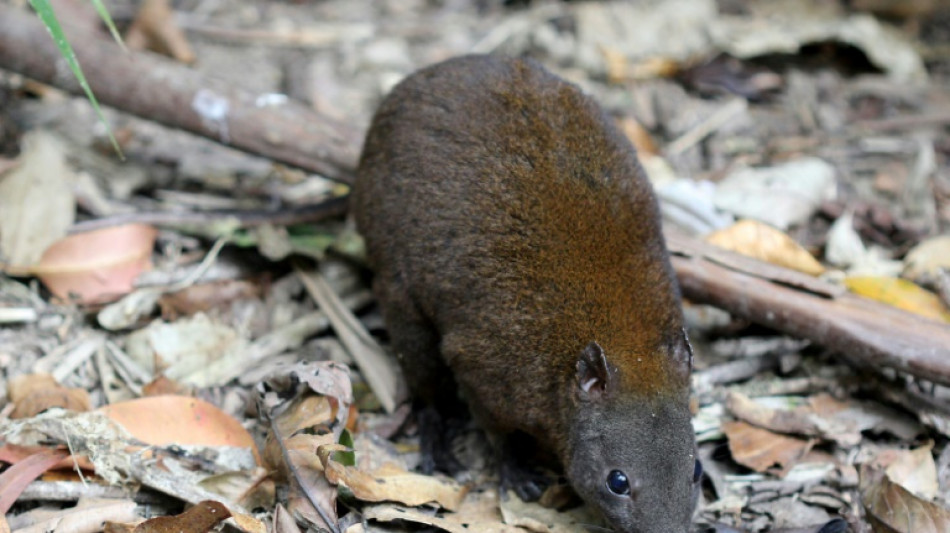
'Musky' marsupial could solve hopping kangaroo mystery / Photo: Handout - FLINDERS UNIVERSITY/AFP

 NASA scan discovers new, 'once in a century' Moon crater

 Most stocks rise as Fed hikes and indicates drive to curb inflation

 UK-Sudanese author pens book to give children 'African history of Africa'

 US Congress passes sweeping Russia sanctions bill

 US stocks fall, dollar gains after Fed lifts interest rates

 US Fed raises rates to tackle 'too high' inflation in move sure to rile Trump

 US Fed raises rates to battle inflation in move likely to rile Trump

 US House faces test on sweeping Russia sanctions bill

 British PM says to make 'difficult decisions' as inflation rises

 Global fuel price demos: a round-up

 Leverate Launches MCP for Traders to Connect AI Assistants With Trading Platforms

 MEXC Launches $1M "Discover Your Wall Street DNA" Campaign to Help Traders Find Their Market Fit

 Stocks edge higher ahead of US Fed rate call

 BASIS.pro Expands On-Chain Infrastructure with XDC Network Partnership and Zypher DAO as Auto Earn Goes Live

 Pickle-flavoured tart? AI inspires Japan's convenience stores

 EU chief hosts Canada's Carney in push to 'deepen' alliance

 Meta chief pushes back on AI slowdown calls

 US Fed to deliver rate decision with markets betting on hike

 i-payout Expands U.S. Money Transmitter Licensing Footprint and Advances European EMI Strategy

 US Senate crypto bill collapses amid partisan deadlock

 OpenAI, Anthropic and Google are working to create an AI standards body

 Protesting shepherds, farmers clash with Romanian police

 Foundation Lets Ledger Users Switch to Open Source Without Starting Over

 EU to propose curbing social media, online games for under 15s

 FX Junction Reaches 40,600 Members and 26 Million Trades

Scientists stalking a small marsupial through a remote Australian rainforest say they may have found a clue to the mystery of why its bigger kangaroo cousins hop instead of walk.
Kangaroos and closely related wallabies are the only large animals to hop upright on two legs, researchers from Australia's Flinders University said Thursday, but why remains a mystery.
They believe the answer may lie with the small musky rat-kangaroo, a bush-dwelling marsupial weighing about the same as a loaf of bread.
Musky rat-kangaroos are a distant ancestor of the larger kangaroo species that famously roam the country's outback.
Researcher Amy Tschirn said musky rat-kangaroos -- named for their pungent scent -- were the only member of the "macropodoid" family that did not hop.
"As the only living macropodoid that doesn't hop, the musky rat-kangaroo provides a crucial insight into how and when the iconic hopping form of locomotion evolved in Australia."
Scientists tracked the creatures, also known as "muskies", through the tropical rainforests of far-northern Queensland state.
They observed the creatures moving in a "bounding" motion -- hopping with their back legs while their front paws remained on the ground.
It suggested a kind of mid-point in the evolutionary journey from walking on all fours to hopping on two, the researchers said.
"These results signal a potential pathway to how bipedal hopping evolved in kangaroos," said Harvard University biologist Peter Bishop, who was involved in the work.
"Perhaps it started with an ancestor that moved about on all fours like other marsupials, then an animal that bounded like the muskies, and finally evolved into the iconic hopping kangaroos we see in Australia today."
Kangaroos and wallabies are the only hopping species heavier than five kilogrammes (11 pounds), the researchers said.
Some smaller species of rodent also hop.
The researchers said they hoped to find fossils of ancient marsupials to better understand the evolution of modern-day kangaroos.
Their findings were published Thursday in peer-reviewed journal Australian Mammalogy.
P.Kolisnyk--CPN