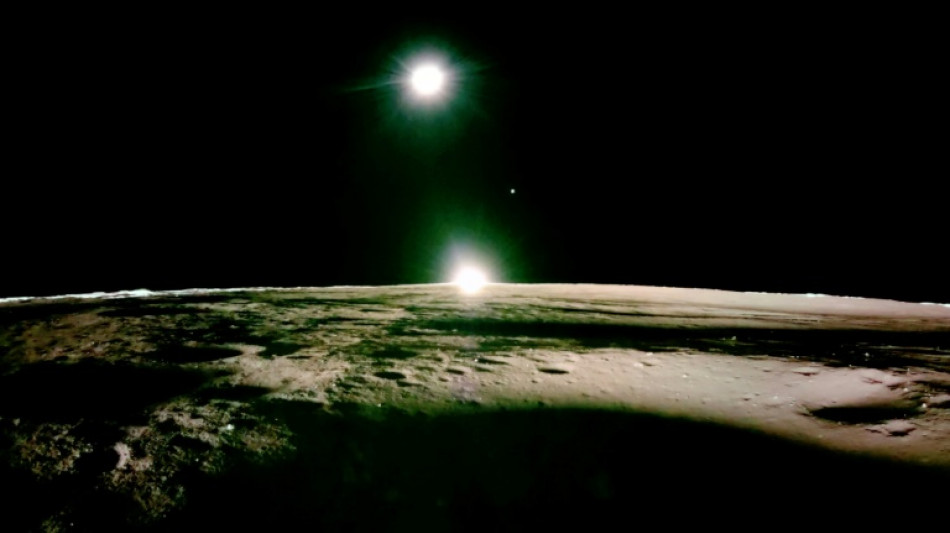
Ghostly lunar sunsets shot by private lander / Photo: HANDOUT - Firefly Aerospace/AFP

 NASA scan discovers new, 'once in a century' Moon crater

 Most stocks rise as Fed hikes and indicates drive to curb inflation

 UK-Sudanese author pens book to give children 'African history of Africa'

 US Congress passes sweeping Russia sanctions bill

 US stocks fall, dollar gains after Fed lifts interest rates

 US Fed raises rates to tackle 'too high' inflation in move sure to rile Trump

 US Fed raises rates to battle inflation in move likely to rile Trump

 US House faces test on sweeping Russia sanctions bill

 British PM says to make 'difficult decisions' as inflation rises

 Global fuel price demos: a round-up

 Leverate Launches MCP for Traders to Connect AI Assistants With Trading Platforms

 MEXC Launches $1M "Discover Your Wall Street DNA" Campaign to Help Traders Find Their Market Fit

 Stocks edge higher ahead of US Fed rate call

 BASIS.pro Expands On-Chain Infrastructure with XDC Network Partnership and Zypher DAO as Auto Earn Goes Live

 Pickle-flavoured tart? AI inspires Japan's convenience stores

 EU chief hosts Canada's Carney in push to 'deepen' alliance

 Meta chief pushes back on AI slowdown calls

 US Fed to deliver rate decision with markets betting on hike

 i-payout Expands U.S. Money Transmitter Licensing Footprint and Advances European EMI Strategy

 US Senate crypto bill collapses amid partisan deadlock

 OpenAI, Anthropic and Google are working to create an AI standards body

 Protesting shepherds, farmers clash with Romanian police

 Foundation Lets Ledger Users Switch to Open Source Without Starting Over

 EU to propose curbing social media, online games for under 15s

 FX Junction Reaches 40,600 Members and 26 Million Trades

A private US lander has captured eerie high-definition images of a lunar sunset, which NASA hopes will help unravel the mystery of a strange haze first observed on the Moon in the 1960s.
Texas-based Firefly Aerospace, which published the pictures on Tuesday, became the first private company to land a robotic spacecraft upright on the Moon earlier this month.
Its Blue Ghost lander -- roughly the size of two rhinos side by side -- touched down on March 2 at Mons Latreille, a volcanic feature within Mare Crisium on the Moon's northeastern near side, and operated until March 16 when it powered down with the onset of the lunar night.
One of the new images shows the Sun glowing just above the horizon, its halo tinged with green.
Above it, a small dot marks Venus, while Earth's bright reflection appears almost as large as the Sun at the top of the frame. Another view reveals the setting Sun bathed in a green glow, as seen from a west-facing camera.
"We are taking time to have scientific specialists go over all the imagery," said Joel Kearns, deputy associate administrator for exploration at NASA's Science Mission Directorate.
"One of the things they will be looking for is to see if they can identify 'horizon glow' or a mechanism called 'dust lofting.'"
Scientists believe lunar dust particles may become electrically charged due to ultraviolet radiation from the Sun, causing them to levitate above the surface. The phenomenon was first spotted by NASA's Surveyor probes in the 1960s and later observed by Apollo astronauts.
Kearns noted that scientists will compare the images with complementary readings from Blue Ghost's instruments, including electromagnetic field and radiation sensors, to refine existing theories.
"The images themselves are beautiful, they're really aesthetic," he said.
The west-facing image, in particular, shows soil in front of the lander illuminated by light reflected from mountains behind it. The picture's level of detail could help scientists refine models of how light scatters on the lunar surface.
Earlier in the mission, Blue Ghost also captured high-definition imagery of a total solar eclipse from the Moon on March 14.
The mission was part of a NASA-industry collaboration aimed at cutting costs and supporting Artemis, the program to return astronauts to the Moon and use lessons learned there to go to Mars.
Firefly Aerospace's spaceflight program director, Ray Allensworth, said the company is already applying lessons to future flights, including Blue Ghost-2 and Blue Ghost-3.
"The lander is absolutely not designed to survive the extreme cold of lunar night, so I think the probability is very low that we will power back on -- but this lander has surprised me," she added.
M.García--CPN