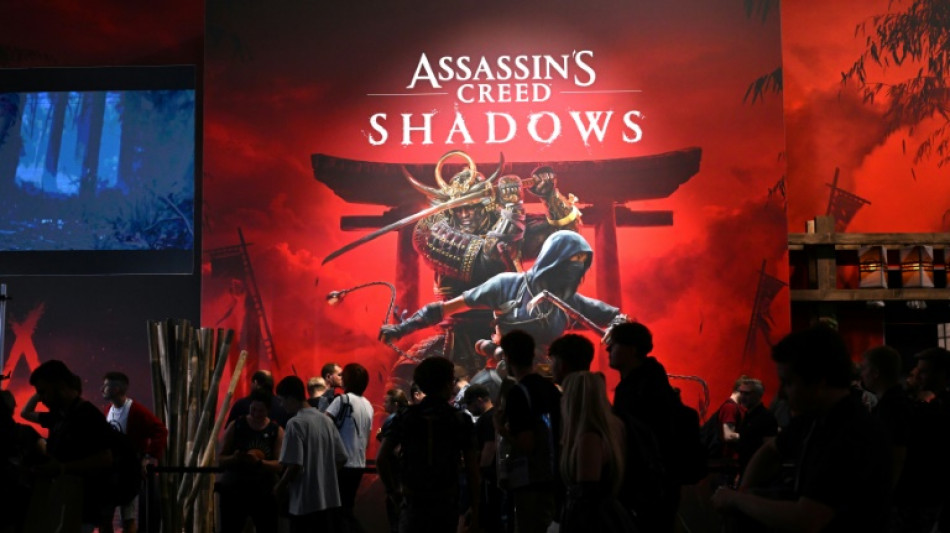
Historic fantasy 'Assassin's Creed' sparks bitter battles / Photo: Ina FASSBENDER - AFP/File

 NASA scan discovers new, 'once in a century' Moon crater

 Most stocks rise as Fed hikes and indicates drive to curb inflation

 UK-Sudanese author pens book to give children 'African history of Africa'

 US Congress passes sweeping Russia sanctions bill

 US stocks fall, dollar gains after Fed lifts interest rates

 US Fed raises rates to tackle 'too high' inflation in move sure to rile Trump

 US Fed raises rates to battle inflation in move likely to rile Trump

 US House faces test on sweeping Russia sanctions bill

 British PM says to make 'difficult decisions' as inflation rises

 Global fuel price demos: a round-up

 Leverate Launches MCP for Traders to Connect AI Assistants With Trading Platforms

 MEXC Launches $1M "Discover Your Wall Street DNA" Campaign to Help Traders Find Their Market Fit

 Stocks edge higher ahead of US Fed rate call

 BASIS.pro Expands On-Chain Infrastructure with XDC Network Partnership and Zypher DAO as Auto Earn Goes Live

 Pickle-flavoured tart? AI inspires Japan's convenience stores

 EU chief hosts Canada's Carney in push to 'deepen' alliance

 Meta chief pushes back on AI slowdown calls

 US Fed to deliver rate decision with markets betting on hike

 i-payout Expands U.S. Money Transmitter Licensing Footprint and Advances European EMI Strategy

 US Senate crypto bill collapses amid partisan deadlock

 OpenAI, Anthropic and Google are working to create an AI standards body

 Protesting shepherds, farmers clash with Romanian police

 Foundation Lets Ledger Users Switch to Open Source Without Starting Over

 EU to propose curbing social media, online games for under 15s

 FX Junction Reaches 40,600 Members and 26 Million Trades

The "Assassin's Creed" series of video games is adored for painstaking historic accuracy, but also sparks controversy with heavy use of artistic license -- most recently with a black samurai in the latest instalment, "Shadows".
Released on Thursday, "Shadows" takes place in 16th-century feudal Japan, replete with imposing fortified cities and tranquil temples crafted by developers.
"They've done a really fantastic job with very accurate recreations," said Pierre-Francois Souyri, a historian among a dozen French and Japanese experts consulted for the game in a bid to weed out cliches and anachronisms.
Since being tapped in late 2021, Souyri says he has answered "a hundred or more questions" from the development team, ranging from how salt was produced to how puppet shows were staged.
Souyri adds that within the carefully crafted setting, "it's not too hard to come up with characters who find themselves having adventures" in "a very eventful period" marked by intense conflicts.
- Black samurai -
But one foundational choice by the creative team has provoked fierce debate online and beyond: casting a black samurai, Yasuke, as one of the two playable protagonists. The other is a young female ninja, Fujibayashi Naoe.
Irritation that an African character was depicted with the rank of samurai prompted a Japanese petition against the move, receiving more than 100,000 signatures.
The text blasted "lack of historical accuracy and cultural respect" by game developers.
Souyri was unimpressed by the criticism.
"It's the game's conceit to call him a samurai, it's not a doctoral thesis," he said.
Like other historians who have weighed in, he pointed out that Yasuke "is a person who really existed" -- although the historic evidence on his status "can be difficult to interpret".
Yuichi Gozai, assistant professor at the National Centre for Japanese Studies in Kyoto, disagreed.
"Nothing proves that Yasuke had such qualifications" making him a samurai, medieval history specialist Gozai said.
In surviving documents, "Yasuke stood out above all for the colour of his skin and his physical strength".
His patron, warlord Oda Nobunaga, likely "kept Yasuke by his side to show him off", Gozai believes.
Erupting even before "Shadows" had been released, the controversy over the black character's inclusion has been the fiercest surrounding any "Assassin's Creed" game.
The series has been attacked in the past, including by hard-left French politician Jean-Luc Melenchon for how firebrand Robespierre was depicted in "Assassin's Creed Unity", set during the French Revolution.
- Culture war battleground -
In a February report, the European Video Game Observatory noted that Ubisoft's announcement of Yasuke immediately "sparked a heated controversy amplified by social media".
The outfit blamed most of the uproar on "an American conservative moral crusade" waged by a hard core of "at least 728 interconnected accounts".
That group made up "only 0.8 percent of speakers on the topic of 'Assassin's Creed Shadows' in the US (but) account for 22.1 percent of all related coverage", the Observatory added.
The researchers said the behaviour "suggests an astroturfing campaign" that piggybacked on the broader culture-war battles going on during the US presidential election campaign.
"Our use of Yasuke has been instrumentalised by certain people to get their own message across... but that's not the message of the game," said Marc-Alexis Cote, executive producer of the "Assassin's Creed" franchise.
Nevertheless, within Japan depictions of the country's history remain a sensitive issue -- as shown by reactions to images showing a "Shadows" player damaging the interior of a temple.
"I understand France's secularist principles, but it's important to acknowledge that ill-considered insults about religion can spark strong reactions," Gozai said.
"This risk should have been foreseen."
Ubisoft itself had resisted for some time fans' demands to see an "Assassin's Creed" game set in Japan.
But recent successful games set in the feudal period, such as 2019's "Sekiro" or 2020's "Ghost of Tsushima", may have helped overcome the publisher's reticence.
"There's a combined effect of exoticism and familiarity which fascinates Westerners," historian Souyri said.
Many young people, especially in Western countries such as France and the United States, devour Japanese mangas and anime series.
But Gozai argues that "these depictions become counterproductive if they reinforce discrimination and prejudice towards Japan".
He calls "Shadows" a "clear example of these concerns being realised".
X.Wong--CPN