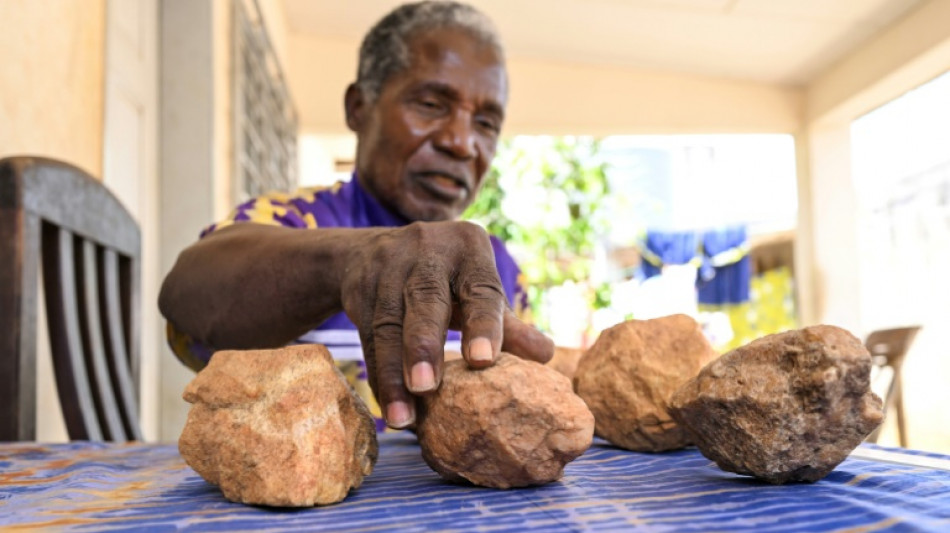
Ivory Coast's epochal prehistoric finds pass unseen / Photo: Issouf SANOGO - AFP

 NASA scan discovers new, 'once in a century' Moon crater

 Most stocks rise as Fed hikes and indicates drive to curb inflation

 UK-Sudanese author pens book to give children 'African history of Africa'

 US Congress passes sweeping Russia sanctions bill

 US stocks fall, dollar gains after Fed lifts interest rates

 US Fed raises rates to tackle 'too high' inflation in move sure to rile Trump

 US Fed raises rates to battle inflation in move likely to rile Trump

 US House faces test on sweeping Russia sanctions bill

 British PM says to make 'difficult decisions' as inflation rises

 Global fuel price demos: a round-up

 Leverate Launches MCP for Traders to Connect AI Assistants With Trading Platforms

 MEXC Launches $1M "Discover Your Wall Street DNA" Campaign to Help Traders Find Their Market Fit

 Stocks edge higher ahead of US Fed rate call

 BASIS.pro Expands On-Chain Infrastructure with XDC Network Partnership and Zypher DAO as Auto Earn Goes Live

 Pickle-flavoured tart? AI inspires Japan's convenience stores

 EU chief hosts Canada's Carney in push to 'deepen' alliance

 Meta chief pushes back on AI slowdown calls

 US Fed to deliver rate decision with markets betting on hike

 i-payout Expands U.S. Money Transmitter Licensing Footprint and Advances European EMI Strategy

 US Senate crypto bill collapses amid partisan deadlock

 OpenAI, Anthropic and Google are working to create an AI standards body

 Protesting shepherds, farmers clash with Romanian police

 Foundation Lets Ledger Users Switch to Open Source Without Starting Over

 EU to propose curbing social media, online games for under 15s

 FX Junction Reaches 40,600 Members and 26 Million Trades

In the streets of Anyama, children play and braziers smoke on corners. There is little to show that the ground of this everyday Ivory Coast neighbourhood conceals seminal prehistoric treasures.
Near the local storefronts lies the site of an excavation that unearthed stone tools from 150,000 years ago -- the earliest sign ever of humans inhabiting a tropical forest.
"That's interesting," said Ruth Fabiola Agoua, 25, who keeps a shop with her mother yards from the spot, north of the Ivorian economic capital, Abidjan.
"You cannot live without knowing your history."
- Ages of man -
Homo sapiens emerged in Africa 300,000 years ago but were once thought to have colonised tropical forests only 70,000 years back at the most.
After dating the findings from Anyama, researchers from Ivory Coast and several other countries concluded in a study that humans were living in such an environment at that spot 150 millennia ago.
By analysing biological traces and sediments, the study revealed the place was "a wet forest environment" at the time when the tools were deposited there.
"The results represent the oldest yet known clear association between humans and this habitat type," they wrote in their paper, published in the journal Nature last month after years of research.
"The secure attribution of stone tool assemblages with the wet forest environment demonstrates that Africa's forests were not a major ecological barrier" for homo sapiens at that stage.
- Tool boxes -
Among the study's authors was retired Ivorian archaeologist Francois Guede Yiode, 77 -- considered by colleagues to be the only qualified prehistory specialist in the country.
He started excavating on the privately owned land in 1982 after being alerted to the remains by a geologist.
Eventually, he and the study's co-authors got several metres below the surface, finding tools from the pleistocene epoch, which stretched from some 2.5 million to 12,000 years ago.
"The picks were used to cut up materials," he said. Other tools, dubbed "choppers", had a sharp edge for cutting through animal skin.
Today, despite the findings they inspired, the tools themselves lie hidden in boxes stacked in a small room in Guede Yiode's modest house -- a sign of what he bitterly calls the state's "lack of will" to help.
Despite a growth in research over the past 15 years, here "archaeology is a science that is slow in publishing findings because it is not funded", he said.
The artefacts and biological remains found in Anyama were analysed in German laboratories and part of the research was funded by European universities and institutes.
The Ivorian archaeologist said he provided 15 million Central African francs (currently $25,000) from his own pocket to fund the first few years of excavations at Anyama.
- Past and present -
Now Guede Yiode and his colleagues hope the finds will boost archaeology in Ivory Coast.
"There are several sites in Ivory Coast where you could perform archaeological excavations and studies on the palaeolithic period," said another of the study's authors, Eugenie Affoua Kouame, a researcher at Ivory Coast's Institute of African History, Art and Archaeology.
Guede Yiode said he has been trying in vain to have the cache of tools displayed in a museum for public and researchers to see.
"I don't feel comfortable having it all in my house."
A local anthropology undergraduate, Akissi Diane Guebie, said she hoped the Nature study would "encourage students to specialise in these subjects".
Walking to work in Anyama, local security guard Basile Sawadogo, 51, seemed unmoved by the closeness of prehistory, however.
"We live in the present," he said.
O.Ignatyev--CPN