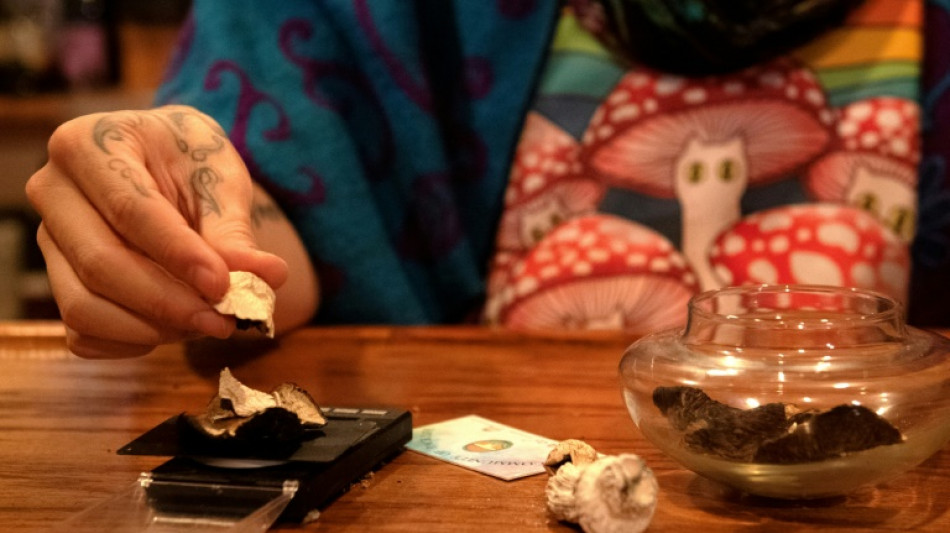
Legalizing magic mushrooms under Trump? Psychedelic fans remain skeptical / Photo: Jason Connolly - AFP

 NASA scan discovers new, 'once in a century' Moon crater

 Most stocks rise as Fed hikes and indicates drive to curb inflation

 UK-Sudanese author pens book to give children 'African history of Africa'

 US Congress passes sweeping Russia sanctions bill

 US stocks fall, dollar gains after Fed lifts interest rates

 US Fed raises rates to tackle 'too high' inflation in move sure to rile Trump

 US Fed raises rates to battle inflation in move likely to rile Trump

 US House faces test on sweeping Russia sanctions bill

 British PM says to make 'difficult decisions' as inflation rises

 Global fuel price demos: a round-up

 Leverate Launches MCP for Traders to Connect AI Assistants With Trading Platforms

 MEXC Launches $1M "Discover Your Wall Street DNA" Campaign to Help Traders Find Their Market Fit

 Stocks edge higher ahead of US Fed rate call

 BASIS.pro Expands On-Chain Infrastructure with XDC Network Partnership and Zypher DAO as Auto Earn Goes Live

 Pickle-flavoured tart? AI inspires Japan's convenience stores

 EU chief hosts Canada's Carney in push to 'deepen' alliance

 Meta chief pushes back on AI slowdown calls

 US Fed to deliver rate decision with markets betting on hike

 i-payout Expands U.S. Money Transmitter Licensing Footprint and Advances European EMI Strategy

 US Senate crypto bill collapses amid partisan deadlock

 OpenAI, Anthropic and Google are working to create an AI standards body

 Protesting shepherds, farmers clash with Romanian police

 Foundation Lets Ledger Users Switch to Open Source Without Starting Over

 EU to propose curbing social media, online games for under 15s

 FX Junction Reaches 40,600 Members and 26 Million Trades

Dressed in a floral shawl, Benji Dezaval carefully places hallucinogenic mushrooms on the tongues of the faithful of his Colorado "psychedelic church," as if they were communion wafers.
A fervent advocate of psychedelic therapies, Dezaval believes these fungi can help fight depression, alcoholism and post-traumatic stress.
So in theory, he might be expected to welcome the appointment of Donald Trump's new Health Secretary, Robert Kennedy Jr -- a famously contrarian figure who has expressed enthusiasm for exploring these alternative treatments.
But Dezaval instead dismisses Kennedy's supposed interest as "a lot of lip service."
"RFK's history of misinformation, I believe, will hurt our movement more than help it," he said, using a popular nickname for Kennedy.
"If misinformation was a disease, he'd be patient zero."
A nephew of the late US president John F. Kennedy, Robert Kennedy Jr is well-known for embracing conspiracy theories.
The former environmental lawyer has amplified discredited research linking vaccinations to autism, claimed Covid-19 was "ethnically targeted" to spare Ashkenazi Jews and Chinese people, and alleged that HIV does not cause AIDS.
None of which prevented his confirmation as health secretary last month by the Republican-controlled US Senate.
A strong critic of the pharmaceutical industry, the former Democrat also advocates the legalization of psychedelics.
"My inclination would be to make this available, at least in therapeutic settings and maybe more generally, but in ways that would discourage the corporate control and exploitation of it," he said in a late 2023 interview.
- 'Eye-opening experience' -
Long associated with hippie counter-culture, magic mushrooms remain illegal in much of the United States.
But in recent years, major US universities and the government have revived research into their active ingredient, psilocybin.
It shows promising potential for treatment of certain forms of depression and addiction. But the consequences of chronic use are still poorly understood.
Without waiting for federal law against them to change, the western states Oregon and Colorado have legalized the use of hallucinogenic mushrooms. Across the country a handful of cities that include Washington DC have decriminalized them.
Dezaval, a 38-year-old resident of Colorado Springs, leapt at the chance. He founded a "church" in the basement of his home.
Surrounded by plastic plants and wearing circular blue sunglasses, Dezaval distributes magic mushrooms during group and individual sessions that he supervises.
He says he has received well over 1,000 people in the past year.
Many of them take tiny doses -- enough to provoke fits of laughter, and a slight distortion of the senses, without dissociating their mind from their bodies.
For Luna Valentine, a depressed transgender woman, this was enough to change her life.
After a decade of ineffective antidepressants, she tried mushrooms last June. Thanks to psilocybin, which she now "micro-doses" every other day, Valentine has regained the motivation to take care of herself and get back to work.
Taking mushrooms was an "eye-opening experience," said the 28-year-old. "They've helped more than any of the pharmaceuticals."
- 'Broken clock' -
Colorado law still does not allow the free purchase of psychedelic mushrooms.
They must instead be ingested under the supervision of a licensed "facilitator," at a designated center. The first of these are scheduled to officially open this summer.
Already up-and-running in Oregon, this model involves extensive training and licensing fees. As a result, sessions can cost up to $3,000.
Dezaval rejects this system. He distributes his mushrooms for free, financing their cultivation with donations from his community. The decision to found a "church" allows him to comply with the law, which authorizes their use in "spiritual ceremonies."
"This is free because it needs to be, because people are dying every day... The acceptable number of suicides is zero. This is how we fix that," he said.
Dezaval hopes that his work will help to expel some of the sinister connotations that psychedelics retain in broader American culture.
For this reason, Kennedy's arrival in government is far from helpful, he says.
"A broken clock is still right twice a day," says Dezaval, who is saddened that Kennedy's positive position on psychedelics may be drowned out by the rest of his untruths.
"I would not expect somebody to look at what he's saying and to treat it with the actual respect that it deserves," he says.
Ng.A.Adebayo--CPN