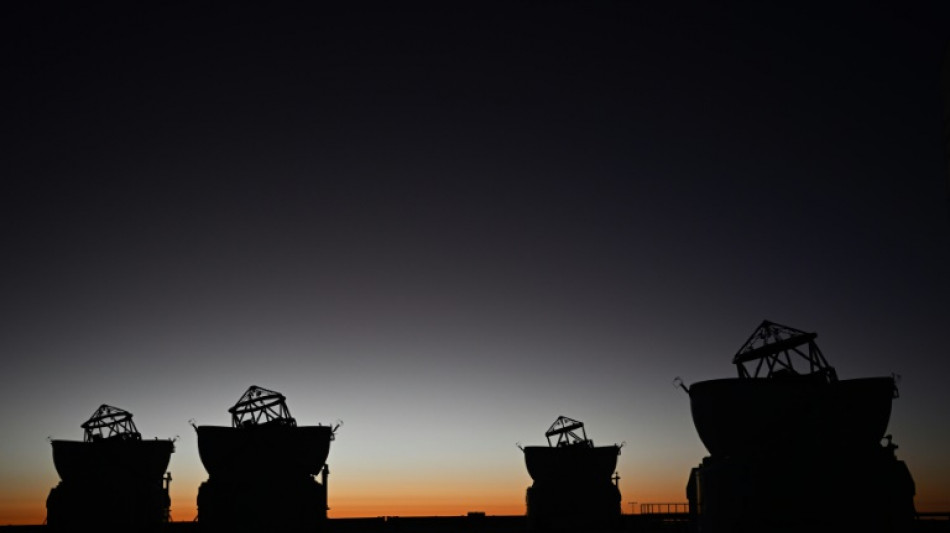
European star-gazing agency says Chile green power plant will ruin its view / Photo: RODRIGO ARANGUA - AFP

 NASA scan discovers new, 'once in a century' Moon crater

 Most stocks rise as Fed hikes and indicates drive to curb inflation

 UK-Sudanese author pens book to give children 'African history of Africa'

 US Congress passes sweeping Russia sanctions bill

 US stocks fall, dollar gains after Fed lifts interest rates

 US Fed raises rates to tackle 'too high' inflation in move sure to rile Trump

 US Fed raises rates to battle inflation in move likely to rile Trump

 US House faces test on sweeping Russia sanctions bill

 British PM says to make 'difficult decisions' as inflation rises

 Global fuel price demos: a round-up

 Leverate Launches MCP for Traders to Connect AI Assistants With Trading Platforms

 MEXC Launches $1M "Discover Your Wall Street DNA" Campaign to Help Traders Find Their Market Fit

 Stocks edge higher ahead of US Fed rate call

 BASIS.pro Expands On-Chain Infrastructure with XDC Network Partnership and Zypher DAO as Auto Earn Goes Live

 Pickle-flavoured tart? AI inspires Japan's convenience stores

 EU chief hosts Canada's Carney in push to 'deepen' alliance

 Meta chief pushes back on AI slowdown calls

 US Fed to deliver rate decision with markets betting on hike

 i-payout Expands U.S. Money Transmitter Licensing Footprint and Advances European EMI Strategy

 US Senate crypto bill collapses amid partisan deadlock

 OpenAI, Anthropic and Google are working to create an AI standards body

 Protesting shepherds, farmers clash with Romanian police

 Foundation Lets Ledger Users Switch to Open Source Without Starting Over

 EU to propose curbing social media, online games for under 15s

 FX Junction Reaches 40,600 Members and 26 Million Trades

Europe's ESO astrophysics agency said Monday that a giant green energy project billed for Chile's Atacama desert -- home to the world's darkest skies -- will spoil its view of the stars and threaten its science mission.
AES Andes, a subsidiary of US energy company AES Corporation, has submitted proposals for the construction of a 3,000-hectare (7,400-acre) project in the desert to generate solar and wind energy and green hydrogen.
The $10 billion Inna project, part of Chile's plans to become carbon neutral, is still subject to an environmental impact assessment.
On Monday, the European Southern Observatory (ESO) said its own technical analysis has revealed "alarming" consequences for the telescopes that form part of its Paranal Observatory.
"The impact is going to be devastating, irreversible, and cannot be mitigated if the project remains where they intend" to build it, ESO Chile representative Itziar de Gregorio-Monsalvo told reporters in Santiago.
The telescopes examine faraway Earth-like planets and galaxies to create a better understanding of our universe, "and even monitor asteroids that could cause damage to our planet," according to the ESO.
The analysis found Inna would increase light pollution above the Very Large Telescope (VLT) "by at least 35 percent."
The VLT started operating in 1999 with an ESO investment of 330 million euros (about $360 million), according to the agency.
At its stadium-sized Extremely Large Telescope -- due to start scientific observations in 2029 with a budget of 1.45 billion euros -- light pollution would increase by five percent -- "a level of interference incompatible with the conditions required for world-class astronomical observations," said the ESO.
There will also be harms from atmospheric turbulence, ground vibrations and dust contamination, an ESO statement said.
AES Andes has said the Inna project would conform to the "highest norms in terms of lighting," including a Chilean rule to protect astronomy sites from skyglow.
It has also said the project would be further away from the telescopes than stated by the ESO.
The agency said it would submit a full technical report to Chilean authorities this month to be considered in the environmental impact assessment.
Ch.Lefebvre--CPN