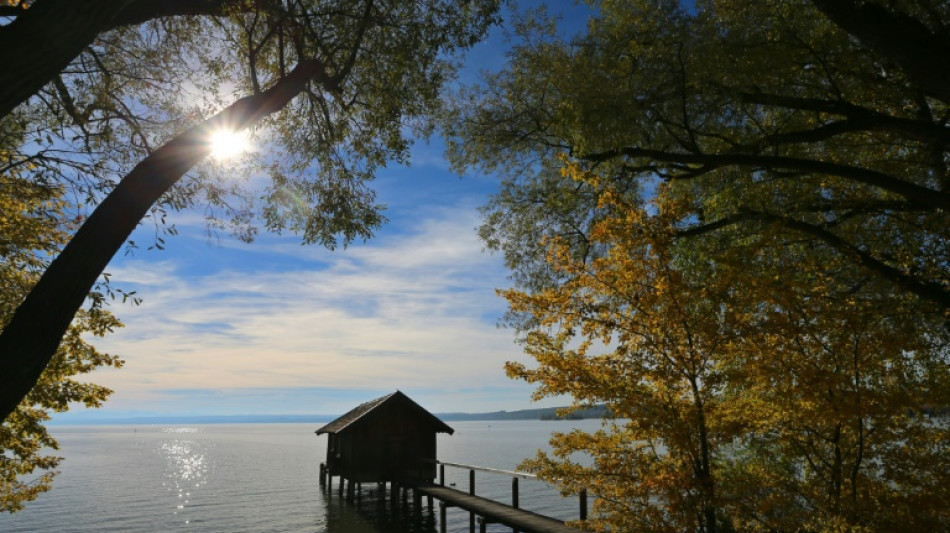
Just looking at images of nature can relieve pain, study finds / Photo: KARL-JOSEF HILDENBRAND - DPA/AFP/File

 NASA scan discovers new, 'once in a century' Moon crater

 Most stocks rise as Fed hikes and indicates drive to curb inflation

 UK-Sudanese author pens book to give children 'African history of Africa'

 US Congress passes sweeping Russia sanctions bill

 US stocks fall, dollar gains after Fed lifts interest rates

 US Fed raises rates to tackle 'too high' inflation in move sure to rile Trump

 US Fed raises rates to battle inflation in move likely to rile Trump

 US House faces test on sweeping Russia sanctions bill

 British PM says to make 'difficult decisions' as inflation rises

 Global fuel price demos: a round-up

 Leverate Launches MCP for Traders to Connect AI Assistants With Trading Platforms

 MEXC Launches $1M "Discover Your Wall Street DNA" Campaign to Help Traders Find Their Market Fit

 Stocks edge higher ahead of US Fed rate call

 BASIS.pro Expands On-Chain Infrastructure with XDC Network Partnership and Zypher DAO as Auto Earn Goes Live

 Pickle-flavoured tart? AI inspires Japan's convenience stores

 EU chief hosts Canada's Carney in push to 'deepen' alliance

 Meta chief pushes back on AI slowdown calls

 US Fed to deliver rate decision with markets betting on hike

 i-payout Expands U.S. Money Transmitter Licensing Footprint and Advances European EMI Strategy

 US Senate crypto bill collapses amid partisan deadlock

 OpenAI, Anthropic and Google are working to create an AI standards body

 Protesting shepherds, farmers clash with Romanian police

 Foundation Lets Ledger Users Switch to Open Source Without Starting Over

 EU to propose curbing social media, online games for under 15s

 FX Junction Reaches 40,600 Members and 26 Million Trades

Simply looking at nature -- or even just digital pictures of it -- can relieve pain, according to new research which scanned the brains of people receiving electrical shocks.
Nature's many health benefits has been documented by decades of research.
More than 40 years ago, a pioneering study showed that hospitalised patients needed fewer painkillers and recovered quicker when they looked out of a window onto green space rather than a brick wall.
"Yet until now, the underlying reasons for this effect were unclear," said Maximilian Steininger, a neuroscientist at the University of Vienna and lead author of a study published in Nature Communications on Thursday.
The problem is that both nature and pain can be subjective.
Because people like nature, it could have a placebo effect. Or what if it is not nature that reduces pain, but city life that increases it?
To find out more, the researchers recorded the brain activity of 49 volunteers using functional magnetic resonance imaging (fRMI).
The subjects looked at different images while receiving a series of electric shocks -- some more painful than others -- on the back of their left hand.
The first scene depicted a lake surrounded by trees blowing in the wind, while the sounds of rustling leaves and birdsong played in the background.
In the second scene, some urban elements such as buildings, benches and alleyways were added, while city noise intruded.
The third scene was of an office, with the accompanying drab furniture and whir of work.
- 'Important practical implications' -
Not only did the participants report feeling less pain when they looking at the natural landscapes, the fMRI scans showed there was a difference in their brains.
"Our study is the first to provide evidence from brain scans that this isn't just a placebo effect," Steininger said in a statement.
The nature scenes provoked decreased activity in a part of the brain involved in perceiving pain, called nociception. However other areas linked to regulating pain were not significantly affected.
The researchers said the results could be because natural environments capture people's attention, diverting them away from the sensation of pain.
This is known in psychology as the "attention restoration theory".
"The fact that this pain-relieving effect can be achieved through a virtual nature exposure which is easy to administer has important practical implications," said study co-author Alex Smalley from the UK's Exeter University.
It also "opens new avenues for research to better understand how nature impacts our minds," he added.
S.F.Lacroix--CPN