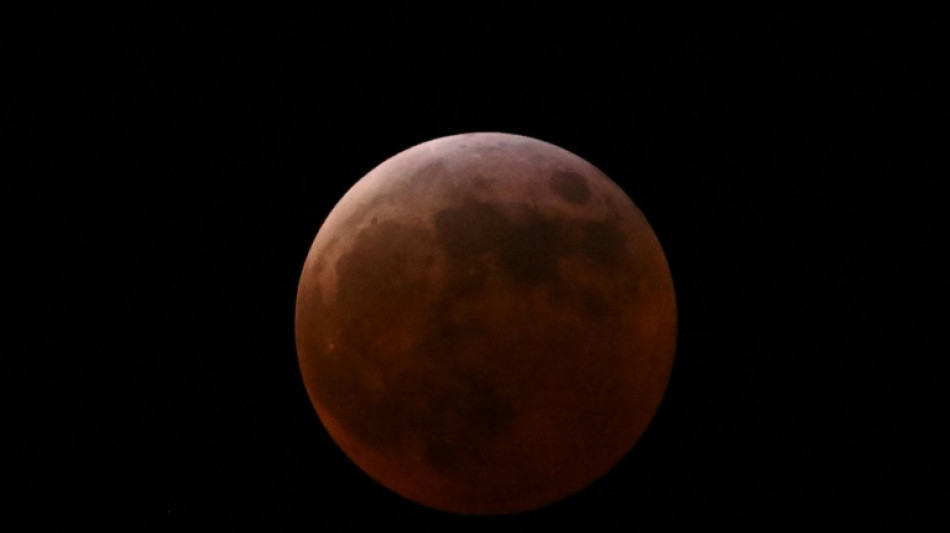
Stargazers marvel at 'Blood Moon', rare total lunar eclipse / Photo: Yuri CORTEZ - AFP

 NASA scan discovers new, 'once in a century' Moon crater

 Most stocks rise as Fed hikes and indicates drive to curb inflation

 UK-Sudanese author pens book to give children 'African history of Africa'

 US Congress passes sweeping Russia sanctions bill

 US stocks fall, dollar gains after Fed lifts interest rates

 US Fed raises rates to tackle 'too high' inflation in move sure to rile Trump

 US Fed raises rates to battle inflation in move likely to rile Trump

 US House faces test on sweeping Russia sanctions bill

 British PM says to make 'difficult decisions' as inflation rises

 Global fuel price demos: a round-up

 Leverate Launches MCP for Traders to Connect AI Assistants With Trading Platforms

 MEXC Launches $1M "Discover Your Wall Street DNA" Campaign to Help Traders Find Their Market Fit

 Stocks edge higher ahead of US Fed rate call

 BASIS.pro Expands On-Chain Infrastructure with XDC Network Partnership and Zypher DAO as Auto Earn Goes Live

 Pickle-flavoured tart? AI inspires Japan's convenience stores

 EU chief hosts Canada's Carney in push to 'deepen' alliance

 Meta chief pushes back on AI slowdown calls

 US Fed to deliver rate decision with markets betting on hike

 i-payout Expands U.S. Money Transmitter Licensing Footprint and Advances European EMI Strategy

 US Senate crypto bill collapses amid partisan deadlock

 OpenAI, Anthropic and Google are working to create an AI standards body

 Protesting shepherds, farmers clash with Romanian police

 Foundation Lets Ledger Users Switch to Open Source Without Starting Over

 EU to propose curbing social media, online games for under 15s

 FX Junction Reaches 40,600 Members and 26 Million Trades

Stargazers across a swathe of the world marvelled at a dramatic red "Blood Moon" during a rare total lunar eclipse in the early hours of Friday morning.
The celestial spectacle was visible in the Americas and Pacific and Atlantic oceans, as well as in the westernmost parts of Europe and Africa.
The phenomenon happens when the Sun, Earth and Moon line up, causing our planet to cast a giant shadow across its satellite.
But as the Earth's shadow crept across the Moon, it did not entirely blot out its white glow -- instead the Moon glowed a reddish colour.
This is because the only sunlight that reaches the Moon is "bent and scattered" as it goes through Earth's atmosphere, said Daniel Brown, an astronomer at Britain's Nottingham Trent University.
It is similar to how the light can become pink or red during sunrises or sunsets on Earth, he added.
The more clouds and dust there are in Earth's atmosphere, the redder the Moon appears.
Brown called the lunar eclipse, which will last around six hours, "an amazing way to see the solar system in action".
The period when the Moon is completely in Earth's shadow -- called the totality -- lasts just over an hour.
This event has been dubbed the "Blood Worm Moon", after one of the names given to March full moons by some Native Americans.
- 'Inspire us' -
In North America, the moon started to look like a bite was being taken out of it from 1:09 am Eastern Time (0509 GMT), with the totality from 2:26 am to 3:31 am, according to NASA.
In France, the totality is from 7:26 am to 8:31 am local time (0626-0731 GMT), according to the French Institute of Celestial Mechanics and Ephemeris Calculation.
Only the most western parts of Europe, such as France's Brittany region, will get any chance to see the totality before the Moon sets.
People in New Zealand have the opposite problem, with the eclipse only partially visible as the Moon rose.
Brown dislikes the term "Blood Moon", saying it has a negative connotation and "originates from a misinformed theory of the end of the world".
But not all societies took a negative view of these celestial shows.
Some people in Africa traditionally viewed a lunar eclipse as a conflict between the Sun and Moon that could be resolved by people "demonstrating on Earth how we work together" and laying old feuds aside, Brown said.
He called it "an amazing story that should inspire us all".
- Solar eclipse soon -
It is the first total lunar eclipse since 2022, but there will be another one this September.
Thursday's event is a "Micromoon", meaning the Moon is the farthest away it gets from Earth, making it appear about seven percent smaller than normal, according to the website Earthsky.
This is the opposite of a "Supermoon", as was seen during 2022's lunar eclipse.
Some stargazers will be in for another treat later this month -- a partial solar eclipse, which is when the Moon blocks out the Sun's light on Earth.
This eclipse will be visible on March 29 in eastern Canada, parts of Europe, northern Russia and northwest Africa.
Viewing even a partial solar eclipse with the naked eye is dangerous, and people are advised to use special eclipse glasses or pinhole projectors.
Y.Ponomarenko--CPN