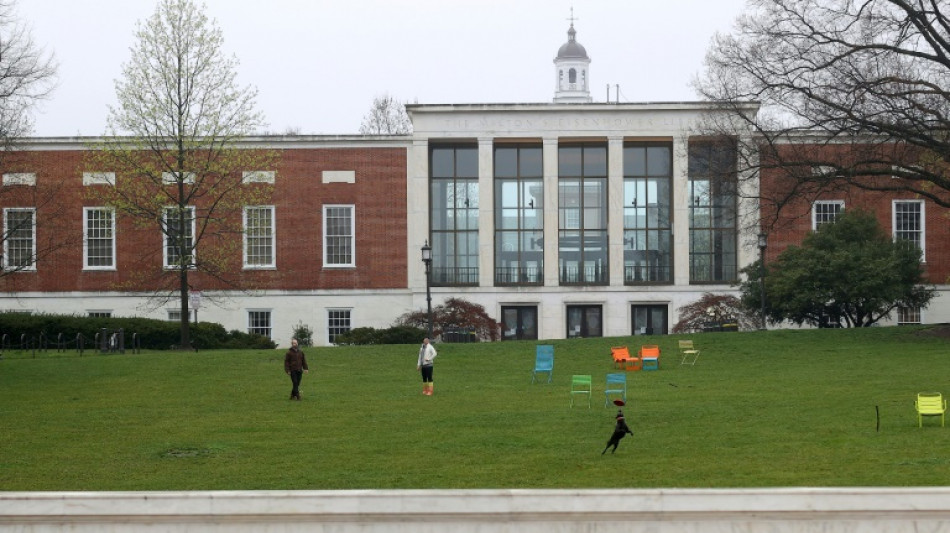
Renowned US health research hub Johns Hopkins to slash 2,000 jobs / Photo: Rob Carr - GETTY IMAGES NORTH AMERICA/AFP/File

 NASA scan discovers new, 'once in a century' Moon crater

 Most stocks rise as Fed hikes and indicates drive to curb inflation

 UK-Sudanese author pens book to give children 'African history of Africa'

 US Congress passes sweeping Russia sanctions bill

 US stocks fall, dollar gains after Fed lifts interest rates

 US Fed raises rates to tackle 'too high' inflation in move sure to rile Trump

 US Fed raises rates to battle inflation in move likely to rile Trump

 US House faces test on sweeping Russia sanctions bill

 British PM says to make 'difficult decisions' as inflation rises

 Global fuel price demos: a round-up

 Leverate Launches MCP for Traders to Connect AI Assistants With Trading Platforms

 MEXC Launches $1M "Discover Your Wall Street DNA" Campaign to Help Traders Find Their Market Fit

 Stocks edge higher ahead of US Fed rate call

 BASIS.pro Expands On-Chain Infrastructure with XDC Network Partnership and Zypher DAO as Auto Earn Goes Live

 Pickle-flavoured tart? AI inspires Japan's convenience stores

 EU chief hosts Canada's Carney in push to 'deepen' alliance

 Meta chief pushes back on AI slowdown calls

 US Fed to deliver rate decision with markets betting on hike

 i-payout Expands U.S. Money Transmitter Licensing Footprint and Advances European EMI Strategy

 US Senate crypto bill collapses amid partisan deadlock

 OpenAI, Anthropic and Google are working to create an AI standards body

 Protesting shepherds, farmers clash with Romanian police

 Foundation Lets Ledger Users Switch to Open Source Without Starting Over

 EU to propose curbing social media, online games for under 15s

 FX Junction Reaches 40,600 Members and 26 Million Trades

Prestigious US university Johns Hopkins said Thursday it will lay off more than 2,000 employees around the world in the aftermath of the Trump administration's massive reduction in foreign aid funds.
"This is a difficult day for our entire community. The termination of more than $800 million in USAID funding is now forcing us to wind down critical work," the leading scientific institution said.
The university is based in Baltimore, Maryland's largest city an hour's drive north of the US capital, but is eliminating at least 1,975 jobs in projects across 44 countries and 247 jobs in the United States.
New US President Donald Trump and his senior advisor, billionaire tech mogul Elon Musk, have embarked on a campaign to slash federal spending, targeting in particular support from the US Agency for International Development (USAID) for foreign aid, research and development.
Johns Hopkins University is one of the institutions hardest hit by these drastic reductions. In early March, its president Ronald Daniels explained in a message to students and professors that federal money accounted for nearly half of the backing it funds received last year.
Referring to a "historical relationship" between the "first American research university" and the government, he warned that students, researchers and professors would see damage to programs designed to improve health, hygiene and medicine across the world.
- Drinking water -
Thursday's announcement confirmed that the cuts hit the university's medical school and school of public health as well as Jhpiego, a global non-profit organization founded more than 50 years ago and which works to improve health in countries worldwide.
"Johns Hopkins is immensely proud of the work done by our colleagues in Jhpiego, the Bloomberg School of Public Health, and the School of Medicine to care for mothers and infants, fight disease, provide clean drinking water, and advance countless other critical, life-saving efforts around the world," the university said.
The university receives roughly $1 billion annually in funding from the National Institutes of Health (NIH) and is currently running 600 clinical trials, according to The New York Times, which added that Hopkins is one of the plaintiffs in a federal lawsuit challenging such cuts.
USAID, the largest funding agency for Jhpiego, distributes humanitarian aid around the world, with health and emergency programs in around 120 countries.
Trump, whose appointees are dismantling the humanitarian agency, signed an executive order in January demanding a freeze on all US foreign aid to allow time to assess expenses. Critics warn that slashing USAID work will endanger millions of lives.
A.Agostinelli--CPN