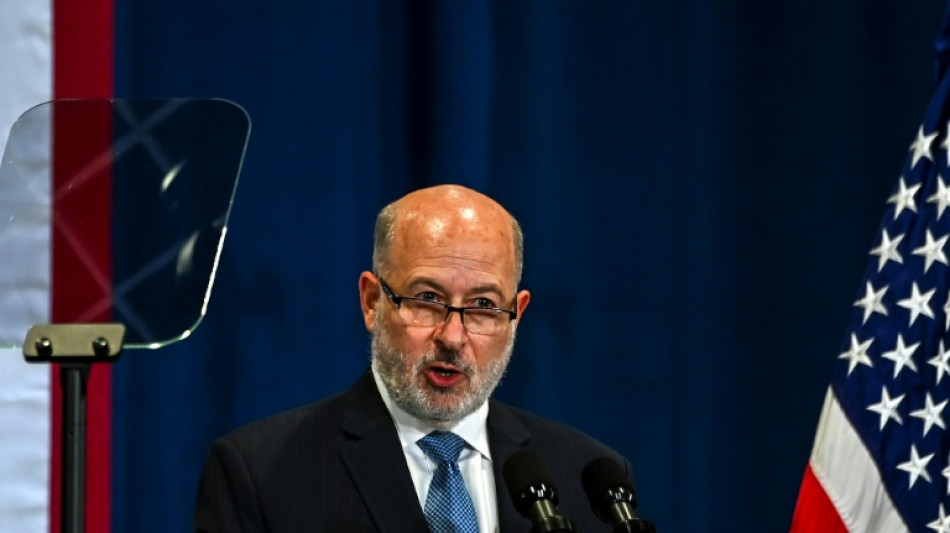
Ex-NOAA chief: Trump firings put lives, jobs, and science in jeopardy / Photo: Chandan KHANNA - AFP/File

 NASA scan discovers new, 'once in a century' Moon crater

 Most stocks rise as Fed hikes and indicates drive to curb inflation

 UK-Sudanese author pens book to give children 'African history of Africa'

 US Congress passes sweeping Russia sanctions bill

 US stocks fall, dollar gains after Fed lifts interest rates

 US Fed raises rates to tackle 'too high' inflation in move sure to rile Trump

 US Fed raises rates to battle inflation in move likely to rile Trump

 US House faces test on sweeping Russia sanctions bill

 British PM says to make 'difficult decisions' as inflation rises

 Global fuel price demos: a round-up

 Leverate Launches MCP for Traders to Connect AI Assistants With Trading Platforms

 MEXC Launches $1M "Discover Your Wall Street DNA" Campaign to Help Traders Find Their Market Fit

 Stocks edge higher ahead of US Fed rate call

 BASIS.pro Expands On-Chain Infrastructure with XDC Network Partnership and Zypher DAO as Auto Earn Goes Live

 Pickle-flavoured tart? AI inspires Japan's convenience stores

 EU chief hosts Canada's Carney in push to 'deepen' alliance

 Meta chief pushes back on AI slowdown calls

 US Fed to deliver rate decision with markets betting on hike

 i-payout Expands U.S. Money Transmitter Licensing Footprint and Advances European EMI Strategy

 US Senate crypto bill collapses amid partisan deadlock

 OpenAI, Anthropic and Google are working to create an AI standards body

 Protesting shepherds, farmers clash with Romanian police

 Foundation Lets Ledger Users Switch to Open Source Without Starting Over

 EU to propose curbing social media, online games for under 15s

 FX Junction Reaches 40,600 Members and 26 Million Trades

As the Trump administration prepares for its next wave of federal layoffs, the former head of a key US climate agency spoke with AFP about its role in public safety, scientific research, and protecting the American economy.
Rick Spinrad, an oceanographer turned government official, capped his career as director of the National Oceanic and Atmospheric Administration (NOAA) under the Biden administration.
Q: What has been the impact of so far losing more than 1,200 of the 12,000 strong workforce?
A: Many of NOAA's support functions, including those essential for deploying ships and aircraft, have been cut, preventing the agency from conducting critical stock assessments needed to manage fisheries effectively.
Commercial fishing seasons must soon be established, but without data from stock assessments, setting meaningful seasons will be impossible. That's a $320 billion industry supporting over two million jobs.
- Hurricane season -
We're now entering tornado season in the central and southeastern US. As we lose technicians, maintaining and operating satellites and radars becomes more difficult.
Several of the country's 120 plus weather forecast offices can no longer conduct their regular upper-air profiles, where they launch balloons twice a day to collect essential data for accurate forecasts.
I'm very concerned about hurricane season. If we can't deploy hurricane hunter planes or sustain the observational systems that feed forecasting models, the consequences could be severe."
Q: What have you heard about the next cuts, which would slash the agency’s staffing by almost 20 percent?
A: The agency is submitting to the Department of Commerce, its parent department, a list of 1,029 candidate positions for its "reduction in force."
It's not unusual for governments to look for cuttings and cost savings, but every other exercise that I went through of that nature during my nearly 40-year experience with the government included some statement of mission priority or strategy or even an ideology. Nothing of that nature, not even a geographic priority, has been provided.
When I left, NOAA had 12,000 federal employees and nearly as many contractors working alongside them. The need for that contractor support shows the agency would have been better served by a larger workforce, not a smaller one, because, quite honestly, contractors are expensive.
Q: The conservative Project 2025 plan, which the administration appears to be following, calls to privatize the National Weather Service. Your thoughts?
A: The costs would go up simply because the capital expenditures and the operations and maintenance. Think about the private sector having to operate 122 weather radars, 16 satellites, ten airplanes... not to mention the ships.
By law, the federal agencies are indemnified. If the private sector puts out a forecast that is bad or wrong, they are liable for loss. That has happened in the past.
- Government for the people? -
At the end of the day, what it really means is that weather forecasts would kind of be like streaming video. If you can afford it, and you want it, you buy it. So how does this comport with the idea that the government is there for all of the people all of the time?
Q: How will curbing NOAA's climate work harm US interests?
A: It will mean we won't have a seat at the table, which will be a terrible loss. We've worked so hard to work collaboratively with our partners through the World Meteorological Organization.
The vast majority of the American public understands climate impacts are real and they are being felt right now. Our ability to contribute to the understanding of how climate change will impact our society will be compromised. I worry a lot about our ability to build the workforce for the future.
Scientists are demoralized. They are very concerned, because the paradigm that we have operated under for almost 60 years is being shattered, and we don't know what the new paradigm will look like.
St.Ch.Baker--CPN