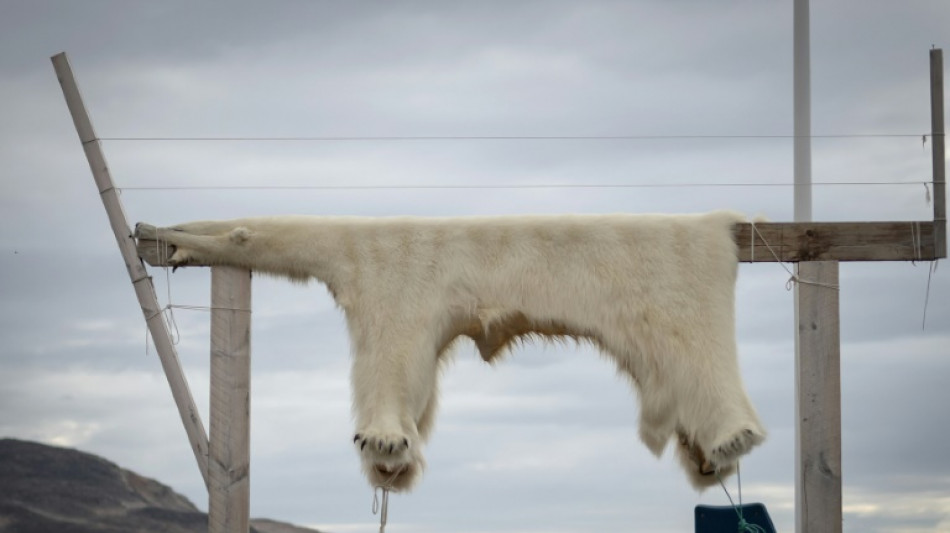
Diet puts Greenland Inuit at risk from 'forever chemicals': study / Photo: Olivier MORIN - AFP

 NASA scan discovers new, 'once in a century' Moon crater

 Most stocks rise as Fed hikes and indicates drive to curb inflation

 UK-Sudanese author pens book to give children 'African history of Africa'

 US Congress passes sweeping Russia sanctions bill

 US stocks fall, dollar gains after Fed lifts interest rates

 US Fed raises rates to tackle 'too high' inflation in move sure to rile Trump

 US Fed raises rates to battle inflation in move likely to rile Trump

 US House faces test on sweeping Russia sanctions bill

 British PM says to make 'difficult decisions' as inflation rises

 Global fuel price demos: a round-up

 Leverate Launches MCP for Traders to Connect AI Assistants With Trading Platforms

 MEXC Launches $1M "Discover Your Wall Street DNA" Campaign to Help Traders Find Their Market Fit

 Stocks edge higher ahead of US Fed rate call

 BASIS.pro Expands On-Chain Infrastructure with XDC Network Partnership and Zypher DAO as Auto Earn Goes Live

 Pickle-flavoured tart? AI inspires Japan's convenience stores

 EU chief hosts Canada's Carney in push to 'deepen' alliance

 Meta chief pushes back on AI slowdown calls

 US Fed to deliver rate decision with markets betting on hike

 i-payout Expands U.S. Money Transmitter Licensing Footprint and Advances European EMI Strategy

 US Senate crypto bill collapses amid partisan deadlock

 OpenAI, Anthropic and Google are working to create an AI standards body

 Protesting shepherds, farmers clash with Romanian police

 Foundation Lets Ledger Users Switch to Open Source Without Starting Over

 EU to propose curbing social media, online games for under 15s

 FX Junction Reaches 40,600 Members and 26 Million Trades

Scientists warned on Thursday that the long-term health of Inuit hunters in eastern Greenland was under threat, due to so-called "forever chemicals" in the atmosphere and their diet of polar bear and seal meat.
Christian Sonne, from Denmark's Aarhus University, said the Ittoqqortoormiit fishing and hunting community had levels of the chemicals -- also known as PFAS -- in their blood 13 times higher than the risk threshold.
The remote zone is particularly affected by the contamination because the chemicals are carried there by nearby sea and air currents, said Sonne, author of a study of the issue published in the journal Cell.
"East Greenland is really a hotspot of human contamination because you can both eat polar bears, which you don't hunt in Russia or Svalbard, and ringed seals that accumulate PFAS and other harmful substances," he told AFP.
"These substances are so persistent in the environment and in the body that the concentrations will still be very high over the next 75 to 100 years."
The area, home to just 300 people, has the highest PFAS levels in the world, excluding those affecting firefighters, factory workers and that linked to groundwater contamination in Sweden and Italy, said Sonne.
He attributed that to the long-range transfer of the chemicals in the air and water, which end up in the bodies of animals, particularly those that are then eaten.
To lower their levels, he advised the Inuit community to diversify what they eat.
He also called for tighter regulations to force industry to manufacture fewer toxic compounds that are less likely to be spread widely.
- High mercury, PCB levels -
PFAS are synthetic chemicals first developed in the 1940s to withstand intense heat and repel water and grease.
They have since been used in a vast range of household and industrial products, including food packaging, make-up, stain-proof fabrics, non-stick cookware and flame retardants.
Studies have suggested that exposure to PFAS chemicals is associated with increased rates of cancer, obesity, thyroid, liver and kidney disease, higher cholesterol, low birthweight and even weaker response to vaccines.
Polychlorinated biphenyls -- banned by the United States in 1979 -- are industrial chemicals, which affect immune, reproductive, nervous and endocrine systems, and are likely to cause cancer.
They also bind to sediment, threatening fish and wildlife.
Depending on ocean currents and winds, the situation varies across the Arctic territories.
Sonne said Inuit hunters also had very high levels of mercury and probably the highest levels of toxic man-made PCB chemicals in the world.
C.Peyronnet--CPN