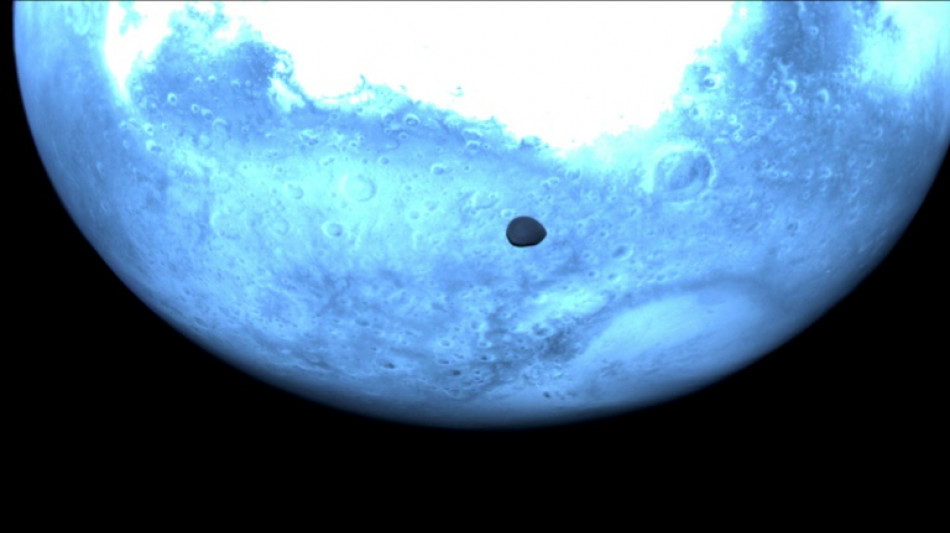
Asteroid probe snaps rare pics of Martian moon / Photo: Handout - ESA/AFP

 NASA scan discovers new, 'once in a century' Moon crater

 Most stocks rise as Fed hikes and indicates drive to curb inflation

 UK-Sudanese author pens book to give children 'African history of Africa'

 US Congress passes sweeping Russia sanctions bill

 US stocks fall, dollar gains after Fed lifts interest rates

 US Fed raises rates to tackle 'too high' inflation in move sure to rile Trump

 US Fed raises rates to battle inflation in move likely to rile Trump

 US House faces test on sweeping Russia sanctions bill

 British PM says to make 'difficult decisions' as inflation rises

 Global fuel price demos: a round-up

 Leverate Launches MCP for Traders to Connect AI Assistants With Trading Platforms

 MEXC Launches $1M "Discover Your Wall Street DNA" Campaign to Help Traders Find Their Market Fit

 Stocks edge higher ahead of US Fed rate call

 BASIS.pro Expands On-Chain Infrastructure with XDC Network Partnership and Zypher DAO as Auto Earn Goes Live

 Pickle-flavoured tart? AI inspires Japan's convenience stores

 EU chief hosts Canada's Carney in push to 'deepen' alliance

 Meta chief pushes back on AI slowdown calls

 US Fed to deliver rate decision with markets betting on hike

 i-payout Expands U.S. Money Transmitter Licensing Footprint and Advances European EMI Strategy

 US Senate crypto bill collapses amid partisan deadlock

 OpenAI, Anthropic and Google are working to create an AI standards body

 Protesting shepherds, farmers clash with Romanian police

 Foundation Lets Ledger Users Switch to Open Source Without Starting Over

 EU to propose curbing social media, online games for under 15s

 FX Junction Reaches 40,600 Members and 26 Million Trades

On the way to investigate the scene of a historic asteroid collision, a European spacecraft swung by Mars and captured rare images of the red planet's mysterious small moon Deimos, the European Space Agency said Thursday.
Europe's HERA mission is aiming to find out how much of an impact a NASA spacecraft made when it deliberately smashed into an asteroid in 2022 in the first-ever test of our planetary defences.
But HERA will not reach the asteroid -- which is 11 million kilometres (seven million miles) from Earth in the asteroid belt between Mars and Jupiter -- until late 2026.
On the long voyage there, the spacecraft received a gravity boost by slingshotting around Mars on Wednesday.
For an hour, it flew as close as 5,600 kilometres from the Martian surface, at a speed of 33,480 kilometres an hour.
It used the opportunity to test some of its scientific instruments, snapping around 600 pictures, including rare ones of Deimos.
The lumpy, 12.5 kilometre-wide moon is the smaller and less well-known of the two moons of Mars.
Exactly how Deimos and the bigger Phobos were formed remains a matter of debate.
The new images add "another piece of the puzzle" to efforts to determine their origin, Marcel Popescu of the Astronomical Institute of the Romanian Academy told an ESA press conference on Wednesday.
There are hopes that data from HERA's "HyperScout" and thermal infrared imagers -- which observe colours beyond the limits of the human eye -- will, in particular, shed light on the moon's composition.
Those infrared imagers are why the red planet appears blue in some of the photos.
Next, HERA will turn its focus back to the asteroid Dimorphos.
When NASA's DART mission smashed into Dimorphos in 2022, it shortened the 160-metre-wide asteroid's orbit around its big brother Didymos by 33 minutes.
Though Dimorphos itself posed no threat to Earth, HERA intends to discover whether this technique could be an effective way for Earth to defend itself against possibly existence-threatening asteroids in the future.
Earlier this year, a newly discovered asteroid capable of destroying a city was briefly given a more than three percent chance of hitting Earth in 2032.
However further observations sent the chances of a direct hit back down to nearly zero.
P.Petrenko--CPN