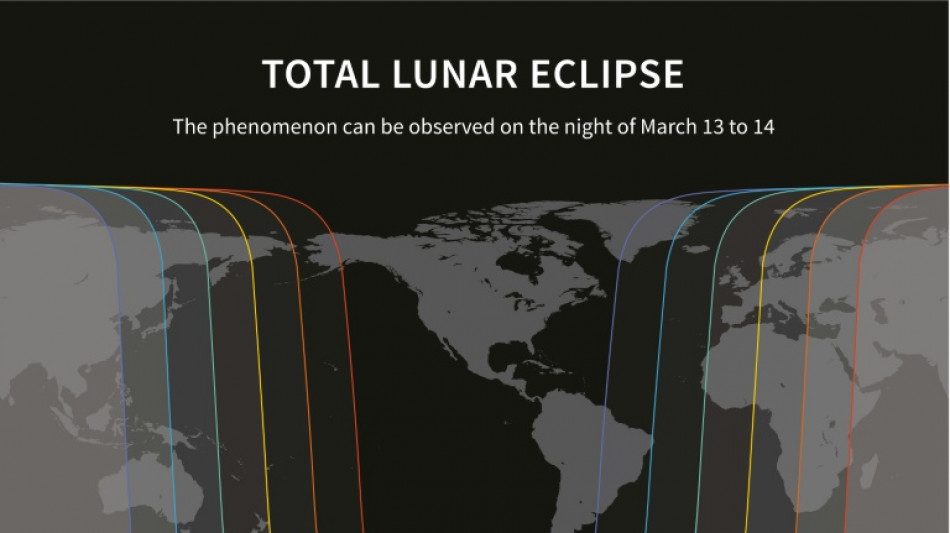
Americas to witness rare 'Blood Moon' total lunar eclipse / Photo: Gustavo IZUS, Gabriela VAZ - AFP

 NASA scan discovers new, 'once in a century' Moon crater

 Most stocks rise as Fed hikes and indicates drive to curb inflation

 UK-Sudanese author pens book to give children 'African history of Africa'

 US Congress passes sweeping Russia sanctions bill

 US stocks fall, dollar gains after Fed lifts interest rates

 US Fed raises rates to tackle 'too high' inflation in move sure to rile Trump

 US Fed raises rates to battle inflation in move likely to rile Trump

 US House faces test on sweeping Russia sanctions bill

 British PM says to make 'difficult decisions' as inflation rises

 Global fuel price demos: a round-up

 Leverate Launches MCP for Traders to Connect AI Assistants With Trading Platforms

 MEXC Launches $1M "Discover Your Wall Street DNA" Campaign to Help Traders Find Their Market Fit

 Stocks edge higher ahead of US Fed rate call

 BASIS.pro Expands On-Chain Infrastructure with XDC Network Partnership and Zypher DAO as Auto Earn Goes Live

 Pickle-flavoured tart? AI inspires Japan's convenience stores

 EU chief hosts Canada's Carney in push to 'deepen' alliance

 Meta chief pushes back on AI slowdown calls

 US Fed to deliver rate decision with markets betting on hike

 i-payout Expands U.S. Money Transmitter Licensing Footprint and Advances European EMI Strategy

 US Senate crypto bill collapses amid partisan deadlock

 OpenAI, Anthropic and Google are working to create an AI standards body

 Protesting shepherds, farmers clash with Romanian police

 Foundation Lets Ledger Users Switch to Open Source Without Starting Over

 EU to propose curbing social media, online games for under 15s

 FX Junction Reaches 40,600 Members and 26 Million Trades

Stargazers in North and South America will be able to view a red-colored "Blood Moon" starting Thursday night in the first total lunar eclipse visible on the continents since 2022.
The celestial event, observable with the naked eye, will have more than an hour of totality and can additionally be seen in parts of western Europe and Africa, as well as New Zealand.
A lunar eclipse occurs when the Earth goes between the Moon and the Sun, casting the Earth's shadow on the Moon.
A rare total lunar eclipse involves the Earth's umbra, the darkest part of the planet's shadow, covering the Moon.
According to NASA, this type of eclipse can also be called a "Blood Moon" due to the reddish-orange color the Moon can become during totality.
The coloration occurs due to sunlight scattering through the Earth's atmosphere before reaching the Moon's surface -- shorter wavelengths like blue and violet fail to reach the Moon, leaving only longer wavelengths such as red and orange to illuminate it.
As a result, the more items there are in the Earth's atmosphere -- such as clouds or dust -- the redder the Moon will appear during the eclipse.
"Keep a close eye on the weather forecast leading up to the eclipse," said NASA Chief Scientist Renee Weber in a statement. "That totality will last for close to an hour, so even if it's cloudy you may still be able to glimpse it if the clouds are scattered."
The timing of totality occurs simultaneously across time zones, and is expected to begin at 2:26 am Friday for those in Eastern Daylight Time and 11:26 pm Thursday in Pacific Daylight Time.
For about an hour both before and after totality, the moon will also be obscured in a partial eclipse.
P.Schmidt--CPN