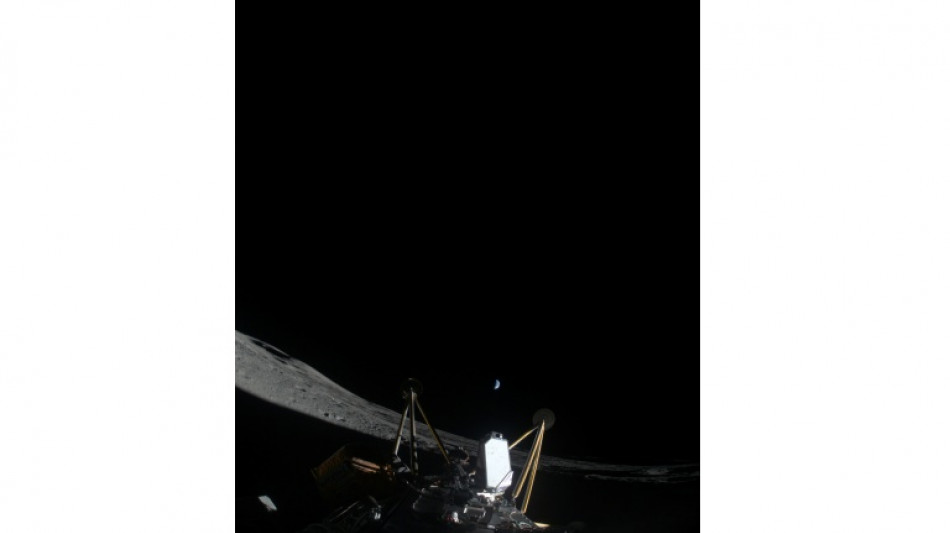
Oops, we tipped it again: Mission over for private US lander / Photo: Handout - Intuitive Machines, LLC/AFP

 NASA scan discovers new, 'once in a century' Moon crater

 Most stocks rise as Fed hikes and indicates drive to curb inflation

 UK-Sudanese author pens book to give children 'African history of Africa'

 US Congress passes sweeping Russia sanctions bill

 US stocks fall, dollar gains after Fed lifts interest rates

 US Fed raises rates to tackle 'too high' inflation in move sure to rile Trump

 US Fed raises rates to battle inflation in move likely to rile Trump

 US House faces test on sweeping Russia sanctions bill

 British PM says to make 'difficult decisions' as inflation rises

 Global fuel price demos: a round-up

 Leverate Launches MCP for Traders to Connect AI Assistants With Trading Platforms

 MEXC Launches $1M "Discover Your Wall Street DNA" Campaign to Help Traders Find Their Market Fit

 Stocks edge higher ahead of US Fed rate call

 BASIS.pro Expands On-Chain Infrastructure with XDC Network Partnership and Zypher DAO as Auto Earn Goes Live

 Pickle-flavoured tart? AI inspires Japan's convenience stores

 EU chief hosts Canada's Carney in push to 'deepen' alliance

 Meta chief pushes back on AI slowdown calls

 US Fed to deliver rate decision with markets betting on hike

 i-payout Expands U.S. Money Transmitter Licensing Footprint and Advances European EMI Strategy

 US Senate crypto bill collapses amid partisan deadlock

 OpenAI, Anthropic and Google are working to create an AI standards body

 Protesting shepherds, farmers clash with Romanian police

 Foundation Lets Ledger Users Switch to Open Source Without Starting Over

 EU to propose curbing social media, online games for under 15s

 FX Junction Reaches 40,600 Members and 26 Million Trades

Intuitive Machines' second Moon mission ended in disappointment Friday after its spacecraft tipped over and was left unable to recharge its solar-powered batteries, mirroring the US company's first attempt last year.
It marked a premature conclusion to a mission that had sparked excitement in the space community, thanks to its cutting-edge payloads, including a futuristic hopping drone, multiple rovers, an ice drill, and a 4G network test.
Houston-based Intuitive Machines (IM) had hoped to make history with Athena, a hexagonal lander roughly the height of a giraffe, designed to touch down on a spot called the Mons Mouton plateau, closer to the lunar south pole than any mission before.
But after blasting off last week aboard a SpaceX Falcon 9 rocket and traveling more than a million kilometers through space, the spacecraft came to rest inside a crater, 250 meters from its intended target, face down on the lunar surface.
A photo released by the company showed Athena resting on an incline, with Earth visible between two of its splayed landing legs -- a similar fate to IM's prior landing with its Odysseus spacecraft in February 2024.
- Faulty instruments -
Despite this, teams were able to "accelerate several program and payload milestones," including a NASA experiment designed to drill beneath the lunar surface in search of ice and chemicals, before Athena's batteries depleted, the company said.
"With the direction of the Sun, the orientation of the solar panels, and extreme cold temperatures in the crater, Intuitive Machines does not expect Athena to recharge," it continued.
"The mission has concluded, and teams are continuing to assess the data collected throughout the mission."
The science investigations and technology demonstrations were originally expected to last approximately 10 days, with the company hoping to capture a lunar eclipse from the Moon's perspective on March 14.
On Thursday, IM executives suggested that issues with Athena's laser altimeters contributed to the bad landing, similar to the previous mission, when Odysseus came in too fast, caught a foot on the surface, and toppled over.
Specifically, the Terrain Relative Navigation laser, designed to provide altitude and velocity readings, was returning "noisy" data that could not be fully trusted, while the Hazard Relative Navigation sensors only sent intermittent signals, IM said on Thursday.
Athena, like Odysseus, has a tall, slender build, standing 15.6 feet (4.8 meters) in height, raising stability concerns.
But CEO Steve Altemus isisted that the lander's weight distribution kept the center of gravity low, and the company remains confident in its design.
- Texas rival succeeds -
Adding to the disappointment, the latest mishap came just days after Texas rival Firefly Aerospace successfully landed its Blue Ghost lander on its first attempt.
These missions are part of NASA's $2.6 billion Commercial Lunar Payload Services (CLPS) program, which seeks to leverage private industry to lower costs and support Artemis -- NASA's effort to return astronauts to the Moon and eventually reach Mars.
Meanwhile, two probes that had hitched a ride on the same SpaceX rocket as the IM equipment have also been lost, adding to the sense of an ill-fated voyage. NASA's Lunar Trailblazer probe was designed to map the Moon's water distribution, while Odin, a small private probe, aimed to capture close-up photos of an asteroid.
IM has been awarded two more lunar missions but will be reviewing data from IM-2 to better understand its implications for IM-3.
Of the four CLPS missions attempted so far, only one lander managed an upright touchdown, two landed sideways, and one failed to reach the Moon altogether.
Y.Uduike--CPN