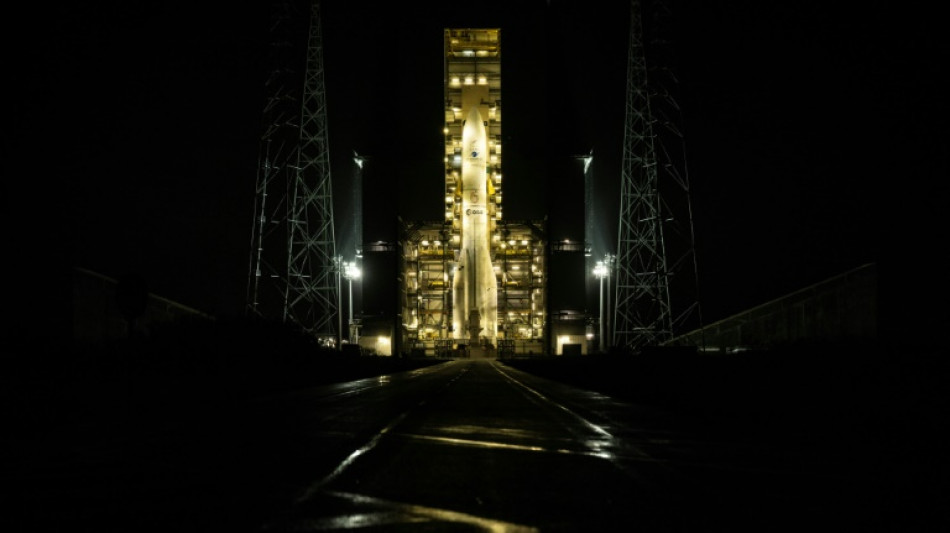
Europe's Ariane 6 rocket launch postponed due to 'anomaly' / Photo: JULIEN DE ROSA - AFP

 NASA scan discovers new, 'once in a century' Moon crater

 Most stocks rise as Fed hikes and indicates drive to curb inflation

 UK-Sudanese author pens book to give children 'African history of Africa'

 US Congress passes sweeping Russia sanctions bill

 US stocks fall, dollar gains after Fed lifts interest rates

 US Fed raises rates to tackle 'too high' inflation in move sure to rile Trump

 US Fed raises rates to battle inflation in move likely to rile Trump

 US House faces test on sweeping Russia sanctions bill

 British PM says to make 'difficult decisions' as inflation rises

 Global fuel price demos: a round-up

 Leverate Launches MCP for Traders to Connect AI Assistants With Trading Platforms

 MEXC Launches $1M "Discover Your Wall Street DNA" Campaign to Help Traders Find Their Market Fit

 Stocks edge higher ahead of US Fed rate call

 BASIS.pro Expands On-Chain Infrastructure with XDC Network Partnership and Zypher DAO as Auto Earn Goes Live

 Pickle-flavoured tart? AI inspires Japan's convenience stores

 EU chief hosts Canada's Carney in push to 'deepen' alliance

 Meta chief pushes back on AI slowdown calls

 US Fed to deliver rate decision with markets betting on hike

 i-payout Expands U.S. Money Transmitter Licensing Footprint and Advances European EMI Strategy

 US Senate crypto bill collapses amid partisan deadlock

 OpenAI, Anthropic and Google are working to create an AI standards body

 Protesting shepherds, farmers clash with Romanian police

 Foundation Lets Ledger Users Switch to Open Source Without Starting Over

 EU to propose curbing social media, online games for under 15s

 FX Junction Reaches 40,600 Members and 26 Million Trades

Minutes before it was scheduled to launch, the first commercial mission of Europe's new heavy-lift rocket Ariane 6 was called off on Monday due to an "anomaly" on the ground.
It was the latest of several postponements for the rocket as Europe seeks to secure independent access to space amid a shock rapprochement between Moscow and Washington.
The launch had been scheduled to blast off from Europe's spaceport in Kourou, French Guiana at 1:24 pm (1624 GMT) Monday.
While there had been some scattered rain in Kourou, teams on the ground had received the green light until just minutes before blast off.
But after an "anomaly" on the ground was detected, "the only possible decision now is to postpone the launch," said David Cavailloles, the head of the French company Arianespace which operates the rocket.
"I have no doubt that we will have another flight again soon," he added.
The launch was postponed as Europe seeks to reduce its reliance on the United States for security -- and the European space industry struggles to remain competitive with Elon Musk's SpaceX.
The launcher was intended to place a French military satellite in orbit at an altitude of around 800 kilometres (500 miles) above Earth.
Europe has not been able to use Russia's Soyuz rockets since Moscow invaded Ukraine in 2022, while the workhorse Ariane 5 was retired in 2023.
- 'We must be united' -
The mission had taken on greater symbolic significance after the administration of new US President Donald Trump initiated a surprise rapprochement with Russia, prompting European nations to close ranks.
"Europe must ensure its own security," ESA space transportation director Toni Tolker-Nielsen told a press conference in Kourou before the postponement was announced.
"We must be united," Cavailloles said, stressing the importance of "not depending on anyone else" to launch satellites "in today's world".
The space industry has been experiencing major upheaval -- and more is expected after SpaceX's billionaire founder Elon Musk recently became a prominent advisor to Trump.
"The concept of strategic autonomy, once mocked as a French whim, is at the heart of the Europe of tomorrow," France's research minister Philippe Baptiste told local media.
"The number of launches has exploded -- not only American, but also Chinese," said French General Philippe Steininger, a consultant at the space research institute CNES.
Initially planned for December, the Ariane 6 mission was delayed until February 26 and then to March 3. The next launch date is not yet known.
The mission is to take the CSO-3 satellite into space. CSO-3 will complete a network of three French military imaging satellites, with the first two launched in 2018 and 2020 on Soyuz rockets.
- Heavy security -
The satellites have "orbiting cameras that take images in both visible and infrared light all over the globe, which is very important for military operations," Michel Sayegh, the head of the French government's armament agency DGA, told AFP.
Given the military role of the satellite, strict security precautions were taken to limit access at the spaceport on the northern coast of South America, with French fighter jets deployed to patrol the surrounding skies.
Europe's smaller Vega-C launcher was earlier grounded for two years due to an accident that resulted in the loss of two satellites, only resuming flights in December 2024.
Europe has only a handful of military satellites, compared to the hundreds of the United States and China.
Y.Tengku--CPN