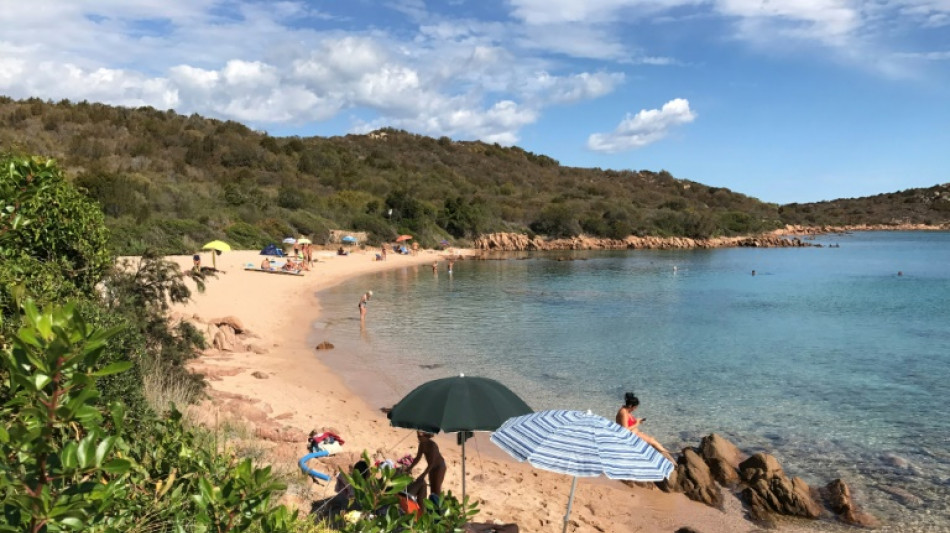
The secret to living to 110? Bad record-keeping, researcher says / Photo: Daniel SLIM - AFP/File

 Germany urges EU action against China to defend carmakers

 Japan eyes changing prostitution law to punish sex buyers

 Modi pitches India as global chipmaking hub

 Ukraine plans record defence spending in 2027

 NASA scan discovers new, 'once in a century' Moon crater

 Most stocks rise as Fed hikes and indicates drive to curb inflation

 UK-Sudanese author pens book to give children 'African history of Africa'

 US Congress passes sweeping Russia sanctions bill

 US stocks fall, dollar gains after Fed lifts interest rates

 US Fed raises rates to tackle 'too high' inflation in move sure to rile Trump

 US Fed raises rates to battle inflation in move likely to rile Trump

 US House faces test on sweeping Russia sanctions bill

 British PM says to make 'difficult decisions' as inflation rises

 Global fuel price demos: a round-up

 Leverate Launches MCP for Traders to Connect AI Assistants With Trading Platforms

 MEXC Launches $1M "Discover Your Wall Street DNA" Campaign to Help Traders Find Their Market Fit

 Stocks edge higher ahead of US Fed rate call

 BASIS.pro Expands On-Chain Infrastructure with XDC Network Partnership and Zypher DAO as Auto Earn Goes Live

 Pickle-flavoured tart? AI inspires Japan's convenience stores

 EU chief hosts Canada's Carney in push to 'deepen' alliance

 Meta chief pushes back on AI slowdown calls

 US Fed to deliver rate decision with markets betting on hike

 i-payout Expands U.S. Money Transmitter Licensing Footprint and Advances European EMI Strategy

 US Senate crypto bill collapses amid partisan deadlock

 OpenAI, Anthropic and Google are working to create an AI standards body

Most of what we know about humans living to very old age is based on faulty data, including the science behind the "blue zones" famous for having a high proportion of people over 100, according to one researcher.
The desire to live as long as possible has driven a booming lifestyle industry selling supplements, books, tech and tips to those wanting to learn the secrets of the world's oldest people.
But Saul Justin Newman, a researcher at University College London's Centre for Longitudinal Studies, told AFP that most extreme old age data "is junk to a really shocking degree".
Newman's research, which is currently being peer-reviewed, looked at data about centenarians and supercentenarians -- people who live to 100 and 110 -- in the United States, Italy, England, France and Japan.
Contrary to what one might expect, he found that supercentenarians tended to come from areas with poor health, high levels of poverty -- and bad record-keeping.
The true secret to extreme longevity seems to be to "move where birth certificates are rare, teach your kids pension fraud and start lying", Newman said as he accepted an Ig Nobel prize, a humorous version of the Nobel, in September.
Just one of many examples is Sogen Kato, who was thought to be Japan's oldest living person until his mummified remains were discovered in 2010.
It turned out he had been dead since 1978. His family was arrested for collecting three decades of pensions payments.
The government then launched a review which found that 82 percent of Japan's centenarians -- 230,000 people -- were missing or dead.
"Their paperwork is in order, they're just dead," Newman said.
This illustrates the problem Newman has sought to shine a light on -- that confirming ages in this field involves triple-checking very old documents that could have been wrong from the start.
The industry that has popped up around blue zones is one "symptom" of this problem, he said.
- 'Only alive on pension day' -
Blue zones are regions around the world where people are said to live disproportionately longer and healthier lives.
The term was first used in 2004 by researchers referring to the Italian island of Sardinia.
The following year, National Geographic reporter Dan Buettner wrote a story that added the Japanese islands of Okinawa and the Californian city of Loma Linda.
Buettner admitted to the New York Times in October that he only included Loma Linda because his editor told him: "you need to find America's blue zone".
The reporter teamed up with some demographers to create the Blue Zones lifestyle brand, and they added Costa Rica's Nicoya Peninsula and the Greek island of Ikaria to the list.
However, as seen in Japan, later government records have cast doubt on old age data in these regions.
In Costa Rica, 2008 research showed that 42 percent of centenarians had "lied about their age" in an earlier census, Newman said.
For Greece, he found 2012 data suggesting that 72 percent of the country's centenarians were dead or imaginary.
"They're only alive on pension day," Newman said.
Several prominent blue zone researchers wrote a rebuttal earlier this year, calling Newman's work "ethically and academically irresponsible".
They accused Newman of referring to broader regions of Japan and Sardinia when the blue zones were smaller areas.
The demographers also emphasised they had "meticulously validated" the ages of supercentenarians in blue zones, double-checking historical records and registries dating back to the 1800s.
Newman said this argument illustrated his point.
"If you start with a birth certificate that's wrong, that gets copied to everything, and you get perfectly consistent, perfectly wrong records," he said.
- A clock to measure age -
The only "way out of this quagmire" is to physically measure people's ages, Newman said.
Steve Horvath, an ageing researcher at the University of California, told AFP he had created a new technique called a methylation clock "for the express purpose of validating claims of exceptional longevity".
The clock can "reliably detect instances of severe fraud", such as when a child assumes their parent's identity, but cannot yet tell the difference between a 115- and 120-year-old, he said.
Horvath has offered to test a DNA sample of France's Jeanne Calment, who died at 122 in 1997 and holds the record for the oldest confirmed age.
Newman's analysis "appears to be both rigorous and convincing", Horvath said, adding that several blue zones are overseen by rigorous scientists.
"I suspect both opinions hold some truth," he said.
So what can people at home take away from this debate?
"If you want to live a long time, step number one: don't buy anything," Newman said.
"Listen your GP (doctor), do some exercise, don't drink, don't smoke -- that's it."
O.Hansen--CPN