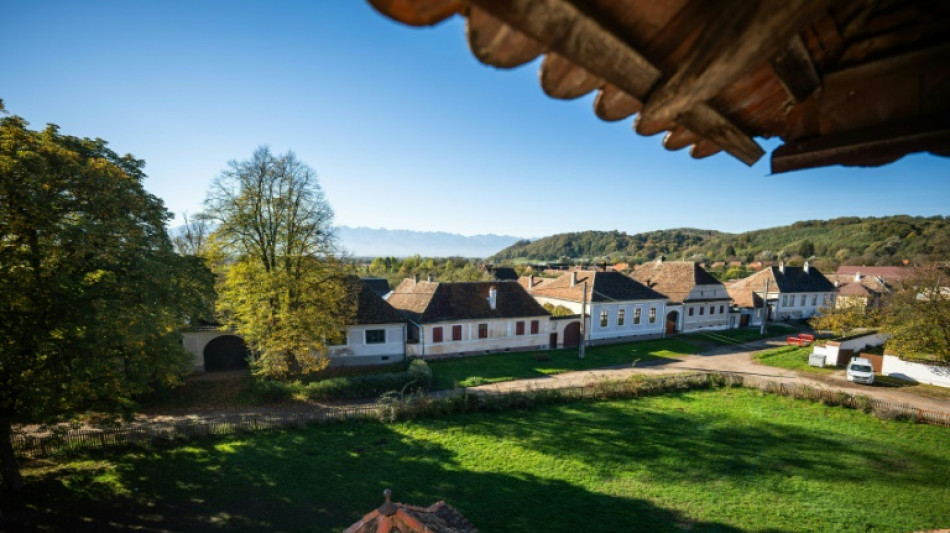
Transylvania's last Saxons revive its stunning ghost villages / Photo: Mihai Barbu - AFP

 Germany urges EU action against China to defend carmakers

 Japan eyes changing prostitution law to punish sex buyers

 Modi pitches India as global chipmaking hub

 Ukraine plans record defence spending in 2027

 NASA scan discovers new, 'once in a century' Moon crater

 Most stocks rise as Fed hikes and indicates drive to curb inflation

 UK-Sudanese author pens book to give children 'African history of Africa'

 US Congress passes sweeping Russia sanctions bill

 US stocks fall, dollar gains after Fed lifts interest rates

 US Fed raises rates to tackle 'too high' inflation in move sure to rile Trump

 US Fed raises rates to battle inflation in move likely to rile Trump

 US House faces test on sweeping Russia sanctions bill

 British PM says to make 'difficult decisions' as inflation rises

 Global fuel price demos: a round-up

 Leverate Launches MCP for Traders to Connect AI Assistants With Trading Platforms

 MEXC Launches $1M "Discover Your Wall Street DNA" Campaign to Help Traders Find Their Market Fit

 Stocks edge higher ahead of US Fed rate call

 BASIS.pro Expands On-Chain Infrastructure with XDC Network Partnership and Zypher DAO as Auto Earn Goes Live

 Pickle-flavoured tart? AI inspires Japan's convenience stores

 EU chief hosts Canada's Carney in push to 'deepen' alliance

 Meta chief pushes back on AI slowdown calls

 US Fed to deliver rate decision with markets betting on hike

 i-payout Expands U.S. Money Transmitter Licensing Footprint and Advances European EMI Strategy

 US Senate crypto bill collapses amid partisan deadlock

 OpenAI, Anthropic and Google are working to create an AI standards body

Carmen Schuster was a young woman when she left the Transylvanian village of Cincsor in Romania for West Germany in search of a better life 40 years ago.
After returning to Romania for work many years later, she was overcome by the urge to stay, attempting to save the centuries-old Saxon community she once called home.
Schuster is a member of the dwindling ethnic German minority, descendants of Saxons and others who were recruited by the Hungarian kings to settle in Transylvania from the 12th century onwards.
"We had to save the school, which was in ruins," Schuster, who is now in her 60s, told AFP.
Together with her husband Michael Lisske, she has been carefully restoring the historical heart of Cincsor for more than a decade -- including its former Saxon school -- and transforming the buildings into guesthouses.
"Other buildings have also been restored and the village once again revolves around its Protestant church," which still holds services for its seven remaining parishioners, Schuster said.
Britain's King Charles III -- who claims descent from a notorious 15th-century Transylvanian prince known as Vlad the Impaler -- also owns a number of properties nearby, renting out some to tourists.
- 'Belated victory' -
Before World War II, Romania boasted a Saxon population of up to 300,000. Today, there are only about 10,000, much of the population having emigrated in the 1970s and the 1980s to escape persecution by the communist dictatorship of Nicolae Ceaucescu.
Transylvania's abandoned Saxon villages were gradually repopulated by Romanians, who often had no connection to the region's 800-year-old history.
But the unique atmosphere of these historic villages at the foot of the Carpathian mountains never fully faded, with many of their fortress-like churches listed as UNESCO world heritage sites.
"In the 15th century, they fortified their churches so they could serve as a refuge for the inhabitants in the event of an attack," said 71-year-old Lisske.
"The Hungarians had promised the Saxons freedom in exchange for bringing them here, so they had no royal protection," the former history teacher said.
For Schuster, preserving the Saxon heritage symbolises a "belated victory" over the "inhumane and contemptuous" treatment during Ceaucescu's communist rule that "did everything to erase it".
- Idea 'catching on' -
Schuster's year-round guesthouses have become the village's main employer, she said, boosting tourism in a region heavily dependent on agriculture and farming.
Ramona Amariei is one of 15 locals who found work there as a chambermaid and waitress and seamstress during the off-season.
"There is no discrimination," said Amariei, who has Roma roots, and feels proud to be part of the "family". "Mrs Schuster is trying to integrate pretty much all types of people."
Adrian Boscu, a cook, said he is committed to putting a modern twist on "old Saxon recipes" to revive them, incorporating local produce as much as he can.
The guesthouse business has been booming, with the tower in a church now being converted into a bedroom, and the idea is spreading.
"I think that's catching on," said Schuster, with nearby villages also restoring their centuries-old heritage to revitalise the local economy. "There are lots of people who have interesting projects."
The house next door has also been renovated. Its Romanian owner, Nicolas Mioque, returned from France after 57 years.
Schuster and her husband "have breathed new life into this village," he said, noting that Cincsor without the guesthouses would be "sad".
A.Levy--CPN