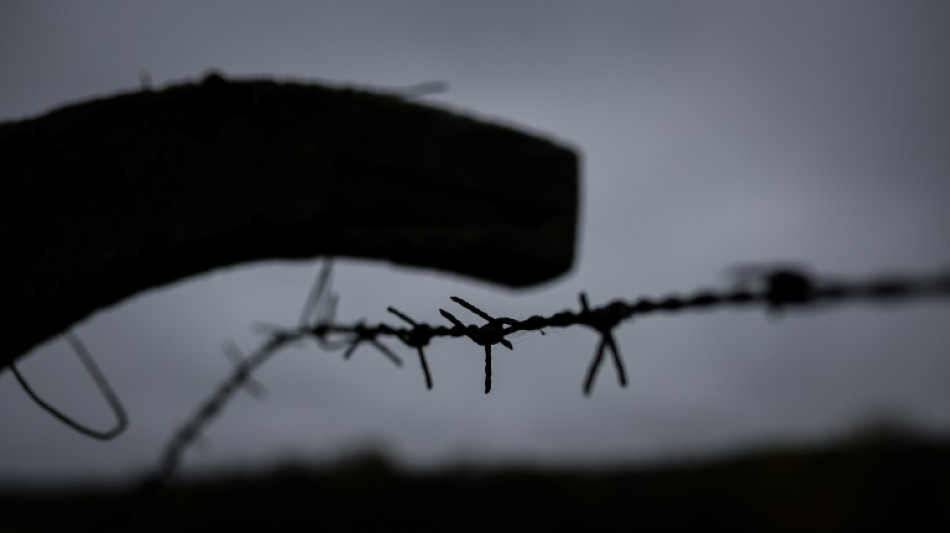
Anger at plan to turn Nazi tunnels into bunker for super-rich / Photo: Ronny Hartmann - AFP

 Germany urges EU action against China to defend carmakers

 Japan eyes changing prostitution law to punish sex buyers

 Modi pitches India as global chipmaking hub

 Ukraine plans record defence spending in 2027

 NASA scan discovers new, 'once in a century' Moon crater

 Most stocks rise as Fed hikes and indicates drive to curb inflation

 UK-Sudanese author pens book to give children 'African history of Africa'

 US Congress passes sweeping Russia sanctions bill

 US stocks fall, dollar gains after Fed lifts interest rates

 US Fed raises rates to tackle 'too high' inflation in move sure to rile Trump

 US Fed raises rates to battle inflation in move likely to rile Trump

 US House faces test on sweeping Russia sanctions bill

 British PM says to make 'difficult decisions' as inflation rises

 Global fuel price demos: a round-up

 Leverate Launches MCP for Traders to Connect AI Assistants With Trading Platforms

 MEXC Launches $1M "Discover Your Wall Street DNA" Campaign to Help Traders Find Their Market Fit

 Stocks edge higher ahead of US Fed rate call

 BASIS.pro Expands On-Chain Infrastructure with XDC Network Partnership and Zypher DAO as Auto Earn Goes Live

 Pickle-flavoured tart? AI inspires Japan's convenience stores

 EU chief hosts Canada's Carney in push to 'deepen' alliance

 Meta chief pushes back on AI slowdown calls

 US Fed to deliver rate decision with markets betting on hike

 i-payout Expands U.S. Money Transmitter Licensing Footprint and Advances European EMI Strategy

 US Senate crypto bill collapses amid partisan deadlock

 OpenAI, Anthropic and Google are working to create an AI standards body

A German property developer has sparked outrage with a plan to turn a World War II tunnel system into a luxury bunker for rich survivalists who fear the outbreak of World War III.
Relatives of the prison labourers who built it under the Nazis are aghast at the business venture that is offering a crypto-currency called "BunkerCoin" as entry tokens to the promised apocalypse shelter.
Others suspect an elaborate ploy to embarrass German authorities and raise the price for the sensitive historical property's eventual re-sale to the state.
The tunnel site was constructed by prisoners held in an annex to the Buchenwald concentration camp, in a forest about 200 kilometres (120 miles) southwest of Berlin near the town of Halberstadt.
About 7,000 forced labourers were interned at the camp, more than half of whom died digging the 13-kilometre-long tunnel system where the Nazis manufactured aircraft in the latter phase of the war.
Today, a memorial centre at the nearby Langenstein-Zwieberge camp site honours the victims as well as the survivors, among them the French wartime prisoner Louis Bertrand.
After the end of World War II, Bertrand dreamed of a "ring of memory" pathway around the underground network where thousands perished, said his 72-year-old son Jean-Louis.
Bertrand died in 2013 and was buried at the camp where he had left behind "part of his youth", his son told AFP.
Jean-Louis Bertrand is furious at the plan to turn the hallowed site into "the largest private bunker in the world".
So far, the promised nuclear-proof underground complex exists only as a series of images on a website.
Well-heeled preppers are offered an underground safe space with its own clinic, school, workshop, casino, bar, gym and spa as well as "artificial sunrises and sunsets".
Housing will be "similar to luxurious yacht accommodations" and food provided through indoor farming and mushroom cultivation.
To gain access in the event of war or other major catastrophe, clients are asked to purchase BunkerCoins, each of which buys one cubic centimetre of future bunker space.
At that rate, a small room would cost around half a million euros.
The business says it is also planning a "safe city in Gambia".
- 'Unfairly treated, insulted' -
The head of the Langenstein-Zwieberge camp memorial site, Gero Fedtke, rejected the luxury bunker project in measured language, labelling it "not an appropriate way of dealing with the historical heritage of the tunnel".
The entrepreneur behind the venture is Peter Karl Jugl, who according to news weekly Der Spiegel has past links to far-right figures.
Jugl's firm, Global Project Management, says it specialises in the purchase of "problematic properties".
His other business interests reportedly include a stake in a dating app, a property he rents out to a table-dancing club and a love hotel.
Jugl bought the tunnel site in 2019 from an insolvency administrator after it had previously served as a munitions depot for the communist East German state.
In a phone interview with AFP, Jugl said he did not understand what all the fuss was about and said he had been "unfairly treated, insulted and threatened".
"I am building a facility there to save human lives in an emergency."
He also argued that "these underground shafts have nothing to do with the camp located two kilometres (1.2 miles) away."
- End-of-days hideout -
An association of prisoners' relatives disagrees, pointing out that the sole reason for the camp's existence was the construction of the nearby tunnel system.
"It is unthinkable to dissociate the two components of this whole, and therefore to ignore the tunnel," they wrote in a statement.
Jugl has allowed memorial visitors to access a section of the tunnel shaft, although he declined to grant entry to AFP.
Fedtke argued that the tunnels are of historical relevance because at the former prison camp site "hardly any historical traces from the Nazi era have been preserved".
"This is different in the tunnel," he told AFP.
As the controversy flares, Jugl has offered the state of Saxony-Anhalt the chance to buy the tunnels back.
His asking price, according to multiple sources, is eight million euros -- far beyond the 1.3 million euros he paid for it.
The state culture ministry told AFP it had not received an application for a building permit for the super-bunker and that, as it is "a cultural monument, all structural or usage changes require approval".
It confirmed that state culture minister Rainer Robra had addressed the issue of a potential repurchase in a letter to Germany's defence and interior ministers.
Bertrand said he suspected Jugl's motivation is not to build an end-of-days hideout for the super-rich but simply "to make money".
L.K.Baumgartner--CPN