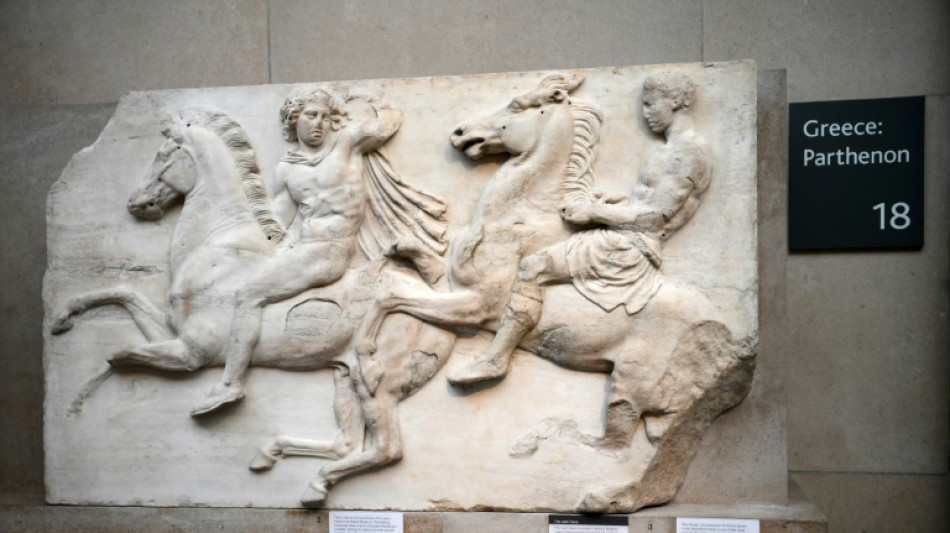
British Museum chief says Marbles deal with Greece 'some distance' away / Photo: Daniel LEAL - AFP/File

 Isolated Syrian-Druze city blames Damascus for shortages

 Kerry James Marshall: American 'blackness' painter celebrated in Europe

 Infantino 'must go', says German FA vice-president

 Japan's busiest rail station tests robot bins

 Backpackers fret over Australian visa crackdown

 Bank of Japan hikes rates to 31-year high to battle inflation

 AI doomsday warnings unlikely to slow IPOs but questions linger

 In Brazil's Amazon, the hunt for oil fuels hopes and fears

 Baby orangutans in India expose 'frightening' scale of trafficking

 Oversight Board blasts 'inadequate' Meta safeguards for AI deepfakes

 Harry makes first public appearance since return to UK

 Princess Diana's brother makes new explosive claims against Charles

 Trump admin overhauls key protection for endangered species

 Mbappe draws political fire over Ceuta t-shirt controversy

 Third malaria death in Germany from outbreak tied to Frankfurt airport

 AtlasClear Holdings Reports Preliminary Fiscal 2026 Revenue of Approximately $20.1 Million, Up 85%; Revenue Plus Interest Income of Approximately $21.9 Million

 'Another arrow to the quiver': World Bank posts record private capital mobilization

 Ireland to boycott Eurovision 2027 over Gaza

 India's Tata Sons reappoints N. Chandrasekaran as chairman

 Germany urges EU action against China to defend carmakers

 Japan eyes changing prostitution law to punish sex buyers

 Modi pitches India as global chipmaking hub

 Ukraine plans record defence spending in 2027

 NASA scan discovers new, 'once in a century' Moon crater

 Most stocks rise as Fed hikes and indicates drive to curb inflation

The head of the British Museum said Wednesday any deal with Greece to loan the prized Parthenon Marbles to Athens was "still some distance" away, as Greek authorities insist on their permanent return.
Expectations have grown this week that a deal is imminent to send the ancient friezes back to Greece, easing a decades-long dispute over them which has soured UK-Greek ties.
UK Prime Minister Keir Starmer hosted his Greek counterpart Kyriakos Mitsotakis in Downing Street on Tuesday, just as the British Museum confirmed it has been holding "constructive" talks with Athens.
A day later, museum chairman George Osborne reiterated the London institution was exploring an "arrangement where at some point some of the sculptures are in Athens", in return for Greece lending "some of its treasures".
"We made a lot of progress on that, but we're still some distance from any kind of agreement," he said on a political podcast he co-hosts.
But Osborne -- a former UK finance minister -- appeared eager to dampen expectations that any loan deal was imminent, noting he was speaking from New York and not the British capital.
"I would be in London if we were on the verge of reaching an agreement with Greece around the Parthenon sculptures," he added.
Meanwhile comments from Athens suggest the two sides are still far apart.
On Monday, Greek government spokesman Pavlos Marinakis insisted the country will not "back down" on its "ownership" claims.
It echoes the stance of Greece's culture minister Lina Mendoni, who said a year ago that "we are in no way talking about a loan".
- 'Diplomatic' -
The Parthenon Marbles, also called the Elgin Marbles, have been a source of contention between Britain and Greece for over two centuries.
Greek authorities maintain that the sculptures were looted in 1802 by Lord Elgin, British ambassador to the Ottoman Empire.
London claims that the sculptures were "legally acquired" by Elgin and then sold to the British Museum.
The issue overshadowed Mitsotakis's last official visit to Britain, when Starmer's predecessor Rishi Sunak cancelled a meeting at the last minute after the Greek leader's public comments about it reportedly irked the UK side.
Osborne suggested Wednesday he had been given a freer hand by the Labour government elected in July.
"Keir Starmer has said this is very much a matter for the trustees of the British Museum, who are independent of the government," he said.
"It seems to me a more sensible and diplomatic way to proceed."
A 1963 UK law prevents the British museum from giving away treasures, but it has about 1,400 objects on long-term loan at other museums every year.
Critics have warned that moving the Marbles could set a precedent for other UK museums holding contentious items from around the world.
- 'Complicated' -
Sunder Katwala, director of the British Future think tank, said the UK "legal constraints" meant "case-by-case exploration of partnerships... is where the sector is going to go."
"I think this particular issue is of a lot greater interest in Greece than in Britain," he noted of the friezes, adding the Starmer government appeared "agnostic" about their return.
Outside the British Museum, Britons and tourists appeared weary of the complex issue but willing to let the friezes go.
"I can see why the Greeks want them back, but it's definitely complicated," said Helge Bugge, 39, a physician from Norway.
"Probably the most important part would be their conservation," he added. "If that's ensured in the original country, then I suppose they should have them back."
Businessman Nick Ward, 50, visiting the museum with his young daughter, mused that a loan was probably a "good interim" measure.
"We've probably had them long enough," he said, adding: "I think there are bigger problems in the world."
But Greek tourist Ioannis Papazachariou, 36, a museum worker in Athens, had refused to tour the London institution with his girlfriend over the Marbles.
"We think that they are stolen," he told AFP as he waited for her to emerge.
Papazachariou was sceptical a loan deal would materialise anytime soon, predicting it would take "many years".
"The British Museum is not going to accept that the marbles are stolen, right?
"We asked the British to give us the Marbles, I think, in 1970. It's too many years."
H.Cho--CPN